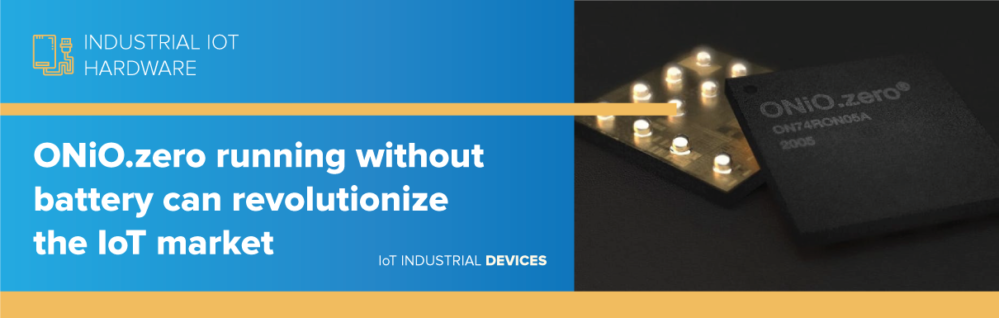
ONiO.zero running without battery can revolutionize the IoT market

ONiO, a Norwegian specialist in the field of the Internet of Things (IoT) for the medical industry, announced ONiO.zero, a RISC-V-based microcontroller with very low power consumption, which can work completely from the energy harvested from the environment. ONiO claims that its design can take energy from the radio spectrum and operate up to 24 MHz.

„ONiO.zero is a wireless MCU with very low power consumption, which uses energy acquisition technology,” wrote the company about its creation. This means that ONiO.zero only works on ambient energy. There are no coin cells, supercaps, lithium and batteries, but still offers a lot of performance.

Battery-based solutions have an unavoidable warning about battery replacement. This leads to increased costs over the entire lifetime. ONiO.zero avoids this problem and reduces operating costs. ONiO.zero is self-powered and supports a wide range of power sources, from multi-frequency RF bands supporting GSM and ISM to optional external sources such as solar, piezoelectric, thermal and voltaic.

Source: https://www.hackster.io/news/onio-zero-offers-up-to-24mhz-of-risc-v-microcontroller-performance-on-nothing-but-harvested-energy-70285321d50d

The microcontroller itself is based on the architecture of the RISC-V instruction set of the open source type (in particular RV32EMC) and operates up to 24 MHz with a supply voltage of 1.8 V. The controller will work if necessary with lower voltages. You can get 6 MHz at 1 V and 1 MHz at 0.8 V, and the system still runs slower, but as fast as 450 mV. Includes 1 KB ROM and 2 KB RAM, as well as 8-32 KB of ultra low power flash memory, capable of 100,000 read and write cycles up to 850 mV.

ONIO.zero running without battery can revolutionize the IoT market

ONiO.zero contains a crystalline Low Energy Bluetooth transmitter (BLE) that can operate at a voltage as low as 850mV, an IEEE 802.15.4 (UWB) broadband transmitter operating in the 3.5-10 GHz band, and optional radio transmitter 433 MHz MICS for the industrial, scientific and medical band (ISM).

ONiO.zero hasn’t been released yet. For more information check the ONiO.zero product page.

Battery-ready IoT devices based on ESP32

Battery / SuperCap power support allows the processes and data to be securely executed, saved or transferred, and the operating system to be safely shutdown or reboot, if the power source has been restored. The power failure alert can also be sent to cloud service, to perform custom task, specified by user or self-learning AI algorithm.

The Moduino device is a comprehensive end-point controller for variety of sensors located throughout any installation. It fully supports temperature and humidity sensors and new ones are currently developed, e.g. accelerometer, gyroscope, magnetometer, etc.

Battery powered Moduino ESP32
Battery powered IoT installation. Source: https://moduino.techbase.eu/

ModuinoModBerry symbiosis allows wide range of wake-up/sleep schedule customization, in order to perform best and save energy accordingly to power supply state. Arduino and MicroPython environments provide libraries to control different scenarios of data and power management.

With built-in algorithms and the possibility to program on your own, the TECHBASE’s sleep/wake addon module can wake the device using schedule/timer. Another option is wake on external trigger, e.g. change of input, etc. All the options for sleep, shutdown and wake can be configured for various scenarios to ensure constant operation of devices, safety of data and continuity of work in case of power failure in any installation.
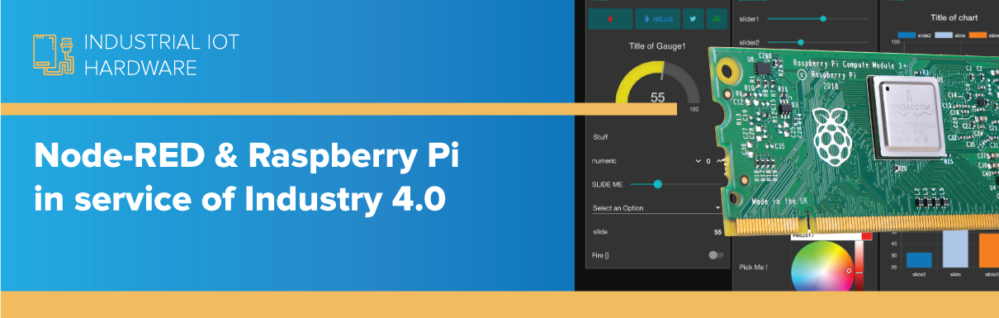
Node-RED and Raspberry Pi

Node-RED is an interesting environment for modeling processes, by visually defining information flows. It is a module working in the node.js environment. It is a flow-based programming tool, originally developed by the IBM Emerging Technology Services team and now part of the JS Foundation.

History of Node-RED environment

Node-RED provides users with a ready-made set of easy-to-connect nodes and supports code creation by configuring data transmission and sensor communication to their applications. It is up to you whether you create a new flow of equipment to increase and control the economics of the IoT system. Hardware platform for this system can easily be Raspberry Pi based industrial device, like ModBerry computer.

Node-RED started life in early 2013 as a side-project by Nick O’Leary and Dave Conway-Jones of IBM’s Emerging Technology Services group. What began as a proof-of-concept for visualising and manipulating mappings between MQTT topics, quickly became a much more general tool that could be easily extended in any direction.

It was open-sourced in September 2013 and has been developed in the open ever since, culminating in it being one of the founding projects of the JS Foundation in October 2016.

Source: https://nodered.org/about/

Who can benefit from Node-RED?

Flow-based programming is ideal for the creators of IoT solutions for visualizing and controlling data flow, maintaining and managing a series of cause-related events. Apart from the fact that Node-RED can be run basically anywhere you can install NodeJS, this program is a card for IoT solution developers for mapping and maintaining solutions.

With the development and implementation of Internet of Things solutions around the world, Node-RED has become an invaluable tool for solution architects and programmers, due to its ease of use in flow programming and solution mapping. IoT solutions, also known as applications, are the convergence of the physical world with the digital world to extract valuable data for insight that increases process or system performance. This convergence results in countless triggers and events that must be performed to control systems or notify those responsible when the system is above its expectations.

How does Node-RED work?

Node.js is a runtime environment for programs written in JavaScript, currently based on the Chrome V8 engine. While I used to associate JavaScript only with scripts for animated galleries on websites, after a really short period of learning I notice the great advantages of using JS as a language for creating programs launched outside of the browser. Programs run in node.js work in the background, in the console, or even have their own UI with normal windows in Windows, macOS or Linux.

Node-RED example
Node-RED example

The principle of operation is relatively simple. Visually, we combine different blocks that perform specific functions. Through connections, Node-RED sends messages, which are basically a JavaScript object, consisting of various data.

Node-RED consists of a Node.js based runtime that you point a web browser at to access the flow editor. Within the browser you create your application by dragging nodes from your palette into a workspace and start to wire them together. With a single click, the application is deployed back to the runtime where it is run. The palette of nodes can be easily extended by installing new nodes created by the community and the flows you create can be easily shared as JSON files.

Source: https://nodered.org/about/
Docker VPN-based Raspberry Pi Server tutorial

Many developement boards can be used in home and industrial applications to control and manage data. Get secure remote access from anywhere via your own VPN based on Docker containers. Check out latest video from open-tech infuencer, Andreas Spiess, in which he uses Raspberry Pi and Docker, Node-RED, influxDB and Grafana to build custom Raspberry Pi data server.

Docker implementation in CM4 cluster – ClusBerry-2M

The introduction of new Compute Module 4 has opened the possibility to construct and maintain effective hardware matrix solutions with the use of both PCI-Express buses and 1GBps Ethernet. Therefore, the ClusBerry-2M opens up completely new capabilities of utilizing cluster solutions for Industrial Automation and server applications.

ClusBerry-2M can be equipped with multiple expansion cards, e.g. serial RS-232/485 ports, range of digital and analog I/Os, USB, HDMI and Ethernet. Interfaces can be expanded with additional I/Os and opto-isolation, relays, Ethernet, 1-Wire, CAN, M-Bus Master and Slave, accelerometer and many more features like TPM Security Chip & eSIM. The device can also be equipped with additional SuperCap backup power source for continuous work and safe boot/shutdown in case of emergency.

ClusBerry-2M series also offers two M.2 NVMe SSD slots and up to four standard miniPCIe module support for various wireless communication protocols, such as:

  • GSM modem (4G/LTE and fast 5G modem)
  • economic NarrowBand-IoT technology
  • LoRa, ZigBee, Z-Wave, Sigfox, Wireless M-Bus
  • secondary Wi-Fi/Bluetooth interface or Wi-Fi Hi-Power
  • custom wireless interfaces

Software cluster management with Docker and K3s Lightweight Kubernetes

With use of Docker-based and Kubernetes solutions, installation and management of ClusBerry-2M is easy and backed with a large community for further support and development. Kubernetes is a portable, extensible open-source software platform for managing containerized tasks and sites that enables declarative configuration and automation. The Kubernetes ecosystem is large and dynamically developing. Kubernetes services, support and tools are widely available.

Kubernetes provides:

  • Detection of new services and traffic. Kubernetes can balance the load and redirect the network traffic to ensure the stability of the entire installation.
  • Kubernetes data storage management enables you to automatically mount any type of storage system – on-premises, from cloud providers and others.
  • Automatic deployment and rollback. You can describe the expected state of your installation with Kubernetes, which will take care of bringing the actual state to the expected state in a controlled manner. For example, with Kubernetes, you can manage your cluster modules at ease, boot modules from one to another, upgrade firmware crosswise and provide safe operation of each module.
  • Automatic management of available resources. ClusBerry-2M provides a cluster of modules that Kubernetes can use to run tasks in containers. You determine the CPU power and RAM requirements for each container. Kubernetes arranges containers on machines in such a way as to make the best use of provided resources.
  • Self-healing Kubernetes reboots containers that have stopped working, replaces them with new ones, forces disabling containers that are not responding to certain status queries, and does not announce their availability until they are ready to run.
  • Managing confidential information and Kubernetes configuration with TPM Security Chip allows you to store and manage confidential information such as passwords, OAuth tokens and SSH keys. Secured data and configuration information can be provided and changed without having to rebuild the container image and without exposing sensitive data in the overall software configuration.
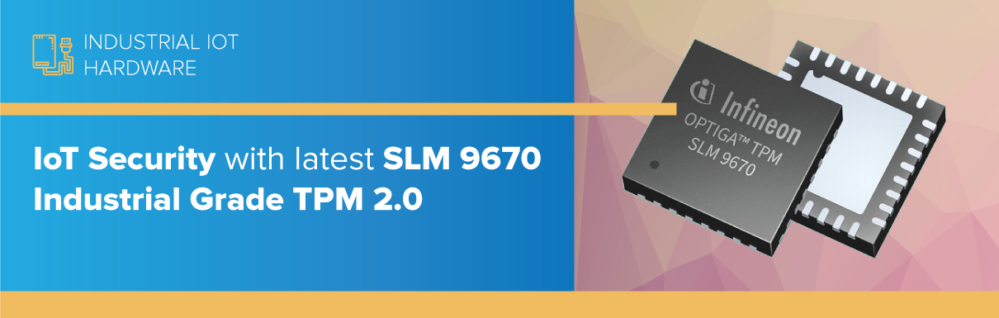
IoT Security with latest SLM 9670 Industrial Grade TPM 2.0

Like other embedded systems, Industrial IoT design faces a constant stream of threats. As hackers adopt new attacks, developers rush to close security holes. Deployed devices need to update IoT firmware, increasing potential security vulnerabilities. For example, using a simple firmware verification check can leave the software published. In this situation, the developer may expect to be able to query external resources for verification and catch attempts to replace the firmware with hacked code. However, even relatively novice hackers can replace the firmware with code that ignores such verification checks. To secure these vurnerabilities comes Industrial Grade TPM 2.0.

Securing devices with Infineon industrial grade TPM

Infineon Technologies AG has unveiled a new security chip that defines the first TPM (Trusted Platform Module), designed specifically for industrial applications such as industrial computers, servers, industrial controllers and edge gates. The module protects confidential data in connected devices and reduces the risk of leakage of this information due to attacks, e.g. hackers.

The OPTIGA TPM SLM 9670 module protects the integrity of industrial systems and the identity of users using them. The system controls access to sensitive data at key locations in industrial environments, such as an automated factory. It also protects the cloud interface if the network uses one. The security system fully meets the TPM 2.0 standard developed by the Trusted Computing Group and is certified by an independent test laboratory in accordance with the criteria contained in this standard. The new module is meticulously controlled and certified by Infineon. Thanks to its use, it is possible to shorten the time of designing and introducing the device to the market, thanks to the ready security solution in the system.

The TPM system has a lifetime declared as 20 years. It allows programmers to perform firmware updates, which in turn enables them to meet the long-term security requirements in rapidly changing industrial environments. In this way, it can also reduce maintenance costs of industrial equipment thanks to secured remote software updates. The TPM chip will be available in serial production in the second half of 2019.

TPM 2.0 Key Features

  • Random Number Generator (RNG) according to NIST SP800-90A
  • TPM FW update functionality installed
  • 6962 Bytes of free NV memory
  • Full personalization with Endorsement Key (EK) and EK certificate
  • Up to 3 keys in the volatile memory
  • Up to 7 keys in the NV memory
  • Up to 8 NV counters
  • Support of various cryptographic algorithms:
    • RSA-1024 and RSA-2048
    • SHA-1 and SHA-256
    • ECC NIST P256
    • ECC BN256

Security chip implementation in Industrial IoT devices

With knowledge of latest Industrial IoT security measures, the choice of proper end-point conroller or gateway is much easier than you think. Some manufacturers can implement TPM 2.0 security chip in production process, to allow users to generate certification keys after purchase, maximizing security of their installations. TECHBASE offers wide range of solutions, optionally aided with TPM system.

For example, ESP-32 based solution, Moduino X series and eModGATE series products offer the support for such security measures. Read more in Industrial IoT Ecosystem brochure, to understand the importance of reliable and secure hardware for Industrial IoT.

ESP32-based LoRa / LoRaWAN wireless network

One way of long-range and low-power data transmission is LoRa wireless technology. Since the Internet of Things market (with ESP32 – based solutions) is mainly covered with short-range Wi-Fi and Bluetooth and long-range with 3G / NarrowBand-IoT technologies, LoRa oftens is omitted or simply unknown by IoT users. Below you will find a short representation of what LoRa is and how can it be used.

What is LoRa / LoRAWAN network?

LoRaWAN® network architecture is deployed in a star-of-stars topology in which gateways relay messages between end-devices and a central network server. The gateways are connected to the network server via standard IP connections and act as a transparent bridge, simply converting RF packets to IP packets and vice versa. The wireless communication takes advantage of the Long Range characteristics of the LoRa physical layer, allowing a single-hop link between the end-device and one or many gateways. All modes are capable of bi-directional communication, and there is support for multicast addressing groups to make efficient use of spectrum during tasks such as Firmware Over-The-Air (FOTA) upgrades or other mass distribution messages.

Source: https://lora-alliance.org/about-lorawan

Industrial use of LoRa & ESP32-based solutions

One of industrial IoT devices, supporting LoRa wireless technology is ESP32 based eModGATE from TECHBASE. Economical, ESP32-based solution can serve as an end-point in any installation or works well as a gateway, gathering data from scattered sensor mesh across the installation. For more information and also Raspberry Pi based solutions check Industrial IoT Shop with all the configuration options for eModGATE.

eModGATE with ESP32
New industrial grade touch panel with Raspberry Pi

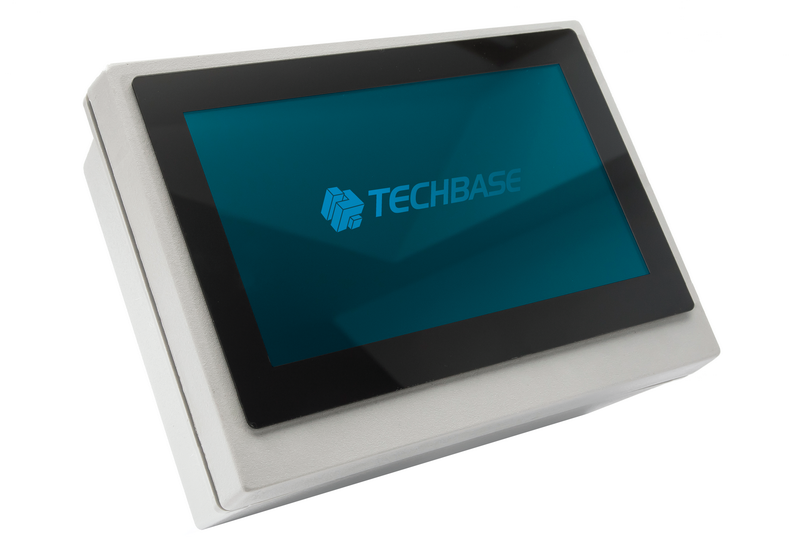
Latest addition to Industrial IoT Ecosystem from TECHBASE is TECHPANEL P500 is an industrial-grade touch panel automation controller for wide range of industrial installations. Equipped with up to date Raspberry Pi Compute Module 3/3+ or Compute Module 3/3+ Lite, 7” capacitive touch display and IP65 hermetic casing with cast gaskets, can be used in harsh conditions of industrial applications.

Raspberry Pi based touch panel features

New TECHPANEL P500 M3/3+ is powered by quad-core Cortex-A53 1.2GHz processor with 1GB RAM and up to 32GB eMMC or 8GB microSD flash memory. Wide range of modems and extra wireline/wireless interfaces via expansion cards makes the TECHPANEL micro-computer a versatile addition to Industrial IoT solutions offered by TECHBASE company.

TECHPANEL devices can easily work remotely with existing ModBerry Gateways & Moduino ESP32 Edge Controllers for data accumulation and monitoring, to perform specific actions before sending the data to cloud services. TECHPANEL with ModuinoModBerry installation can work as standalone Ecosystem (for example via MQTT), providing complex data management solution to any installation.

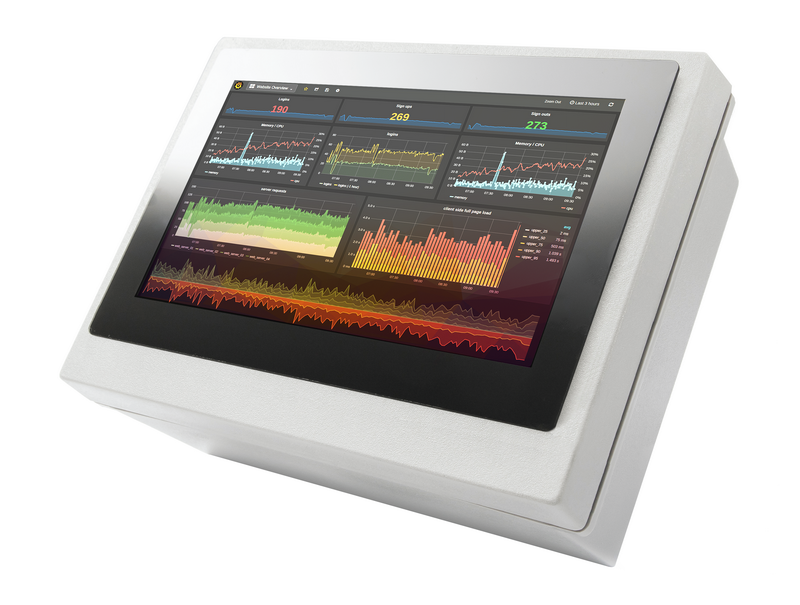
TECHPANEL P500 M3+ with Compute Module 3+ from Raspberry Pi

Visual management and available Raspbian OS

The device is equipped with compact 800 x 480 px 7-inch TFT panel with 10 points capacitive touch to allow the user to perform direct actions on-site. With IP65 casing and extended working temperature range, TECHPANEL can be placed almost everywhere.

Over 23 million Raspberry Pi’s have been sold and the Raspberry Pi is likely to stay as a new standard in the industry. Official Raspbian OS is free operating system based on Linux Debian optimized for the Raspberry Pi comes with over 35,000 packages, pre-compiled software bundled in a nice format for easy installation.

TECHPANEL P500 M3+ with Compute Module 3+ from Raspberry Pi

SPECIFICATION

  • Cortex A53 1.2GHz Processor
  • RAM 1GB, eMMC up to 32GB
  • 7″ TFT screen (800x600px)
  • Capactitive touch screen (10-point)
  • Wide range of expansion modules (Ethernet, RS-232/485/422,  Digital and Analog I/Os, Relay, M-Bus, CAN, optoisolated I/Os, Accelerometer, etc.)
  • Wide range of wireless modules (GPRS/EDGE, 3G/LTE, NarrowBand-IoT, GPS, Wi-Fi, Bluetooth, LoRa, ZigBee, Z-Wave, Sigfox, Wireless M-Bus, etc.)
  • Water-Resistant casing (IP65)
  • Operating temperature: -20°C ~ 70°C
  • Optional SD card support instead of eMMC Flash
Pros and cons of using Raspberry Pi 4 in IoT

Every fan of new technologies has heard of small single-board computers (SBC) in the form of Raspberry Pi 4. Raspberry debuted on the market in many different versions, and the current model is Model 4B. A lot of people got infected with it for DIY, programming or Linux. But new board comes with variety of pros and cons, as compared to previous RPi3 versions.

Industrial use of market Raspberry Pi 4 SBCs

A year ago, TECHBASE released an updated version of the ModBerry M500 industrial IoT computer, replacing the aging Raspberry Pi 3 with a 3B+, giving it better performance. With the recent launch of the Raspberry Pi 4, TECHBASE has yet again, announced another upgrade to the M500, which now packs the latest single-board computer.

ModBerry M500 with Raspberry Pi’s 4

ModBerry M500 also utilizes many more SBC platforms, such as Orange Pi, NanoPi and Intel-based UpBoard. Find more information here: https://iiot-shop.com/product/modberry-m-series/

Technology must transfer data to the central system in real time, otherwise it may have negative consequences. If the sensor battery power runs out, a machine failure may stop production for one day or lead to direct danger. If battery life is unbelievable and short, IoT applications will become useless, causing more interference rather than making life easier for its intended purpose. Therefore battery powered IoT devices come as a standard in up-to-date IoT installations

Wireless sensors and sensor networks are one of the elements of the Internet of Things systems and intelligent factories. Replacing the standard sensors and data collection devices with versions that communicate wirelessly gives many benefits, but also enforces a highly thought-out system design that will minimize energy consumption. This is important because these systems must work for many years without servicing. In the article we present the issues regarding the design of systems and forecasting of energy consumption in IoT systems.

Wireless communication vs Battery power

The idea of wireless sensor networks has been around for at least two decades, while the IEEE subgroup working on personal wireless networks defined the 802.15.4 standard in 2003, a year later the first versions of ZigBee appeared. Since then, many varieties of wireless communication have been developed, such as LoRa & NarrowBand-IoT and additional functions introduced, as a result of which designers now have a choice of various open or proprietary protocols. What significantly affects the way the entire project is implemented is energy consumption.

Battery powered IoT installation. Source: https://modberry.techbase.eu/

The basic elements of these systems are sensors that measure physical quantities. Some signal and data processing capabilities are also important. After all, the communication interface is important, which will allow you to pass the measured data on. Such a sensor node should wake up from time to time, make contact with its superordinate controller, transfer data and fall back to sleep again. Battery life depends on the total charge collected. Minimizing this consumption in the long run means that you need to minimize energy consumption during each work cycle. In many cases, the sensor will only work for a small fraction of the time. A measurement that lasts a few milliseconds can be triggered once per second, once per minute, or even less frequently. Therefore, the energy consumed in sleep mode may dominate the total energy consumption.

Battery powered sensors market growth

The lifetime of IoT sensors varies greatly: some last a year years, others 10, the first being the most realistic. When organizations need to deploy engineers to install new batteries in sensors and employ staff to monitor them, the benefits of technology itself are beginning to run out.

Battery powered IoT devices crucial to 2020+ standards

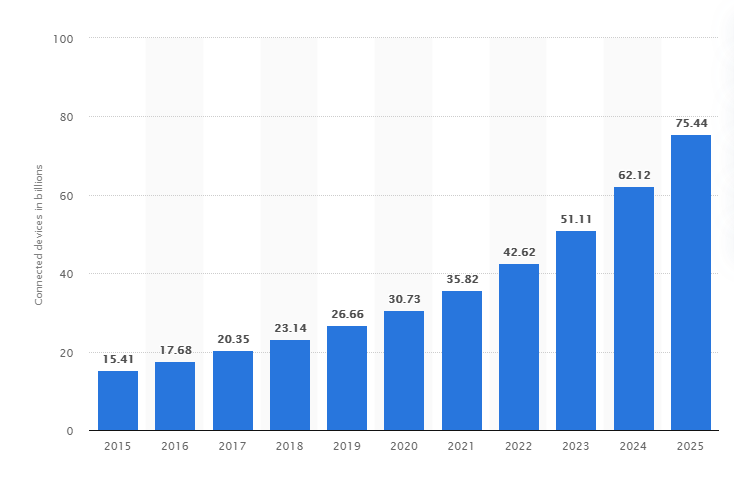
It is estimated that in 2020 nearly 31 billion devices will be connected to the Internet of Things. Such forecasts provide ample opportunities, especially for producers associated with the products that make up it, and they are intensified by the developing IoT technology.

Source: https://globenergia.pl/co-laczy-internet-rzeczy-i-perowskity-fotowoltaika-do-zastosowan-wewnetrznych/

Battery-ready IoT devices based on ESP32

Battery / SuperCap power support allows the processes and data to be securely executed, saved or transferred, and the operating system to be safely shutdown or reboot, if the power source has been restored. The power failure alert can also be sent to cloud service, to perform custom task, specified by user or self-learning AI algorithm.

The Moduino device is a comprehensive end-point controller for variety of sensors located throughout any installation. It fully supports temperature and humidity sensors and new ones are currently developed, e.g. accelerometer, gyroscope, magnetometer, etc.

Battery powered Moduino ESP32
Battery powered IoT installation. Source: https://modberry.techbase.eu/

ModuinoModBerry symbiosis allows wide range of wake-up/sleep schedule customization, in order to perform best and save energy accordingly to power supply state. Arduino and MicroPython environments provide libraries to control different scenarios of data and power management.

With built-in algorithms and the possibility to program on your own, the TECHBASE’s sleep/wake addon module can wake the device using schedule/timer. Another option is wake on external trigger, e.g. change of input, etc. All the options for sleep, shutdown and wake can be configured for various scenarios to ensure constant operation of devices, safety of data and continuity of work in case of power failure in any installation.

Sequent Microsystems has introduced the Raspberry Pi „4-relay” add-on to the Industrial IoT market. Four relays switch lines for loads up to 10 A and 250 V, can be stacked up to 8 times with max. 32 switched relays.

It can be used to control loads of up to 10A and 250V. You can control directly all your lights and appliances. Pluggable connectors accept 18 to 22 AWG wires and simplify the installation, specially if you are planning to use more than one card. The cards are stacked with 18mm male-female standoffs. All the hardware required for the installation is provided. Relays are controlled through I2C IO Expanders, using only 2 pins on the GPIO interface and leaving all the other pins available for the user.

Source: https://www.kickstarter.com/projects/279405789/4-relays-for-raspberry-pi-8-level-stackable-10a-250v-each/

Some industrial IoT devices, based on Raspberry Pi platform already offer Relay expansion modules. One of them is ModBerry 500 CM4 series, introduced in 2014 – later upgraded with latest Raspberry Pi’s Compute Module 4+. ModBerry standard configurator offers up to 12x Relay expansion, with additional customizable options available for larger orders.

ExCard modules to peak the performance

Every TECHBASE’s industrial computer is supported by ExCard add-on modules for extra RS-232/485 serial ports, Ethernet ports, PCIe slots, analog input and output, digital I/Os, relays, M-Bus interface, opto-isolation, accelerometer, etc. To provide specific communication paths, ModBerry can be rigged with additional Wi-Fi/Bluetooth module, 3G/LTE, NarrowBand-IoT, LoRa, ZigBee, GPS and Wireless M-Bus.

The latest options for ModBerry series are:

  • SuperCap expansion, to provide constant power supply as a UPS option
  • OLED 0.96” & new OLED 1,3″ screen, allowing the control without the need of connecting into the device
  • ESP32 module as a security chip, to add a firewall into control installation and ensure constant operation of the device, even with power drops and random events
  • Aluminum case, to grant much higher durability for extra harsh industrial conditions
  • M.2 NVMe SSD controller for extra data storage
ModBerry 500 with Raspberry Pi Compute Module 4

Espressif Systems and Amazon recently announced the ESP32-PICO-V3-ZERO Alexa Connect Kit (ACK) module, which provides support for features such as out-of-the-box connectivity to the cloud service ACK, Alexa control, „seamless setup”, and Amazon Dash completion for connected devices.

This new module is as much as 50% lower in cost.

Source: https://developer.amazon.com/en-US/blogs/alexa/device-makers/2020/07/Introducing-the-New-Alexa-Connect-Kit-Module-with-Espressif-Chipset
ESP32-PICO-V3-ZERO

How Alexa Connect Kit Works

With Alexa Connect Kit, you can make nearly any device with power into an Alexa-compatible smart device your customers will love, all at a fixed per-device cost. You simply integrate an Amazon-managed ACK module into your device, connect it to your device’s microcontroller (MCU) over a serial interface, and add interface code to your device’s firmware to interpret control messages from the ACK module. The ACK module adds Wi-Fi, Bluetooth LE, and all the software needed for Alexa control, Frustration Free Setup, security, and log and metric collection – managed and updated by Amazon. For your customers, products built with ACK include Alexa control through voice and the Alexa app, and the option to support Amazon Dash Replenishment. For developers, ACK enables you to connect your devices to Alexa without the need to operate a cloud, create and maintain an Alexa skill, develop a companion app, or deal with IoT firmware integration. With an ACK module on your device, you can focus on building great hardware.

Source: https://developer.amazon.com/en-US/blogs/alexa/device-makers/2020/07/Introducing-the-New-Alexa-Connect-Kit-Module-with-Espressif-Chipset

Industrial use of LoRa & ESP32-based solutions

One of industrial IoT devices, supporting LoRa wireless technology is ESP32 based eModGATE from TECHBASE. Economical, ESP32-based solution can serve as an end-point in any installation or works well as a gateway, gathering data from scattered sensor mesh across the installation. For more information and also Raspberry Pi based solutions check Industrial IoT Shop with all the configuration options for eModGATE.

eModGATE with ESP32