If you have a Coral Dev Board or Coral SoM, please install latest Mendel update as soon as possible to receive a critical fix to part of the SoC power configuration. To get it, just log onto your board and install the update as follows:
This will install a patch from NXP for the Dev Board / SoM’s SoC, without which it’s possible the SoC will overstress and the lifetime of the device could be reduced. If you recently flashed your board with the latest system image, you might already have this fix (we also updated the flashable image today), but it never hurts to fetch all updates, as shown above.
WebCoral – Coral USB accelerator for Chrome browser
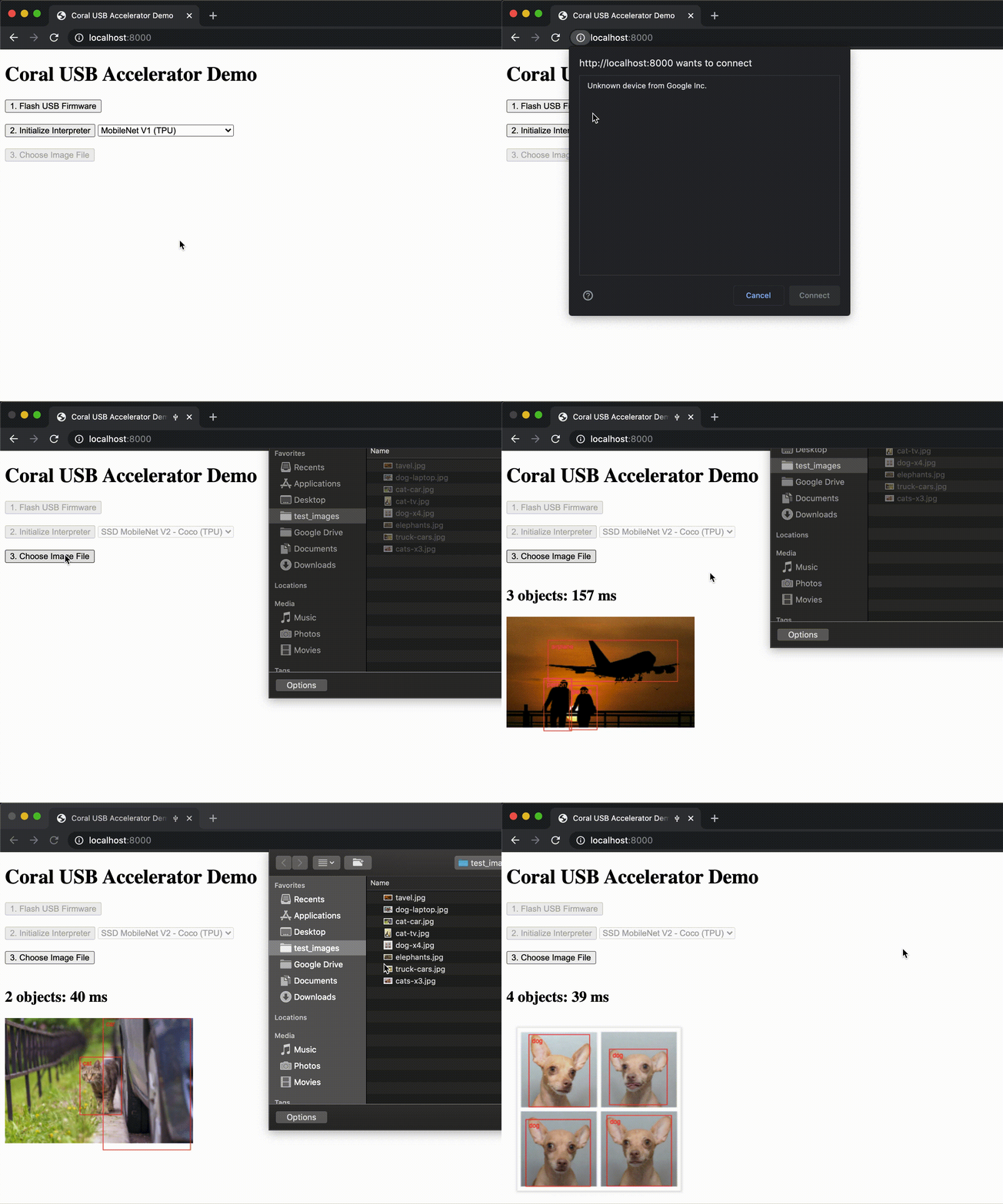
If you don’t like typing the command line in the terminal, Google has added Coral USB Accelerator support in Chrome over WebUSB. Only works on Linux and macOS for now. You’ll need to set up a web server and enter some commands to set up device rules on Linux, but when you’re done, go to http: // localhost: 8000 in Chrome and flash your USB accelerator software. Try some models, such as SSD MobileNet v2, with your own images.
New features of Edge TPU brought to ModBerry series
In October 2020, with the release of the latest Compute Module 4 from Rasbperry Pi Foundation, TECHBASE announced an upgraded device from ModBerry 500 series, called ModBerry 500 CM4. Thanks to the high-performance PCI-Express bus introduced in Compute Module 4 and Raspberry Pi community, the device itself presents support for a wide range of new applications, such as use of Google’s Artificial Intelligence modules at ease.
Therefore, TECHBASE designed a new device, called ModBerry AI GATEWAY 9500-CM4, utilizing the vertical format of ModBerry 9500, latest Compute Module 4 and Google’s Coral TPU. Installation-ready AI GATEWAY allows direct application in industrial fields.
AI GATEWAY with Coral TPU enhancement
Neuron network capabilities enhance CM4-based devices, not only collecting and sending data, but also allows local data change predictions and allows direct management on-site. This feature gives the possibility for various applications, such as data analysing and establishing trends predictions, smart alarms and smart monitoring, local notification control, etc.
Used Edge TPU coprocessor via PCI-Express bus is capable of performing 4 trillion operations per second (TOPS), using 0.5 watts for each TOPS (2 TOPS per watt). Google Coral easily integrates with Raspberry Pi Compute Module in Linux and optionally in Windows with full support of TensorFlow Lite framework and AutoML Vision Edge solution.
TECHBASE’s AI GATEWAY series, world-first industrial gateway utilizing Raspberry Pi Compute Module 4 and Google Coral TPU
AI GATEWAY with available expansion cards
ModBerry AI GATEWAY 9500-CM4 can be equipped with serial RS-232/485 ports, range of digital and analog I/Os, USB, HDMI and Ethernet. Interfaces can be expanded with additional I/Os and opto-isolation, relays, Ethernet, 1-Wire, CAN, M-Bus Master and Slave, accelerometer, OLED screen and many more features like TPM Security Chip, eSIM and SuperCap backup power support.
ModBerry AI GATEWAY 9500-CM4 series also offers a standard PCI module support for various wireless communication protocols, such as:
GSM modem (4G/LTE and fast 5G modem, interchangeable with Coral TPU)
economic NarrowBand-IoT technology
LoRa, ZigBee, Sigfox, Wireless M-Bus
secondary Wi-Fi/Bluetooth interface or Wi-Fi Hi-Power
custom wireless interfaces
ModBerry AI GATEWAY 9500-CM4 availabilityFirst prototypes are being developed, since Compute Module 4 is already available for the purchase. Delivery time for various configurations of AI GATEWAY will be approximately 2 months, depending on the CM4 supply on the market and chosen expansion cards. For more information contact TECHBASE’s Sales Department via email or Live Chat here.
https://iot-industrial-devices.com/wp-content/uploads/2021/07/google-coral-update.png3851210adminhttps://iot-industrial-devices.com/wp-content/uploads/2019/11/iot-industrial-devices-1.pngadmin2021-06-28 11:17:002021-07-01 11:26:12Developer from Google updates for Coral Dev Board AI module
NVIDIA has released Jetson AGX Xavier Industrial Module, that adds two Cortex-R5 functional safety cores (FuSa), with 32GB ECC RAM, 64GB eMMC, and shock and vibration resistance to the original design.
Robotics and automation are increasingly used in manufacturing, agriculture, construction, energy, government, and other industries, but many companies struggle to incorporate the benefits of AI and deep learning into their most demanding applications. doing.
Jetson AGX Xavier
With the new NVIDIA Jetson AGX Xavier Industrial module, NVIDIA can deploy AI to edge devices in harsh environments where security and reliability are important priorities.
AI performance is listed at 30 TOPS. The original AGX Xavier was announced with the same rating but is now listed at 32 TOPS. The module supports the same CUDA-X accelerated computing stack, JetPack SDK, and Ubuntu-based BSP as the other Jetson modules.
In October 2020, with the release of the latest Compute Module 4 from Rasbperry Pi Foundation, TECHBASE announced an upgraded device from ModBerry 500 series, called ModBerry 500 CM4. Thanks to the high-performance PCI-Express bus introduced in Compute Module 4 and Raspberry Pi community, the device itself presents support for a wide range of new applications, such as use of Google’s Artificial Intelligence modules at ease.
Therefore, TECHBASE designed a new device, called ModBerry AI GATEWAY 9500-CM4, utilizing the vertical format of ModBerry 9500, latest Compute Module 4 and Google’s Coral TPU. Installation-ready AI GATEWAY allows direct application in industrial fields.
AI GATEWAY with Coral TPU enhancement
Neuron network capabilities enhance CM4-based devices, not only collecting and sending data, but also allows local data change predictions and allows direct management on-site. This feature gives the possibility for various applications, such as data analysing and establishing trends predictions, smart alarms and smart monitoring, local notification control, etc.
Used Edge TPU coprocessor via PCI-Express bus is capable of performing 4 trillion operations per second (TOPS), using 0.5 watts for each TOPS (2 TOPS per watt). Google Coral easily integrates with Raspberry Pi Compute Module in Linux and optionally in Windows with full support of TensorFlow Lite framework and AutoML Vision Edge solution.
TECHBASE’s AI GATEWAY series, world-first industrial gateway utilizing Raspberry Pi Compute Module 4 and Google Coral TPU
AI GATEWAY with available expansion cards
ModBerry AI GATEWAY 9500-CM4 can be equipped with serial RS-232/485 ports, range of digital and analog I/Os, USB, HDMI and Ethernet. Interfaces can be expanded with additional I/Os and opto-isolation, relays, Ethernet, 1-Wire, CAN, M-Bus Master and Slave, accelerometer, OLED screen and many more features like TPM Security Chip, eSIM and SuperCap backup power support.
ModBerry AI GATEWAY 9500-CM4 series also offers a standard PCI module support for various wireless communication protocols, such as:
GSM modem (4G/LTE and fast 5G modem, interchangeable with Coral TPU)
economic NarrowBand-IoT technology
LoRa, ZigBee, Sigfox, Wireless M-Bus
secondary Wi-Fi/Bluetooth interface or Wi-Fi Hi-Power
custom wireless interfaces
ModBerry AI GATEWAY 9500-CM4 availabilityFirst prototypes are being developed, since Compute Module 4 is already available for the purchase. Delivery time for various configurations of AI GATEWAY will be approximately 2 months, depending on the CM4 supply on the market and chosen expansion cards. For more information contact TECHBASE’s Sales Department via email or Live Chat here.
New features of Edge TPU brought to ModBerry series
In October 2020, with the release of the latest Compute Module 4 from Rasbperry Pi Foundation, TECHBASE announced an upgraded device from ModBerry 500 series, called ModBerry 500 CM4. Thanks to the high-performance PCI-Express bus introduced in Compute Module 4 and Raspberry Pi community, the device itself presents support for a wide range of new applications, such as use of Google’s Artificial Intelligence modules at ease.
Therefore, TECHBASE designed a new device, called ModBerry AI GATEWAY 9500-CM4, utilizing the vertical format of ModBerry 9500, latest Compute Module 4 and Google’s Coral TPU. Installation-ready AI GATEWAY allows direct application in industrial fields.
AI GATEWAY with Coral TPU enhancement
Neuron network capabilities enhance CM4-based devices, not only collecting and sending data, but also allows local data change predictions and allows direct management on-site. This feature gives the possibility for various applications, such as data analysing and establishing trends predictions, smart alarms and smart monitoring, local notification control, etc.
Used Edge TPU coprocessor via PCI-Express bus is capable of performing 4 trillion operations per second (TOPS), using 0.5 watts for each TOPS (2 TOPS per watt). Google Coral easily integrates with Raspberry Pi Compute Module in Linux and optionally in Windows with full support of TensorFlow Lite framework and AutoML Vision Edge solution.
TECHBASE’s AI GATEWAY series, world-first industrial gateway utilizing Raspberry Pi Compute Module 4 and Google Coral TPU
AI GATEWAY with available expansion cards
ModBerry AI GATEWAY 9500-CM4 can be equipped with serial RS-232/485 ports, range of digital and analog I/Os, USB, HDMI and Ethernet. Interfaces can be expanded with additional I/Os and opto-isolation, relays, Ethernet, 1-Wire, CAN, M-Bus Master and Slave, accelerometer, OLED screen and many more features like TPM Security Chip, eSIM and SuperCap backup power support.
ModBerry AI GATEWAY 9500-CM4 series also offers a standard PCI module support for various wireless communication protocols, such as:
GSM modem (4G/LTE and fast 5G modem, interchangeable with Coral TPU)
economic NarrowBand-IoT technology
LoRa, ZigBee, Sigfox, Wireless M-Bus
secondary Wi-Fi/Bluetooth interface or Wi-Fi Hi-Power
custom wireless interfaces
ModBerry AI GATEWAY 9500-CM4 availabilityFirst prototypes are being developed, since Compute Module 4 is already available for the purchase. Delivery time for various configurations of AI GATEWAY will be approximately 2 months, depending on the CM4 supply on the market and chosen expansion cards. For more information contact TECHBASE’s Sales Department via email or Live Chat here.
https://iot-industrial-devices.com/wp-content/uploads/2020/12/ai-gateway.png3851210adminhttps://iot-industrial-devices.com/wp-content/uploads/2019/11/iot-industrial-devices-1.pngadmin2021-05-21 12:17:282021-05-27 12:18:28World-first industrial AI Gateway for Machine Learning
The latest research results from IoT Newark developers reveal that 49% of respondents use AI in their IoT applications. There is also a growing concern about user privacy and the more frequent introduction of ready equipment.
35% of respondents think security is the major concern for any IoT implementation, mainly due to the type of data collected from the things (machines) and humans, which is very sensitive & personal. We can expect to see more and more encryption everywhere. Businesses who initiate IoT projects treat IoT security as their top priority.
SBC is still the preferred hardware foundation for IoT gates, then 54%, followed by personal projects (30%) and silicon supplier platforms (13%). It is unclear whether the latter includes a commercial computing module. As shown in the graph above, many IoT programmers need third party help, especially for edge-to-cloud communication.
About 45% of respondents use environmental sensors for IoT devices, followed by motion sensors (26%) and optical / image sensors (15%). WiFi (67%) is the most popular wireless technology in Internet of Things projects. The next places are Low cellular energy and Bluetooth, followed by LoRa at 21%. The survey results also include responses to programming languages, cloud platforms, IoT data, project motivation and more.
From the end of 2017 to 2018, artificial intelligence-specific processors (AI) began to appear on mobile devices. The goal is to make smartphones more intelligent. As GPUs shrink, AI-related equipment becomes necessary for the Internet of Things.
Support for enterprises from platforms such as Google TensorFlow will be introduced in 2020 with equipment adapted to artificial intelligence. TensorFlow is already optimized for mobile devices and can be quickly launched on single-board computers. In many ways, AI frameworks are better than other mobile frameworks, such as ReactJS. The AI structure is not designed to work with the user interface. It’s perfect for the Internet of Things.
Until the end of 2020, artificial intelligence will be as important for IoT devices as the cloud.
https://iot-industrial-devices.com/wp-content/uploads/2020/04/industrial-iot-ai.png3851210adminhttps://iot-industrial-devices.com/wp-content/uploads/2019/11/iot-industrial-devices-1.pngadmin2021-05-19 11:50:002021-05-27 12:25:06Half of IoT developers use AI in their installations
New features of multiple Raspberry Pi Compute Modules 4 brought to new ClusBerry series
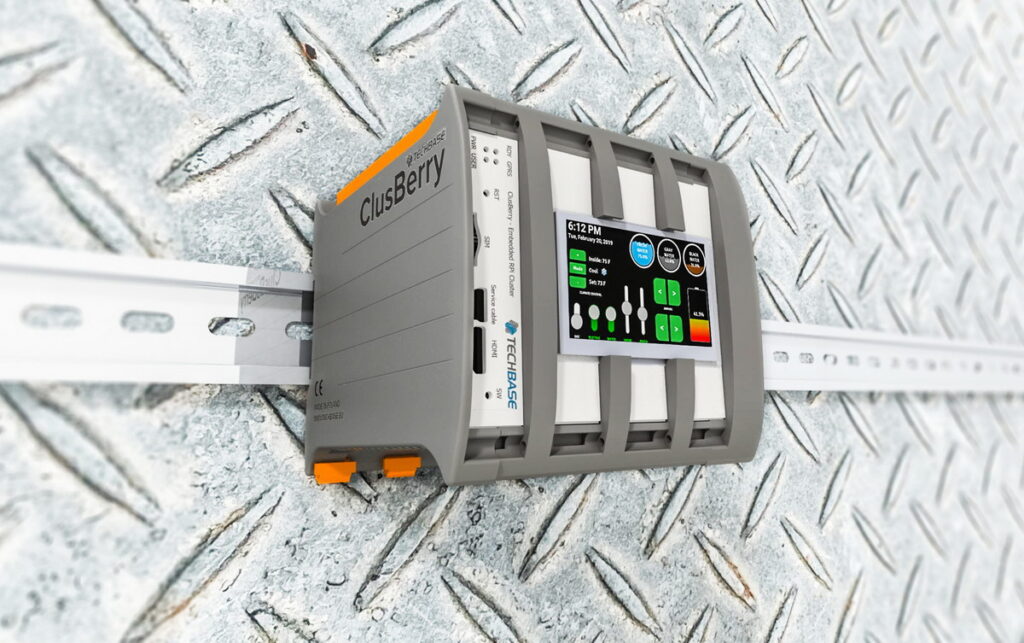
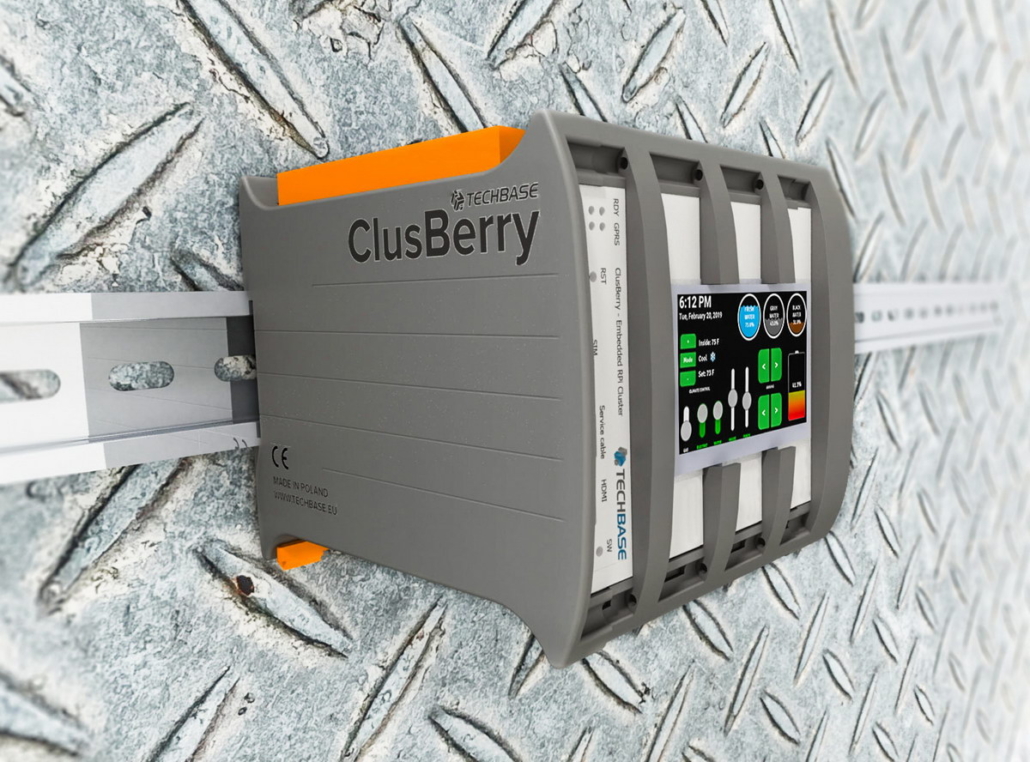
Accompanying the release of ModBerry 500-CM4 and AI GATEWAY 9500-CM4, we present to you a cluster version of the device, called ClusBerry 9500-CM4. Main difference between standard Gateway and ClusBerry is the possibility to include multiple Raspberry Pi Compute Module 4 in one device, as well as the intended suitable amount of wired and wireless interfaces, suited for the project.
Fully configurable devices are something desirable in the IoT market, where high performance and low cost is a key factor to success of implementation. TECHBASE’s Industrial IoT Ecosystem gives the opportunity to adjust ordered devices with certain resources and cut unnecessary I/Os, lowering the total cost of the device.
Wide range of ClusBerry modules
ClusBerry 9500-CM4 supports up to 8 cluster modules andcomes with a variety of interchangeable modules to choose from, including:
Standard 9500-CM4 cluster module with Compute Module 4 and chosen configuration:
I/O Controller with range of DI, DO, AI, 1-Wire, RS-232/485 and CAN interfaces
Communication Gateway with wired (1/2x Ethernet, Serial Ports) and wireless interfaces (LTE-cat.M1, 4G, 5G, LoRa, ZigBee, Z-Wave, Wireless M-Bus)
NAS File Server with 2x SSD SATA III and RAID support, managed with Nextcloud or ownCloud software
USB3.0 Hub for 5G communication, Modems, AI Cluster and peripherals
Gigabit LAN/WAN Router with additional 2.5GbE network card as an independent switch/router shielded from the mainboard cluster network
SuperCap / Power management module for backup power supply (supercapacitors / Li-Ion battery) and sleep mode management aided with ESP32-module
Additional expansion cards, with resources suited for the installation (DIO, AIO, Serial Ports and dedicated sensor cards, detailed below)
This is where Raspberry Pi Compute Module can shine, but due to the hardware speed limitations of the buses in this module, it was not completely effective and was rather a development platform. Altho the introduction of new Compute Module 4 has opened the possibility to construct and maintain effective hardware matrix solutions with the use of both PCI-Express buses and 1GBps Ethernet. Therefore, the ClusBerry 9500-CM4 opens up completely new capabilities of utilizing cluster solutions for Industrial Automation and server applications.
Reason for use of Raspberry Pi CM4 cluster in ClusBerry 9500-CM4
Various implementations must have guaranteed high hardware performance to react fast enough in real time. For this purpose, the arrays of processor blocks are constructed to be assigned to individual tasks. For several years now, attempts have been made to use various types of SBC for this purpose, including, of course, Raspberry Pi. However, the practical effectiveness of such solutions so far has not been of interest for several reasons. First of all, these solutions were most often associated with many mechanical limitations and the structure of the matrix itself required excessive wiring, preventing failure-free operation and the cost of the entire maintenance of the structure.
ClusBerry 9500-CM4 with available expansion cards
ClusBerry 9500-CM4 can be equipped with multiple expansion cards, e.g. serial RS-232/485 ports, range of digital and analog I/Os, USB, HDMI and Ethernet. Interfaces can be expanded with additional I/Os and opto-isolation, relays, Ethernet, 1-Wire, CAN, M-Bus Master and Slave, accelerometer and many more features like TPM Security Chip & eSIM. The device can also be equipped with additional SuperCap backup power source for continuous work and safe boot/shutdown in case of emergency.
ClusBerry 9500-CM4 series also offers a standard PCI module support for various wireless communication protocols, such as:
GSM modem (4G/LTE and fast 5G modem)
economic NarrowBand-IoT technology
LoRa, ZigBee, Z-Wave, Sigfox, Wireless M-Bus
secondary Wi-Fi/Bluetooth interface or Wi-Fi Hi-Power
custom wireless interfaces
Software cluster management with Docker and K3s Lightweight Kubernetes
With use of Docker-based and Kubernetes solutions, installation and management of ClusBerry 9500-CM4 is easy and backed with a large community for further support and development. Kubernetes is a portable, extensible open-source software platform for managing containerized tasks and sites that enables declarative configuration and automation. The Kubernetes ecosystem is large and dynamically developing. Kubernetes services, support and tools are widely available.
Kubernetes provides:
Detection of new services and traffic. Kubernetes can balance the load and redirect the network traffic to ensure the stability of the entire installation.
Kubernetes data storage management enables you to automatically mount any type of storage system – on-premises, from cloud providers and others.
Automatic deployment and rollback. You can describe the expected state of your installation with Kubernetes, which will take care of bringing the actual state to the expected state in a controlled manner. For example, with Kubernetes, you can manage your cluster modules at ease, boot modules from one to another, upgrade firmware crosswise and provide safe operation of each module
Automatic management of available resources. ClusBerry 9500-CM4provides a cluster of modules that Kubernetes can use to run tasks in containers. You determine the CPU power and RAM requirements for each container. Kubernetes arranges containers on machines in such a way as to make the best use of provided resources.
Self-healing Kubernetes reboots containers that have stopped working, replaces them with new ones, forces disabling containers that are not responding to certain status queries, and does not announce their availability until they are ready to run.
Managing confidential information and Kubernetes configuration with TPM Security Chip allows you to store and manage confidential information such as passwords, OAuth tokens and SSH keys. Secured data and configuration information can be provided and changed without having to rebuild the container image and without exposing sensitive data in the overall software configuration.
ClusBerry 9500-CM4 availability
First prototypes are being developed, since Compute Module 4 is already available for the purchase. Delivery time for various configurations of ClusBerry will be approximately 2 months, depending on the CM4 supply on the market and chosen expansion cards. For more information contact TECHBASE’s Sales Department via email or Live Chat here or visit product website: https://clusberry.techbase.eu.
https://iot-industrial-devices.com/wp-content/uploads/2021/04/clusberry-iot.png3851210adminhttps://iot-industrial-devices.com/wp-content/uploads/2019/11/iot-industrial-devices-1.pngadmin2021-05-05 12:45:002021-05-27 12:46:35Raspberry Pi based ClusBerry possitively affecting IoT market
New features of multiple Raspberry Pi Compute Modules 4 brought to new ClusBerry series
Accompanying the release of ModBerry 500-CM4 and AI GATEWAY 9500-CM4, we present to you a cluster version of the device, called ClusBerry 9500-CM4. Main difference between standard Gateway and ClusBerry is the possibility to include multiple Raspberry Pi Compute Module 4 in one device, as well as the intended suitable amount of wired and wireless interfaces, suited for the project.
Fully configurable devices are something desirable in the IoT market, where high performance and low cost is a key factor to success of implementation. TECHBASE’s Industrial IoT Ecosystem gives the opportunity to adjust ordered devices with certain resources and cut unnecessary I/Os, lowering the total cost of the device.
Wide range of ClusBerry modules
ClusBerry 9500-CM4 supports up to 8 cluster modules andcomes with a variety of interchangeable modules to choose from, including:
Standard 9500-CM4 cluster module with Compute Module 4 and chosen configuration:
I/O Controller with range of DI, DO, AI, 1-Wire, RS-232/485 and CAN interfaces
Communication Gateway with wired (1/2x Ethernet, Serial Ports) and wireless interfaces (LTE-cat.M1, 4G, 5G, LoRa, ZigBee, Z-Wave, Wireless M-Bus)
NAS File Server with 2x SSD SATA III and RAID support, managed with Nextcloud or ownCloud software
USB3.0 Hub for 5G communication, Modems, AI Cluster and peripherals
Gigabit LAN/WAN Router with additional 2.5GbE network card as an independent switch/router shielded from the mainboard cluster network
SuperCap / Power management module for backup power supply (supercapacitors / Li-Ion battery) and sleep mode management aided with ESP32-module
Additional expansion cards, with resources suited for the installation (DIO, AIO, Serial Ports and dedicated sensor cards, detailed below)
This is where Raspberry Pi Compute Module can shine, but due to the hardware speed limitations of the buses in this module, it was not completely effective and was rather a development platform. Altho the introduction of new Compute Module 4 has opened the possibility to construct and maintain effective hardware matrix solutions with the use of both PCI-Express buses and 1GBps Ethernet. Therefore, the ClusBerry 9500-CM4 opens up completely new capabilities of utilizing cluster solutions for Industrial Automation and server applications.
Reason for use of Raspberry Pi CM4 cluster in ClusBerry 9500-CM4
Various implementations must have guaranteed high hardware performance to react fast enough in real time. For this purpose, the arrays of processor blocks are constructed to be assigned to individual tasks. For several years now, attempts have been made to use various types of SBC for this purpose, including, of course, Raspberry Pi. However, the practical effectiveness of such solutions so far has not been of interest for several reasons. First of all, these solutions were most often associated with many mechanical limitations and the structure of the matrix itself required excessive wiring, preventing failure-free operation and the cost of the entire maintenance of the structure.
ClusBerry 9500-CM4 with available expansion cards
ClusBerry 9500-CM4 can be equipped with multiple expansion cards, e.g. serial RS-232/485 ports, range of digital and analog I/Os, USB, HDMI and Ethernet. Interfaces can be expanded with additional I/Os and opto-isolation, relays, Ethernet, 1-Wire, CAN, M-Bus Master and Slave, accelerometer and many more features like TPM Security Chip & eSIM. The device can also be equipped with additional SuperCap backup power source for continuous work and safe boot/shutdown in case of emergency.
ClusBerry 9500-CM4 series also offers a standard PCI module support for various wireless communication protocols, such as:
GSM modem (4G/LTE and fast 5G modem)
economic NarrowBand-IoT technology
LoRa, ZigBee, Z-Wave, Sigfox, Wireless M-Bus
secondary Wi-Fi/Bluetooth interface or Wi-Fi Hi-Power
custom wireless interfaces
Software cluster management with Docker and K3s Lightweight Kubernetes
With use of Docker-based and Kubernetes solutions, installation and management of ClusBerry 9500-CM4 is easy and backed with a large community for further support and development. Kubernetes is a portable, extensible open-source software platform for managing containerized tasks and sites that enables declarative configuration and automation. The Kubernetes ecosystem is large and dynamically developing. Kubernetes services, support and tools are widely available.
Kubernetes provides:
Detection of new services and traffic. Kubernetes can balance the load and redirect the network traffic to ensure the stability of the entire installation.
Kubernetes data storage management enables you to automatically mount any type of storage system – on-premises, from cloud providers and others.
Automatic deployment and rollback. You can describe the expected state of your installation with Kubernetes, which will take care of bringing the actual state to the expected state in a controlled manner. For example, with Kubernetes, you can manage your cluster modules at ease, boot modules from one to another, upgrade firmware crosswise and provide safe operation of each module
Automatic management of available resources. ClusBerry 9500-CM4provides a cluster of modules that Kubernetes can use to run tasks in containers. You determine the CPU power and RAM requirements for each container. Kubernetes arranges containers on machines in such a way as to make the best use of provided resources.
Self-healing Kubernetes reboots containers that have stopped working, replaces them with new ones, forces disabling containers that are not responding to certain status queries, and does not announce their availability until they are ready to run.
Managing confidential information and Kubernetes configuration with TPM Security Chip allows you to store and manage confidential information such as passwords, OAuth tokens and SSH keys. Secured data and configuration information can be provided and changed without having to rebuild the container image and without exposing sensitive data in the overall software configuration.
ClusBerry 9500-CM4 availability
First prototypes are being developed, since Compute Module 4 is already available for the purchase. Delivery time for various configurations of ClusBerry will be approximately 2 months, depending on the CM4 supply on the market and chosen expansion cards. For more information contact TECHBASE’s Sales Department via email or Live Chat here or visit product website: https://clusberry.techbase.eu.
https://iot-industrial-devices.com/wp-content/uploads/2021/04/clusberry-iot.png3851210adminhttps://iot-industrial-devices.com/wp-content/uploads/2019/11/iot-industrial-devices-1.pngadmin2021-04-13 09:35:002021-04-19 09:41:08Raspberry Pi based ClusBerry possitively affecting IoT market
IoT technology solves challenges of predictive maintenance by enabling real-time remote status monitoring. Instead of maintaining hardware monthly or every 11 quarters, companies can use IoT health monitoring for direct maintenance. Simple IoT devices can now monitor critical performance metrics in real time and send alerts when problems start.
Now you can equip a simple internet connected microcontroller with all kinds of sensors and functions. These devices can closely monitor the health of your valuable equipment and issue maintenance alerts when needed.
Industrial IoT on the site
The cost of equipment failure tends to cascade. The failure of a single piece of machinery can bring an entire assembly line to a grinding halt. And for every hour that production has stopped, hundreds of thousands of dollars might be slipping out the door. That hiccup in production can also result in unfulfilled contracts, angry customers, and upheaval in your supply chain.
Traditionally, those types of failures were prevented by routine scheduled maintenance by specialized technicians. But as discussed earlier, scheduled maintenance is imperfect. Fear of equipment failure often drives businesses to set aggressive preventative maintenance schedules, which of course raises costs.
In fact, according to a recent paper from IBM, up to 70% of a company’s investment in preventative maintenance does not affect uptime metrics. This is due largely to the fact that only 11% of machine failures follow an age-degradation pattern. A whopping 89% occur at random.
New features of Edge TPU brought to ModBerry series
In October 2020, with the release of the latest Compute Module 4 from Rasbperry Pi Foundation, TECHBASE announced an upgraded device from ModBerry 500 series, called ModBerry 500 CM4. Thanks to the high-performance PCI-Express bus introduced in Compute Module 4 and Raspberry Pi community, the device itself presents support for a wide range of new applications, such as use of Google’s Artificial Intelligence modules at ease.
Therefore, TECHBASE designed a new device, called ModBerry AI GATEWAY 9500-CM4, utilizing the vertical format of ModBerry 9500, latest Compute Module 4 and Google’s Coral TPU. Installation-ready AI GATEWAY allows direct application in industrial fields.
AI GATEWAY with Coral TPU enhancement
Neuron network capabilities enhance CM4-based devices, not only collecting and sending data, but also allows local data change predictions and allows direct management on-site. This feature gives the possibility for various applications, such as data analysing and establishing trends predictions, smart alarms and smart monitoring, local notification control, etc.
Used Edge TPU coprocessor via PCI-Express bus is capable of performing 4 trillion operations per second (TOPS), using 0.5 watts for each TOPS (2 TOPS per watt). Google Coral easily integrates with Raspberry Pi Compute Module in Linux and optionally in Windows with full support of TensorFlow Lite framework and AutoML Vision Edge solution.
TECHBASE’s AI GATEWAY series, world-first industrial gateway utilizing Raspberry Pi Compute Module 4 and Google Coral TPU
AI GATEWAY with available expansion cards
ModBerry AI GATEWAY 9500-CM4 can be equipped with serial RS-232/485 ports, range of digital and analog I/Os, USB, HDMI and Ethernet. Interfaces can be expanded with additional I/Os and opto-isolation, relays, Ethernet, 1-Wire, CAN, M-Bus Master and Slave, accelerometer, OLED screen and many more features like TPM Security Chip, eSIM and SuperCap backup power support.
ModBerry AI GATEWAY 9500-CM4 series also offers a standard PCI module support for various wireless communication protocols, such as:
GSM modem (4G/LTE and fast 5G modem, interchangeable with Coral TPU)
economic NarrowBand-IoT technology
LoRa, ZigBee, Sigfox, Wireless M-Bus
secondary Wi-Fi/Bluetooth interface or Wi-Fi Hi-Power
custom wireless interfaces
ModBerry AI GATEWAY 9500-CM4 availability
First prototypes are being developed, since Compute Module 4 is already available for the purchase. Delivery time for various configurations of AI GATEWAY will be approximately 2 months, depending on the CM4 supply on the market and chosen expansion cards. For more information contact TECHBASE’s Sales Department via email or Live Chat here.
https://iot-industrial-devices.com/wp-content/uploads/2021/08/ai-predictive-maintenance.png3851210adminhttps://iot-industrial-devices.com/wp-content/uploads/2019/11/iot-industrial-devices-1.pngadmin2021-03-28 14:31:002022-05-09 13:48:10The growing power of AI & Industrial IoT in Predictive Maintenance
Hyperautomation is a process in which businesses automate as numerous commerce and IT forms as conceivable utilizing apparatuses like AI, machine learning, event-driven computer program, mechanical process automation, and other sorts of choice prepare and task automation instruments.
It is the key to both computerized operational greatness and operational resiliency for organizations. To empower this, organizations had to digitize their documents/artifacts and guarantee their trade and IT process workflows were advanced. They got to mechanize tasks, processes and coordinate computerization over utilitarian zones.
Hyperautomation is irreversible and inevitable. Everything that can and should be automated will be automated.
Data generated over the Internet of Things is growing exponentially faster than the traditional cloud environment where data is stored, so just the amount of data can justify the acceleration. In addition, in the cloud as the destination, problems related to data transfer (delay and bandwidth) occur, so travel speed is the main issue. This edge is necessary as a solution to the inefficiency of IIoT to Cloud architecture.
When industrial IoT devices and edge processing work together, digital information becomes more powerful. Especially in contexts where you need to collect data in a traditional edge context, such as a smart meter, a parking meter or a connected trash can in a street apartment. The installation of sensors with internet access in metropolitan garbage containers is becoming increasingly common for smart urban engineers. You can then remotely monitor the container using the sensor. When it is full, the city sanitation service receives a notification and can register an order and empty the container.
By introducing AI (artificial intelligence) into the device itself, edge computing can also make more context-sensitive, quick decisions at the edge. Data gathered from the sensors can be transferred to the cloud at any time after local work has been completed, contributing to a more global AI process, or archived. With the combination of industrial IoT devices and advanced technology, high quality analysis and small footprint will become the AI standard in 2020.
ModBerry AI GATEWAY with Raspberry Pi CM4 and Google Coral
Latest innovations used in industrial solutions
One of many uses of IoT can be edge devices, dedicated to data management, process control (e.g. with MQTT protocol) and monitoring. Latest ESP32-based eModGATE controller from TECHBASE company is a series utilizing MicroPython environment to provide data management solutions for end-points applications. TheeModGATE has built-in Wi-Fi/BT modem and can be equipped with additional NarrowBand-IoT, LoRa, ZigBee, etc.
For example eModGATE eqipped with wireless NB-IoT modem are perfect for industrial automation solutions, e.g. data logging, metering, telemetrics, remote monitoring, security and data management through all Industrial IoT applications.
https://iot-industrial-devices.com/wp-content/uploads/2021/03/hyperautomation.png3851210adminhttps://iot-industrial-devices.com/wp-content/uploads/2019/11/iot-industrial-devices-1.pngadmin2021-03-17 13:50:182021-03-17 13:53:12Hyperautomation and IoT as inevitable road of every business
Updated ClusBerry device for Smart Home and developers
A new addition to TECHBASE’s Industrial IoT Ecosystem is a variation of recent cluster device, ClusBerry based on multiple Raspberry Pi Compute Module 4 and custom cluster board allowing free configuration from two up to eight modules. Each module can perform various tasks, from standard I/O gateway, wireless modem, Gigabit LAN router to NAS file server and AI Gateway with up to 4 Google Coral Edge TPU modules.
You can manage your cluster modules at ease, boot modules from one to another, upgrade firmware crosswise and provide safe operation of each module. The modules are connected to internal Ethernet Switch and USB OTG to provide such feature and allow quick heal of the cluster.
For home applications and with the nod to software developers, we released ClusBerry device in less industrial casing, to be used in the comfort of own house – on your desk next to PC or wall-mounted in any convenient place. ClusBerry for Home is fully modular as it’s industrial version and offers the same performance and options.
New features of multiple Compute Modules 4 brought to new ClusBerry series
Accompanying the release of ModBerry 500-CM4 and AI GATEWAY 9500-CM4, we present to you a cluster version of the device, called ClusBerry 9500-CM4. Main difference between standard Gateway and ClusBerry is the possibility to include multiple Compute Module 4 in one device, as well as the intended suitable amount of wired and wireless interfaces, suited for the project.
Fully configurable devices are something desirable in the IoT market, where high performance and low cost is a key factor to success of implementation. TECHBASE’s Industrial IoT Ecosystem gives the opportunity to adjust ordered devices with certain resources and cut unnecessary I/Os, lowering the total cost of the device.
Reason for use of Raspberry Pi CM4 cluster in ClusBerry 9500-CM4
Various implementations must have guaranteed high hardware performance to react fast enough in real time. For this purpose, the arrays of processor blocks are constructed to be assigned to individual tasks. For several years now, attempts have been made to use various types of SBC for this purpose, including, of course, Raspberry Pi. However, the practical effectiveness of such solutions so far has not been of interest for several reasons. First of all, these solutions were most often associated with many mechanical limitations and the structure of the matrix itself required excessive wiring, preventing failure-free operation and the cost of the entire maintenance of the structure.
This is where Raspberry Pi Compute Module can shine, but due to the hardware speed limitations of the buses in this module, it was not completely effective and was rather a development platform. Altho the introduction of new Compute Module 4 has opened the possibility to construct and maintain effective hardware matrix solutions with the use of both PCI-Express buses and 1GBps Ethernet. Therefore, the ClusBerry 9500-CM4 opens up completely new capabilities of utilizing cluster solutions for Industrial Automation and server applications.
Wide range of ClusBerry modules
ClusBerry 9500-CM4 supports up to 8 cluster modules andcomes with a variety of interchangeable modules to choose from, including:
Standard 9500-CM4 cluster module with Compute Module 4 and chosen configuration:
I/O Controller with range of DI, DO, AI, 1-Wire, RS-232/485 and CAN interfaces
Communication Gateway with wired (1/2x Ethernet, Serial Ports) and wireless interfaces (LTE-cat.M1, 4G, 5G, LoRa, ZigBee, Z-Wave, Wireless M-Bus)
NAS File Server with 2x SSD SATA III and RAID support, managed with Nextcloud or ownCloud software
USB3.0 Hub for 5G communication, Modems, AI Cluster and peripherals
Gigabit LAN/WAN Router with additional 2.5GbE network card as an independent switch/router shielded from the mainboard cluster network
SuperCap / Power management module for backup power supply (supercapacitors / Li-Ion battery) and sleep mode management aided with ESP32-module
Additional expansion cards, with resources suited for the installation (DIO, AIO, Serial Ports and dedicated sensor cards, detailed below)
ClusBerry 9500-CM4 with available expansion cards
ClusBerry 9500-CM4 can be equipped with multiple expansion cards, e.g. serial RS-232/485 ports, range of digital and analog I/Os, USB, HDMI and Ethernet. Interfaces can be expanded with additional I/Os and opto-isolation, relays, Ethernet, 1-Wire, CAN, M-Bus Master and Slave, accelerometer and many more features like TPM Security Chip & eSIM. The device can also be equipped with additional SuperCap backup power source for continuous work and safe boot/shutdown in case of emergency.
ClusBerry 9500-CM4 series also offers a standard PCI module support for various wireless communication protocols, such as:
GSM modem (4G/LTE and fast 5G modem)
economic NarrowBand-IoT technology
LoRa, ZigBee, Z-Wave, Sigfox, Wireless M-Bus
secondary Wi-Fi/Bluetooth interface or Wi-Fi Hi-Power
custom wireless interfaces
Software cluster management with Docker and K3s Lightweight Kubernetes
With use of Docker-based and Kubernetes solutions, installation and management of ClusBerry 9500-CM4 is easy and backed with a large community for further support and development. Kubernetes is a portable, extensible open-source software platform for managing containerized tasks and sites that enables declarative configuration and automation. The Kubernetes ecosystem is large and dynamically developing. Kubernetes services, support and tools are widely available.
Kubernetes provides:
Detection of new services and traffic. Kubernetes can balance the load and redirect the network traffic to ensure the stability of the entire installation.
Kubernetes data storage management enables you to automatically mount any type of storage system – on-premises, from cloud providers and others.
Automatic deployment and rollback. You can describe the expected state of your installation with Kubernetes, which will take care of bringing the actual state to the expected state in a controlled manner. For example, with Kubernetes, you can manage your cluster modules at ease, boot modules from one to another, upgrade firmware crosswise and provide safe operation of each module
Automatic management of available resources. ClusBerry 9500-CM4provides a cluster of modules that Kubernetes can use to run tasks in containers. You determine the CPU power and RAM requirements for each container. Kubernetes arranges containers on machines in such a way as to make the best use of provided resources.
Self-healing Kubernetes reboots containers that have stopped working, replaces them with new ones, forces disabling containers that are not responding to certain status queries, and does not announce their availability until they are ready to run.
Managing confidential information and Kubernetes configuration with TPM Security Chip allows you to store and manage confidential information such as passwords, OAuth tokens and SSH keys. Secured data and configuration information can be provided and changed without having to rebuild the container image and without exposing sensitive data in the overall software configuration.
ClusBerry 9500-CM4 availability
First prototypes are being developed, since Compute Module 4 is already available for the purchase. Delivery time for various configurations of ClusBerry will be approximately 2 months, depending on the CM4 supply on the market and chosen expansion cards. For more information contact TECHBASE’s Sales Department via email or Live Chat here or visit product website: https://clusberry.techbase.eu.
https://iot-industrial-devices.com/wp-content/uploads/2021/03/clusberry-for-home.png3851210adminhttps://iot-industrial-devices.com/wp-content/uploads/2019/11/iot-industrial-devices-1.pngadmin2021-03-15 13:38:002021-03-16 10:55:24Raspberry Pi Compute Module 4 Cluster for Smart Home
New features of multiple Raspberry Pi Compute Modules 4 brought to new ClusBerry series
Accompanying the release of ModBerry 500-CM4 and AI GATEWAY 9500-CM4, we present to you a cluster version of the device, called ClusBerry 9500-CM4. Main difference between standard Gateway and ClusBerry is the possibility to include multiple Raspberry Pi Compute Module 4 in one device, as well as the intended suitable amount of wired and wireless interfaces, suited for the project.
Fully configurable devices are something desirable in the IoT market, where high performance and low cost is a key factor to success of implementation. TECHBASE’s Industrial IoT Ecosystem gives the opportunity to adjust ordered devices with certain resources and cut unnecessary I/Os, lowering the total cost of the device.
Reason for use of Raspberry Pi CM4 cluster in ClusBerry 9500-CM4
Various implementations must have guaranteed high hardware performance to react fast enough in real time. For this purpose, the arrays of processor blocks are constructed to be assigned to individual tasks. For several years now, attempts have been made to use various types of SBC for this purpose, including, of course, Raspberry Pi. However, the practical effectiveness of such solutions so far has not been of interest for several reasons. First of all, these solutions were most often associated with many mechanical limitations and the structure of the matrix itself required excessive wiring, preventing failure-free operation and the cost of the entire maintenance of the structure.
This is where Raspberry Pi Compute Module can shine, but due to the hardware speed limitations of the buses in this module, it was not completely effective and was rather a development platform. Altho the introduction of new Compute Module 4 has opened the possibility to construct and maintain effective hardware matrix solutions with the use of both PCI-Express buses and 1GBps Ethernet. Therefore, the ClusBerry 9500-CM4 opens up completely new capabilities of utilizing cluster solutions for Industrial Automation and server applications.
Wide range of ClusBerry modules
ClusBerry 9500-CM4 supports up to 8 cluster modules andcomes with a variety of interchangeable modules to choose from, including:
Standard 9500-CM4 cluster module with Compute Module 4 and chosen configuration:
I/O Controller with range of DI, DO, AI, 1-Wire, RS-232/485 and CAN interfaces
Communication Gateway with wired (1/2x Ethernet, Serial Ports) and wireless interfaces (LTE-cat.M1, 4G, 5G, LoRa, ZigBee, Z-Wave, Wireless M-Bus)
NAS File Server with 2x SSD SATA III and RAID support, managed with Nextcloud or ownCloud software
USB3.0 Hub for 5G communication, Modems, AI Cluster and peripherals
Gigabit LAN/WAN Router with additional 2.5GbE network card as an independent switch/router shielded from the mainboard cluster network
SuperCap / Power management module for backup power supply (supercapacitors / Li-Ion battery) and sleep mode management aided with ESP32-module
Additional expansion cards, with resources suited for the installation (DIO, AIO, Serial Ports and dedicated sensor cards, detailed below)
ClusBerry 9500-CM4 with available expansion cards
ClusBerry 9500-CM4 can be equipped with multiple expansion cards, e.g. serial RS-232/485 ports, range of digital and analog I/Os, USB, HDMI and Ethernet. Interfaces can be expanded with additional I/Os and opto-isolation, relays, Ethernet, 1-Wire, CAN, M-Bus Master and Slave, accelerometer and many more features like TPM Security Chip & eSIM. The device can also be equipped with additional SuperCap backup power source for continuous work and safe boot/shutdown in case of emergency.
ClusBerry 9500-CM4 series also offers a standard PCI module support for various wireless communication protocols, such as:
GSM modem (4G/LTE and fast 5G modem)
economic NarrowBand-IoT technology
LoRa, ZigBee, Z-Wave, Sigfox, Wireless M-Bus
secondary Wi-Fi/Bluetooth interface or Wi-Fi Hi-Power
custom wireless interfaces
Software cluster management with Docker and K3s Lightweight Kubernetes
With use of Docker-based and Kubernetes solutions, installation and management of ClusBerry 9500-CM4 is easy and backed with a large community for further support and development. Kubernetes is a portable, extensible open-source software platform for managing containerized tasks and sites that enables declarative configuration and automation. The Kubernetes ecosystem is large and dynamically developing. Kubernetes services, support and tools are widely available.
Kubernetes provides:
Detection of new services and traffic. Kubernetes can balance the load and redirect the network traffic to ensure the stability of the entire installation.
Kubernetes data storage management enables you to automatically mount any type of storage system – on-premises, from cloud providers and others.
Automatic deployment and rollback. You can describe the expected state of your installation with Kubernetes, which will take care of bringing the actual state to the expected state in a controlled manner. For example, with Kubernetes, you can manage your cluster modules at ease, boot modules from one to another, upgrade firmware crosswise and provide safe operation of each module
Automatic management of available resources. ClusBerry 9500-CM4provides a cluster of modules that Kubernetes can use to run tasks in containers. You determine the CPU power and RAM requirements for each container. Kubernetes arranges containers on machines in such a way as to make the best use of provided resources.
Self-healing Kubernetes reboots containers that have stopped working, replaces them with new ones, forces disabling containers that are not responding to certain status queries, and does not announce their availability until they are ready to run.
Managing confidential information and Kubernetes configuration with TPM Security Chip allows you to store and manage confidential information such as passwords, OAuth tokens and SSH keys. Secured data and configuration information can be provided and changed without having to rebuild the container image and without exposing sensitive data in the overall software configuration.
ClusBerry 9500-CM4 availability
First prototypes are being developed, since Compute Module 4 is already available for the purchase. Delivery time for various configurations of ClusBerry will be approximately 2 months, depending on the CM4 supply on the market and chosen expansion cards. For more information contact TECHBASE’s Sales Department via email or Live Chat here or visit product website: https://clusberry.techbase.eu.
We may request cookies to be set on your device. We use cookies to let us know when you visit our websites, how you interact with us, to enrich your user experience, and to customize your relationship with our website.
Click on the different category headings to find out more. You can also change some of your preferences. Note that blocking some types of cookies may impact your experience on our websites and the services we are able to offer.
Essential Website Cookies
These cookies are strictly necessary to provide you with services available through our website and to use some of its features.
Because these cookies are strictly necessary to deliver the website, you cannot refuse them without impacting how our site functions. You can block or delete them by changing your browser settings and force blocking all cookies on this website.
Other external services
We also use different external services like Google Webfonts, Google Maps and external Video providers. Since these providers may collect personal data like your IP address we allow you to block them here. Please be aware that this might heavily reduce the functionality and appearance of our site. Changes will take effect once you reload the page.