Wpisy

Raspberry Pi based controller with Modbus, M-Bus & MQTT support

Raspberry Pi Compute Module 3+ based ModBerry industrial computer series use latest Compute Module 3+, powered by Quad-core Cortex-A53 1.2GHz processor, 1024MB LPDDR2 RAM and up to 32GB Flash eMMC. The module increase the device’s performance up to ten times, maintaining low power consumption and optimal price of the solution. Raspberry Pi based ModBerry features industrial protocol support, e.g. Modbus, M-Bus, SNMP, MQTT and the possibility to add new protocols with ease.
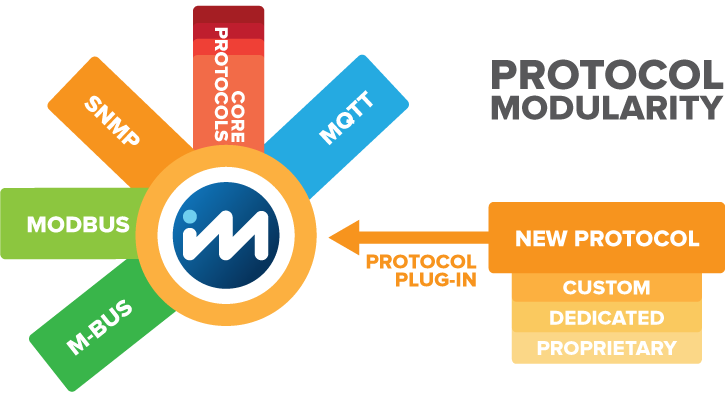
ModBerry protocol modularity

ModBerry remote management

The iMod platform guarantees a quick start and full use of the ModBerry computer, without the need to write complicated software. One of the main advantages of the iMod platform is its ease of use and variety of available functionalities. Due to the available SDK, the platform can be extended with new, dedicated functionalities.

iMod can be installed directly onto ModBerry device or using external PC outside the installation (iModBOX). The third option is using dedicated hosting server to host the iMod software (iModHOST).
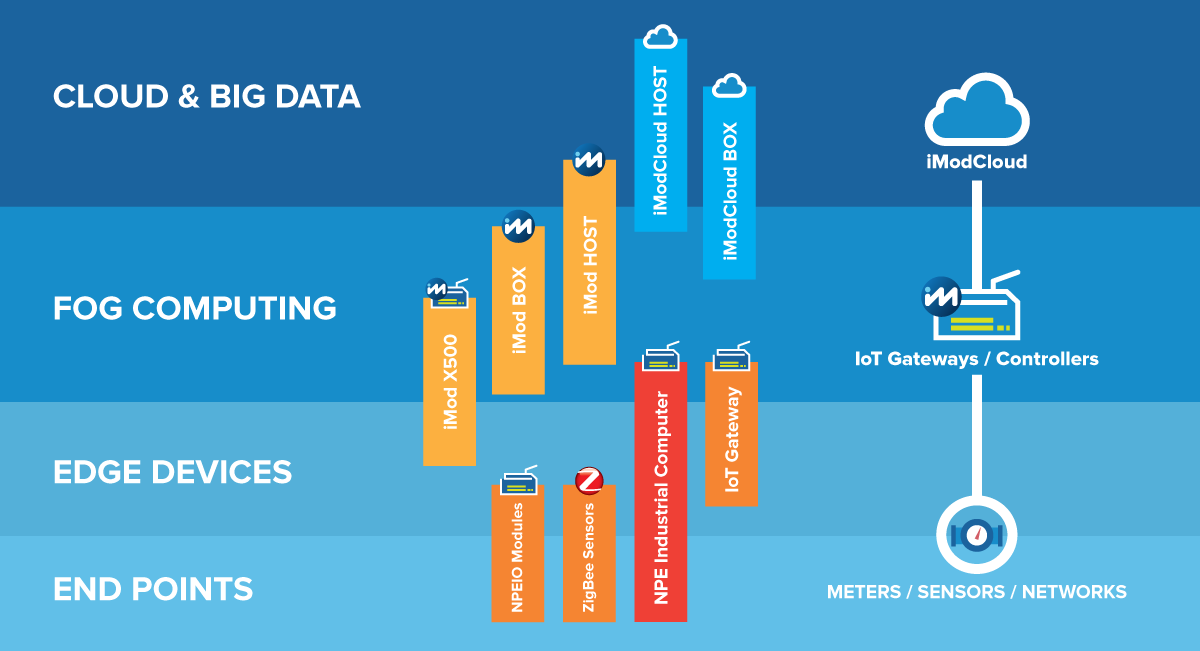
iModCloud Ecosystem

Another product is iModCloud software-service, which enables full control of ModBerry/iMod devices. Together they form a stand-alone solution – iModCloud Ecosystem, a combination of cloud services with web-based user interface and industrial devices, fully manageable remotely.

iModCloud can be hosted externally, using stable DELL servers to host the cloud service.(iModCloudHOST). For higher data security or depending on project features, iModCloud can be hosted internally, inside the installation (iModCloudBOX) hosted by the dedicated Mini-PC or from portable memory stick (iModCloudSTARTER).

More information Raspberry Pi based industrial device

TECHBASE provides solutions for industrial automation, telemetry, remote access and integration with IT systems. Since 2012 the company has been actively developing its competences in the market. Due to an innovative approach – based on the use of cutting-edge technologies, open standards and easy to maintain products – the company has earned the trust of Customers all over the world.

TECHBASE’s mission is to provide our Customers with tools, which will shorten and simplify the process of system implementation. With open architecture and high level of configurability, maintenance of a system is not expensive anymore.

To read more about ModBerry 500 M3 solution, download PDF datasheet: http://a2s.pl/products/ModBerry/ModBerry_500M3_EN.pdf
Read more about all ModBerry Industrial Solutions at: https://modberry.techbase.eu/
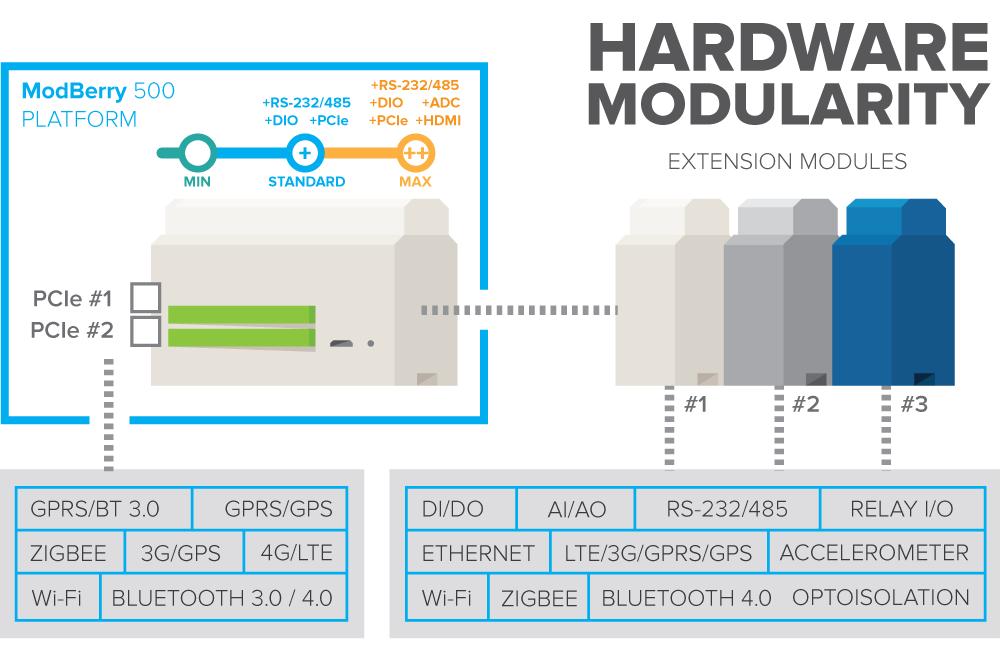
ModBerry hardware modularity

ModBerry 500 hardware modularity

The main features of ModBerry Industrial Computers series are the extension capabilities to increase input/output number, add up to 4 internal wireless communication modems and modules, support additional features such as accelerometer or opto-isolation options.

ModBerry 500 series offers wide range of industrial interfaces e.g.: digital inputs/outputs, analog inputs/outputs, relay outputs, serial RS-232/485 ports, Ethernet, 1-Wire, CAN, USB 2.0, HDMI, LTE/3G/GPRS, NarrowBand IoT/LTE, GPS, ZigBee, WiFi, Bluetooth, LoRa and many more via extension modules.
Docker VPN-based Raspberry Pi Server tutorial

Many developement boards can be used in home and industrial applications to control and manage data. Get secure remote access from anywhere via your own VPN based on Docker containers. Check out latest video from open-tech infuencer, Andreas Spiess, in which he uses Raspberry Pi and Docker, Node-RED, influxDB and Grafana to build custom Raspberry Pi data server.

Docker implementation in CM4 cluster – ClusBerry-2M

The introduction of new Compute Module 4 has opened the possibility to construct and maintain effective hardware matrix solutions with the use of both PCI-Express buses and 1GBps Ethernet. Therefore, the ClusBerry-2M opens up completely new capabilities of utilizing cluster solutions for Industrial Automation and server applications.

ClusBerry-2M can be equipped with multiple expansion cards, e.g. serial RS-232/485 ports, range of digital and analog I/Os, USB, HDMI and Ethernet. Interfaces can be expanded with additional I/Os and opto-isolation, relays, Ethernet, 1-Wire, CAN, M-Bus Master and Slave, accelerometer and many more features like TPM Security Chip & eSIM. The device can also be equipped with additional SuperCap backup power source for continuous work and safe boot/shutdown in case of emergency.

ClusBerry-2M series also offers two M.2 NVMe SSD slots and up to four standard miniPCIe module support for various wireless communication protocols, such as:

  • GSM modem (4G/LTE and fast 5G modem)
  • economic NarrowBand-IoT technology
  • LoRa, ZigBee, Z-Wave, Sigfox, Wireless M-Bus
  • secondary Wi-Fi/Bluetooth interface or Wi-Fi Hi-Power
  • custom wireless interfaces

Software cluster management with Docker and K3s Lightweight Kubernetes

With use of Docker-based and Kubernetes solutions, installation and management of ClusBerry-2M is easy and backed with a large community for further support and development. Kubernetes is a portable, extensible open-source software platform for managing containerized tasks and sites that enables declarative configuration and automation. The Kubernetes ecosystem is large and dynamically developing. Kubernetes services, support and tools are widely available.

Kubernetes provides:

  • Detection of new services and traffic. Kubernetes can balance the load and redirect the network traffic to ensure the stability of the entire installation.
  • Kubernetes data storage management enables you to automatically mount any type of storage system – on-premises, from cloud providers and others.
  • Automatic deployment and rollback. You can describe the expected state of your installation with Kubernetes, which will take care of bringing the actual state to the expected state in a controlled manner. For example, with Kubernetes, you can manage your cluster modules at ease, boot modules from one to another, upgrade firmware crosswise and provide safe operation of each module.
  • Automatic management of available resources. ClusBerry-2M provides a cluster of modules that Kubernetes can use to run tasks in containers. You determine the CPU power and RAM requirements for each container. Kubernetes arranges containers on machines in such a way as to make the best use of provided resources.
  • Self-healing Kubernetes reboots containers that have stopped working, replaces them with new ones, forces disabling containers that are not responding to certain status queries, and does not announce their availability until they are ready to run.
  • Managing confidential information and Kubernetes configuration with TPM Security Chip allows you to store and manage confidential information such as passwords, OAuth tokens and SSH keys. Secured data and configuration information can be provided and changed without having to rebuild the container image and without exposing sensitive data in the overall software configuration.

Hyperautomation is a process in which businesses automate as numerous commerce and IT forms as conceivable utilizing apparatuses like AI, machine learning, event-driven computer program, mechanical process automation, and other sorts of choice prepare and task automation instruments.

It is the key to both computerized operational greatness and operational resiliency for organizations. To empower this, organizations had to digitize their documents/artifacts and guarantee their trade and IT process workflows were advanced. They got to mechanize tasks, processes and coordinate computerization over utilitarian zones.

Hyperautomation is irreversible and inevitable. Everything that can and should be automated will be automated.

Brian Burke, Research Vice President, Gartner

Gartner prepared a Tech Trends 2021 summary with key features of the constantly changing market. Read more at: https://www.gartner.com/en/information-technology/trends/top-strategic-technology-trends-iot-gb-pd

Industrial IoT market evolution

Data generated over the Internet of Things is growing exponentially faster than the traditional cloud environment where data is stored, so just the amount of data can justify the acceleration. In addition, in the cloud as the destination, problems related to data transfer (delay and bandwidth) occur, so travel speed is the main issue. This edge is necessary as a solution to the inefficiency of IIoT to Cloud architecture.

Fast data processing of Industrial IoT devices

When industrial IoT devices and edge processing work together, digital information becomes more powerful. Especially in contexts where you need to collect data in a traditional edge context, such as a smart meter, a parking meter or a connected trash can in a street apartment. The installation of sensors with internet access in metropolitan garbage containers is becoming increasingly common for smart urban engineers. You can then remotely monitor the container using the sensor. When it is full, the city sanitation service receives a notification and can register an order and empty the container.

By introducing AI (artificial intelligence) into the device itself, edge computing can also make more context-sensitive, quick decisions at the edge. Data gathered from the sensors can be transferred to the cloud at any time after local work has been completed, contributing to a more global AI process, or archived. With the combination of industrial IoT devices and advanced technology, high quality analysis and small footprint will become the AI standard in 2020.

ModBerry AI GATEWAY with Raspberry Pi CM4 and Google Coral

Latest innovations used in industrial solutions

One of many uses of IoT can be edge devices, dedicated to data management, process control (e.g. with MQTT protocol) and monitoring. Latest ESP32-based eModGATE controller from TECHBASE company is a series utilizing MicroPython environment to provide data management solutions for end-points applications. The eModGATE has built-in Wi-Fi/BT modem and can be equipped with additional NarrowBand-IoT, LoRa, ZigBee, etc.

For example eModGATE eqipped with wireless NB-IoT modem are perfect for industrial automation solutions, e.g. data logging, metering, telemetrics, remote monitoring, security and data management through all Industrial IoT applications.

Advantages of Industrial IoT in modern manufacturing and smart environments

Industrial Internet of Things (Industrial IoT or just IIoT for short) uses Internet of Things technology to improve production and industrial processes. These processes increasingly require connected devices to perform their tasks effectively.

Data generated over the Internet of Things is growing exponentially faster than the traditional cloud environment where data is stored, so just the amount of data can justify the acceleration. In addition, in the cloud as the destination, problems related to data transfer (delay and bandwidth) occur, so travel speed is the main issue. This edge is necessary as a solution to the inefficiency of IIoT to Cloud architecture.

IIoT market predictions

Industrial IoT devices and edge computing have grown at impressive rates. Accenture predicts the IIoT market will reach $500 billion by 2020; and IIoT already generates 400 zetabytes a year. Gartner estimates that IoT currently generates about 10% of enterprise data; by 2022, Gartner has predicted this will increase to 50%.

According to IDC, IT’s annual investment on edge infrastructure will hit 18% of total IoT spending; and per last year’s Forrester Analytics Global Business Technographics Mobility Survey, 27% of global telecom decision-makers say their companies will either implement or expand edge computing this year.

Source: https://www.cisco.com/c/en/us/solutions/internet-of-things/industrial-iot-devices.html

Perimeter (edge) computing architectures bring computing processing closer to the users and devices that need it, rather than centrally processing it in a local data center or public cloud. This edge is important for industrial and production processes that use large amounts of data that require fast response times and tight security.

Fast data processing of Industrial IoT devices

When industrial IoT devices and edge processing work together, digital information becomes more powerful. Especially in contexts where you need to collect data in a traditional edge context, such as a smart meter, a parking meter or a connected trash can in a street apartment. The installation of sensors with internet access in metropolitan garbage containers is becoming increasingly common for smart urban engineers. You can then remotely monitor the container using the sensor. When it is full, the city sanitation service receives a notification and can register an order and empty the container.

By introducing AI (artificial intelligence) into the device itself, edge computing can also make more context-sensitive, quick decisions at the edge. Data gathered from the sensors can be transferred to the cloud at any time after local work has been completed, contributing to a more global AI process, or archived. With the combination of industrial IoT devices and advanced technology, high quality analysis and small footprint will become the AI standard in 2020.

Industrial IoT use of ESP32 chip in eModGATE

Latest innovations used in industrial solutions

One of many uses of IoT can be edge devices, dedicated to data management, process control (e.g. with MQTT protocol) and monitoring. Latest ESP32-based eModGATE controller from TECHBASE company is a series utilizing MicroPython environment to provide data management solutions for end-points applications. The eModGATE has built-in Wi-Fi/BT modem and can be equipped with additional NarrowBand-IoT, LoRa, ZigBee, etc.

For example eModGATE eqipped with wireless NB-IoT modem are perfect for industrial automation solutions, e.g. data logging, metering, telemetrics, remote monitoring, security and data management through all Industrial IoT applications.

Docker VPN-based Raspberry Pi Server tutorial

Many developement boards can be used in home and industrial applications to control and manage data. Get secure remote access from anywhere via your own VPN based on Docker containers. Check out latest video from open-tech infuencer, Andreas Spiess, in which he uses Raspberry Pi and Docker, Node-RED, influxDB and Grafana to build custom Raspberry Pi data server.

Industrial use of Raspberry Pi 4

A year ago, TECHBASE released an updated version of the ModBerry M500 industrial IoT computer, replacing the aging Raspberry Pi 3 with a 3B+, giving it better performance. With the recent launch of the Raspberry Pi 4, TECHBASE has yet again, announced another upgrade to the M500, which now packs the latest single-board computer.

Raspberry Pi 4

Over 10 million Raspberry Pi’s have been sold and the Raspberry Pi is likely to stay as a new standard in the industry. Official Raspbian OS is free operating system based on Linux Debian optimized for the Raspberry Pi comes with over 35,000 packages, pre-compiled software bundled in a nice format for easy installation. ModBerry devices are compatible with Raspberry Pi accessories, supported by Raspberry Pi Foundation. ModBerry M500 now with Raspberry Pi 3 Model B+ / Raspberry Pi 4 Model B support.

Raspberry Pi based controller with Modbus, M-Bus & MQTT support

Raspberry Pi Compute Module 3+ based ModBerry industrial computer series use latest Compute Module 3+, powered by Quad-core Cortex-A53 1.2GHz processor, 1024MB LPDDR2 RAM and up to 32GB Flash eMMC. The module increase the device’s performance up to ten times, maintaining low power consumption and optimal price of the solution. Raspberry Pi based ModBerry features industrial protocol support, e.g. Modbus, M-Bus, SNMP, MQTT and the possibility to add new protocols with ease.

ModBerry protocol modularity

ModBerry 500 hardware modularity

The main features of ModBerry Industrial Computers series are the extension capabilities to increase input/output number, add up to 4 internal wireless communication modems and modules, support additional features such as accelerometer or opto-isolation options.

ModBerry 500 series offers wide range of industrial interfaces e.g.: digital inputs/outputs, analog inputs/outputs, relay outputs, serial RS-232/485 ports, Ethernet, 1-Wire, CAN, USB 2.0, HDMI, LTE/3G/GPRS, NarrowBand IoT/LTE, GPS, ZigBee, WiFi, Bluetooth, LoRa and many more via extension modules.

ModBerry hardware modularity

Raspberry Pi based industrial computer ModBerry expands to new platforms, setting new trends on the industrial automation market. ModBerry series offers now a variety of new processing units, wider range of possible applications due to much higher performance than before. We introduced ModBerry M700 based on NanoPi platform, Intel-based ModBerry M1000 with UpBoard computing module and latest ModBerry 400 to complete Raspberry Pi platform with economical device for further upgrades with extension modules.

ModBerry remote management

The iMod platform guarantees a quick start and full use of the ModBerry computer, without the need to write complicated software. One of the main advantages of the iMod platform is its ease of use and variety of available functionalities. Due to the available SDK, the platform can be extended with new, dedicated functionalities.

iMod can be installed directly onto ModBerry device or using external PC outside the installation (iModBOX). The third option is using dedicated hosting server to host the iMod software (iModHOST).

iModCloud Ecosystem

Another product is iModCloud software-service, which enables full control of ModBerry/iMod devices. Together they form a stand-alone solution – iModCloud Ecosystem, a combination of cloud services with web-based user interface and industrial devices, fully manageable remotely.

iModCloud can be hosted externally, using stable DELL servers to host the cloud service.(iModCloudHOST). For higher data security or depending on project features, iModCloud can be hosted internally, inside the installation (iModCloudBOX) hosted by the dedicated Mini-PC or from portable memory stick (iModCloudSTARTER).

More information Raspberry Pi based industrial device

TECHBASE provides solutions for industrial automation, telemetry, remote access and integration with IT systems. Since 2012 the company has been actively developing its competences in the market. Due to an innovative approach – based on the use of cutting-edge technologies, open standards and easy to maintain products – the company has earned the trust of Customers all over the world.

TECHBASE’s mission is to provide our Customers with tools, which will shorten and simplify the process of system implementation. With open architecture and high level of configurability, maintenance of a system is not expensive anymore.

To read more about ModBerry 500 M3 solution, download PDF datasheet: http://a2s.pl/products/ModBerry/ModBerry_500M3_EN.pdf
Read more about all ModBerry Industrial Solutions at: https://modberry.techbase.eu/

Raspberry Pi & ESP32 use-hack of OpenMQTTGateway

Many developement boards can be used in home and industrial applications to control and manage data. Check out latest video from open-tech infuencer, Andreas Spiess, in which he uses Raspberry Pi and ESP32 boards to build and visualize weight loss system using Xiaomi scale and Node-RED, influxDB and Grafana. Open MQTT Gateway might come in handy too.

Industrial use of Raspberry Pi & ESP32-based solutions

One of industrial IoT devices, supporting Espressif’s ESP32 technology is eModGATE from TECHBASE. Economical, ESP32-based solution can serve as an end-point in any installation or works well as a gateway, gathering data from scattered sensor mesh across the installation. For more information and also Raspberry Pi based solutions check Industrial IoT Shop with all the configuration options for eModGATE.

eModGATE with ESP32
UP Board Squared ModBerry M2000

First Industrial IoT device based on UP Board

In 2017, the first unit that entered the ModBerry series was a device called ModBerry M1000, utilizing the capabilities of Aaeon’s UP Board platform. The solution uses Quad-core Intel Atom x5-Z8350 processor with 4x 1.44GHz frequency (boost up to 4x 1.92GHz), up to 4GB RAM and 64GB eMMC on board. The platform also features USB 3.0 and Gigabit Ethernet 10/100/1000Mbps for faster communication and supports various operating systems, e.g.: full distribution of Microsoft Windows 10 Pro/Home/IoT, Microsoft Windows 10 IoT Core, Linux and Android.

To read more about Industrial ModBerry solutions, visit: https://iot-industrial-devices.com/

New base platform for Industrial ModBerry device

New addition to TECHBASE’s Industrial IoT Ecosystem is Modberry M2000, powered by Aaeon’s UP Squared development platform, to maximise the performance of Gateway Layer and provide the best data management for end-point layer, built with Industrial Moduino ESP32 devices.

ModBerry M2000 is an industrial computer series designed for the needs of automation, telecommunications, remote supervision and monitoring. ModBerry M2000 comes a choice of processor: Dual-Core Intel N3350 2×2.4GHz or Quad-Core Intel N4200 4×2.5GHz, 2/4/8GB and 16/32/64/128GB eMMC on-board with possibility to expand the storage even further with SATA3 & M.2 slot.

ModBerry M2000 platform can be extended with supported ExCard modules, including physical industrial interfaces: RS-232/485 ports, Digital I/Os, Analog I/Os, Relay, Ethernet, 1-Wire, USB, CAN; and wide range of wireless communication modules: Wi-Fi, Bluetooth GPRS/3G/LTE, for energy-efficient NarrowBand-IoT/LTE cat. M1/NB1, GPS, Wireless M-Bus, LoRa, ZigBee and many more.

ModBerry device and be equipped with dedicated iMod software platform to support standard protocol, such as MQTT, MODBUS, SNMP, M-Bus and many custom protocols. iMod – an innovative software platform allowing for quick start-up and full exploitation of device capabilities without the need for writing programs. A fully configurable system is reflecting typical C-L-V (Convert-Log-Visualize) use. Of course, the PLC software for creation of algorithms in the ladder system with the capability of operation on ModBerry device services the MODBUS protocol is also available.

To order sample devices, visit our new Industrial IoT Shop and ask our Sales Department via chat about new ModBerry M2000: 

Various data connection protocols & MQTT data management solutions

To take full advantage of the TECHBASE’s Industrial IoT Ecosystem’s capabilities, you can build your own installation, depending on project requirements, choosing from variety of Gateways (Gateway Layer) to control data collected from an array of Moduino edge devices (Sensor Layer). Moduino can be programmed in one of open software platforms, e.g. MicroPython to gather the data and send it, using MQTT standard protocol, further to Gateway and/or cloud service.

Both Moduino ESP32 and Pycom-based Moduino supports open & free libraries, shared by Pycom, tested and approved by constantly growing ESP32/Arduino community. TECHBASE company has plans to provide an open-source platform for managing services & remote configuration and control of endpoint Moduino devices using MicroPython.

MQTT Data Management

Wide range of protocol support

All TECHBASE’s solution can be empowered with iMod software incl. protocol support for industrial interfaces, e.g. M-Bus, Modbus, SNMP, MQTT. iMod software works seamlessly with Node-RED using MQTT protocol, allowing use of bacnet and direct control over devices I/Os with Google’s platform-neutral protobuf – extensible mechanism for serializing structured data and zeroMQ controls to connect the code in any modern language, on any platform. The protocol drivers library can be expanded with CODESYS development system to support PROFIBUS, CANopen, EtherCAT, PROFINET and EtherNet/IP.

The latest version of Raspberry Pi development board, Raspberry Pi Model 3 B+, is now available as a platform for ModBerry M500 industrial computer series. Raspberry Pi 3 Model B+ (Plus) offers has more computing power and much greater possibilities in the field of wired and wireless communication.

The biggest new feature introduced in 2016 is the Raspberry Pi 3 wireless support. Now the creators took a step forward and refined the solution. The new Raspberry Pi 3 Model B+ – supports two-band Wi-Fi (2.4 GHz and new 5 GHz), Bluetooth version 4.2  and Ethernet over USB 2.0 (up to 300 Mb / s). Upgraded ModBerry M500 series is powered by s more powerful heart, in the form of a Broadcom BCM2837B0 quad-core processor clocked at 1.4 GHz. Power-over-Ethernet support has also appeared, and heat dissipation has been improved.

ModBerry M500 on Raspberry Pi 3 Model B+

ModBerry M500 vs ModBerry 500(CM3)

Standard ModBerry 500 series is based on Raspberry Pi Compute Module 3, an industrial version of commercial Raspberry Pi branch, with flagship Raspberry Pi 3 Model B+. Used Compute Module is more suitable for custom products, such as our ModBerry 500 industrial computer, which can be adapted to customer’s need with wide range of extension modules from TECHBASE. ModBerry equipped with CM3 can be configured to support chosen number of RS-232/485 serial ports, Digital and Analog I/Os, various setup of Ethernet/USB ports, CAN interface, 1-Wire and wireless modems: 3G/LTE, GPRS/EDGE, GPS, LoRa, ZigBee, Wireless M-Bus, NarrowBand-IoT and many more.

The updated M500 availability

Currently the updated M500 samples, are available on demand. Please contact TECHBASE’s sales department via https://iot-industrial-devices.com/ contact form with specific requirements to receive an offer that will suit the project’s needs. Since the M300 update is still under the development, the development, specific datasheets will be available in mid-June. The pricing of each unit may vary on the basis of configuration and order quota.