Ubuntu 19.10 „Eoan Ermine” for Raspberry Pi 4

Many users’ favorite Linux distribution has a new version. Ubuntu 19.10 has been officially released, whose name is „Eoan Ermine”. Ubuntu 19.10 „Eoan Emine” is the latest version of the popular Linux distribution, valued for its intuitive operation, fast operation, pleasant interface and wide compatibility. Anyone interested can already update or download and install this edition manually.

This new version replaces Ubuntu 19.04 „Disco Dingo”. It will be updated for 9 months, followed by 20.04 „Focal Fossa” with extended support period (LTS).

The most important news in Ubuntu 19.10 is the Linux 5.3 kernel and the GNOME 3.34 graphical environment, which is supposed to provide faster performance, better responsiveness and the option of grouping applications in the menu along with many other functions and changes. The authors also tout „dramatically improved” performance and accelerated startup (although this has never been a major problem).

The installer of the new Ubuntu may also contain Nvidia graphics card drivers, which may not be a revolutionary change, but it is certainly something that users will welcome with open arms. The same as the appearance of USB icons in the system dock, clearer graphic themes, support for the ZFS file system or the software package in the latest versions: LibreOffice 6.3, Firefox 69, Thunderbird 68, Transmission 2.9.4 or Remmina 1.3.4.

Ubuntu 19.10 for latest Raspberry Pi applications

With 19.10 release of Ubuntu Server, Canonical announced official support for the Raspberry Pi 4. The latest board from the Raspberry Pi Foundation sports a faster system-on-a-chip with a processor that uses the Cortex-A72 architecture (quad-core 64-bit ARMv8 at 1.5GHz). Additionally, it offers up to 4GB of RAM. We are supporting the Raspberry Pi 4 to give developers access to a low-cost board, powerful enough to consolidate compute workloads at the edge. 

The Raspberry Pi has established itself as a most accessible platform for innovators in the embedded space. Canonical is dedicated to empowering innovators with open-source software. Consequently, Canonical endeavors to offer full official support for all the boards in the Raspberry Pi family. Canonical will therefore enable both Ubuntu Server and Ubuntu Core for existing and upcoming Pi boards.

Ubuntu Roadmap. Source: https://ubuntu.com/blog/roadmap-for-official-support-for-the-raspberry-pi-4

Industrial use of Raspberry Pi 4

A year ago, TECHBASE released an updated version of the ModBerry M500 industrial IoT computer, replacing the aging Raspberry Pi 3 with a 3B+, giving it better performance. With the recent launch of the Raspberry Pi 4, TECHBASE has yet again, announced another upgrade to the M500, which now packs the latest single-board computer.

Raspberry Pi 4

Over 10 million Raspberry Pi’s have been sold and the Raspberry Pi is likely to stay as a new standard in the industry. Official Raspbian OS is free operating system based on Linux Debian optimized for the Raspberry Pi comes with over 35,000 packages, pre-compiled software bundled in a nice format for easy installation. ModBerry devices are compatible with Raspberry Pi accessories, supported by Raspberry Pi Foundation. ModBerry M500 now with Raspberry Pi 3 Model B+ / Raspberry Pi 4 Model B support.
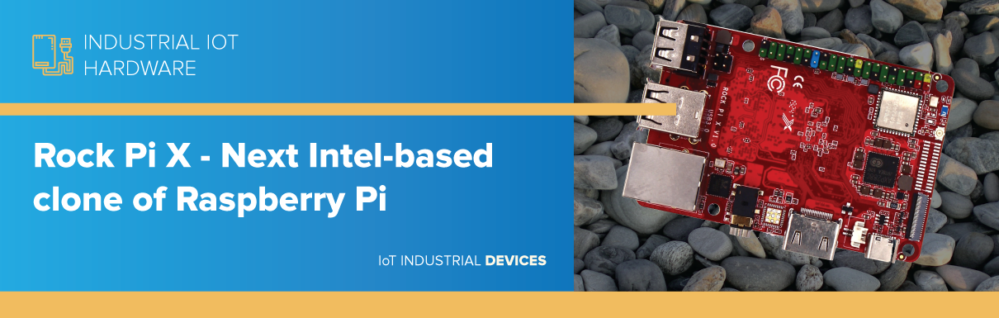


Rock Pi X - Next Intel-based clone of Raspberry Pi

Every fan of new technologies has heard of small single-board computers (SBC) in the form of Raspberry Pi. Raspberry debuted on the market in many different versions, and the current model is Model 4B. A lot of people got infected with it for DIY, programming or Linux. No wonder that many other companies are trying to replicate British success. One of them is Rock Pi, which has just presented Rock Pi X. Compared to many other SBCs available on the market, it does not use a processor based on ARM architecture, but a chip from Intel. However, it is already quite old and cheap CPU, but it translates into a low price of the device.

Next Intel-based Rock Pi X clone of Raspberry Pi
Rock Pi X (front look). Source: https://wiki.radxa.com/RockpiX

Another player on SBC market – Rock Pi X

Rock Pi X is a single-board computer with dimensions of 52 x 85 x 18 millimeters. The heart of the device is the Intel Atom x5-Z8300 processor from 2015, which has 4-cores and 4-threads clocked from 1.44 to 1.88 GHz, 2 MB Cache memory and integrated graphics Intel HD Graphics (Cherry Trail). RAM memory depends on the chosen variant and it can be 1, 2 or 4 GB DDR3L 1866 MHz. There is no built-in memory here, but there is a slot for MicroSD cards and eMMC modules. Model Rock Pi X A has no wireless connection (only RJ-45 socket), while Model B has a module 802.11ac WiFi + Bluetooth 4.2 LE.

Among the available connectors we will find one HDMI 1.4, headphone port, one USB 3.1 Gen 1, two USB 2.0, one USB type C with OTG support and a 40-pin GPIO identical to that of the Raspberry Pi. Most importantly, however, that the use of the x86 processor allows the normal installation and support of Windows 10, and not its prosthesis with the annotation ARM. However, it should be remembered that the discussed Atom was not a performance demon even at the time of its release. Rock Pi X will be available soon, suggested prices are as follows:

  • Model A 1GB RAM – $39
  • Model A 2GB RAM – $49
  • Model A 4GB RAM – $65
  • Model B 1GB RAM – $49
  • Model B 2GB RAM – $59
  • Model B 4GB RAM – $75
ModBerry M500 with Raspberry Pi’s 4

Industrial use of market SBCs

A year ago, TECHBASE released an updated version of the ModBerry M500 industrial IoT computer, replacing the aging Raspberry Pi 3 with a 3B+, giving it better performance. With the recent launch of the Raspberry Pi 4, TECHBASE has yet again, announced another upgrade to the M500, which now packs the latest single-board computer.

ModBerry M500 also utilizes many more SBC platforms, such as Orange Pi, NanoPi and Intel-based UpBoard. Find more information here: https://iiot-shop.com/product/modberry-m-series/


Raspberry Pi 4 as an alternative for gateway platform

The Raspberry Pi platform, which is no longer intended solely for educational and experimental purposes, is increasingly being promoted for Industrial IoT use. Despite few minor drawbacks of standard Raspberry Pi 4 Model B format, such as reduced working temperature range, as compared to industrial standards, RPi4 can serve as a platform for high performance computing on gateway level of installation, processing data gathered from lighter end-point units, such as ESP32-based solutions.

ModBerry M500 Gateway with Raspberry Pi 4

Raspberry Pi increase in IoT significance

More and more engineers and technology providers believe that it is suitable for industrial applications in the real world. Over the past few years, there has been a lot of discussion about the use of Raspberry Pi in industry, most of which emphasize that Raspberry Pi is a great tool for engineering experiments, but not so much for industrial applications in the real world. While it is true that the Raspberry Pi is not considered the best choice for mission-critical applications, it is also true that the Raspberry Pi is no longer a platform for experimentation.

Latest Raspberry Pi 4 development board, equipped with a 1.5GHz quad-core 64-bit ARM Cortex-A72 processor (approximately 3 times better performance than previous Cortex-A53 powering Raspberry Pi 3+ Model B and Compute Module 3 and 3+). can be chosen from 1GB / 2GB / 4GB LPDDR4 SDRAM options.

Raspberry Pi 4 continues the tradition of one of the most versatile and cheapest computer devices. It can be used for virtually anything from proprietary IoT solutions to a full-fledged desktop computer. The new Malinka has two micro-HDMI ports, a Gigabit Ethernet port, two USB 3.0 type A ports and two USB 2.0 type A ports.

Raspberry Pi 4, with 2xHDMI, Gigabit Ethernet and 2xUSB3.0

Industrial use of Raspberry Pi 4

A year ago, TECHBASE released an updated version of the ModBerry M500 industrial IoT computer, replacing the aging Raspberry Pi 3 with a 3B+, giving it better performance. With the recent launch of the Raspberry Pi 4, TECHBASE has yet again, announced another upgrade to the M500, which now packs the latest single-board computer.

Over 10 million Raspberry Pi’s have been sold and the Raspberry Pi is likely to stay as a new standard in the industry. Official Raspbian OS is free operating system based on Linux Debian optimized for the Raspberry Pi comes with over 35,000 packages, pre-compiled software bundled in a nice format for easy installation. ModBerry devices are compatible with Raspberry Pi accessories, supported by Raspberry Pi Foundation. ModBerry M500 now with Raspberry Pi 3 Model B+ / Raspberry Pi 4 Model B support.

NarrowBand-IoT the new black of Industrial IoT

The NB-IoT is becoming a standard in wireless communication of IoT devices, for standalone solutions and complex installations with thousands of units, coordinated with gateways. Will NarrowBand-IoT replace other wireless technologies in industrial automation?

What exactly is NarrowBand?

NarrowBand-IoT (NB-IoT) is a radio technology in the field of LPWAN (Low Power Wide Area Network) dedicated for IoT devices, operating on the licensed frequency band used by telecommunications operators.

The biggest advantages of NB-IoT include:

  • long battery life (up to 10 years),
  • efficiency in the amount of data transferred,
  • intra-building penetration,
  • the ability to connect even tens of thousands of devices in one system,
  • a global standard,
  • a high level of security and low cost

You can build mass solutions and those that until now were considered unprofitable. NB-IoT technology works in the licensed band, so there is no risk of interference and blocking communication by competing networks.

The service life of devices powered by two AA batteries is up to 10 years. However, the devices themselves are constructed in such a way that they can work for many years without the need for technical supervision and recharging the battery.

NB-IoT used in industrial solutions

One of many uses of NarrowBand-IoT wireless modems can be communication of edge devices, dedicated to data management, process control (e.g. with MQTT protocol) and monitoring. Latest ESP32-based eModGATE controller from TECHBASE company is a series utilizing MicroPython environment to provide data management solutions for end-points applications. The eModGATE has built-in Wi-Fi/BT modem and can be equipped with additional NarrowBand-IoT modems

eModGATE eqipped with wireless NB-IoT modem are perfect for industrial automation solutions, e.g. data logging, metering, telemetrics, remote monitoring, security and data management through all Industrial IoT applications.

Supported bandwidths:

  • Global-Band LTE CAT-M1:  B1/B2/B3/B4/B5/B8/B12/B13/B18/B19/B20/B26/B28/B39;
  • Global-Band LTE CAT NB-IoT1:  B1/B2/B3/B5/B8/B12/B13/B17/B18/B19/B20/B26/B28;
  • GPRS/EDGE 850/900/1800/1900Mhz Control Via AT Commands

Supported data transfer:

  • LTE CAT-M1(eMTC) – Uplink up to 375kbps, Downlink up to 300kbps
  • NB-IoT – Uplink up to 66kbps, Downlink up to 34kbps
  • EDGE Class – Uplink up to 236.8Kbps, Downlink up to 236.8Kbps
  • GPRS – Uplink up to 85.6Kbps, Downlink up to 85.6Kbps

TECHBASE updates M500 devices with Raspberry Pi 4

The newest addition to TECHBASE’s Industrial IoT Ecosystem is an updated ModBerry M500 with latest Raspberry Pi 4 development board, equipped with a 1.5GHz quad-core 64-bit ARM Cortex-A72 processor (approximately 3 times better performance than previous Cortex-A53 powering Raspberry Pi 3+ Model B and Compute Module 3 and 3+). ModBerry M500 can be configured from 1GB / 2GB / 4GB LPDDR4 SDRAM options.

Gigabit Ethernet & USB 3.0 on-board

Another new and appreciated feature is an upgrade to full-throughput Gigabit Ethernet for fast network connection and 2x USB 3.0 / 2x USB 2.0 for additional I/O, data storage extension and fast wireless modem support. ModBerry M500 with Rasbperry Pi 4 has dual-band 802.11ac Wi-Fi and Bluetooth 5.0 on-board. For additional wireless networks expansions, you can choose from variety of Industrial IoT modems from TECHBASE offer, incl. 3G/LTE, NarrowBand-IoT (NB-IoT), Wireless M-Bus, ZigBee, LoRa, Sigfox, Wi-Fi, Bluetooth and many more.

Enhanced Video support for RPi4

The full HDMI port has been replaced with two microHDMI ports with dual monitor support, at resolutions up to 4K, VideoCore VI graphics, supporting OpenGL ES 3.x and 4Kp60 hardware decode of HEVC video. The device is fully compatible with previous versions of Rasbperry Pi based Industrial IoT devices and accessories from TECHBASE.

Raspberry Pi 3 Model B Modberry M500

Raspberry Pi 4 based ModBerry M500 availability

New ModBerry M500 with three variants of Raspberry Pi 4 based devices is available for pre-orders via https://iiot-shop.com/product/modberry-m-series/ For specific delivery time please contact us via e-mail or Live Chat, directly at Industrial IoT Shop.

The embedded SIM card (eSIM) is a form of programmable SIM card that is directly built in the device. eSIM is a global GSMA specification that enables remote SIM delivery to any supported device, and GSMA defines eSIM as the SIM card for the next generation of connected consumer / professional devices and network solution with the use of eSIM technology.

Easy SIM operator swap

In Industrial IoT applications in which there is no need to change the SIM card, the need of using a connector is avoided, which increases reliability and data security. eSIM can be remotely configured – users can add or change operators without having to physically swap the SIM card from the device. It is often a crucial requirement for the installations where factors such as temperature, water and shock resistance, as well as lack of access forces user to choose remote solutions.

eSIM Raspberry Pi Connvectivity

Raspberry Pi & ESP32-based devices

TECHBASE company is now developing eSIM support for Raspberry Pi and ESP32 industrial devices, such as ModBerry and Moduino X to improve the handling of wireless modem connectivity. To receive an offer for ModBerry/Moduino device with eSIM-based modem, contact our Sales Department via e-mail or Live Chat.

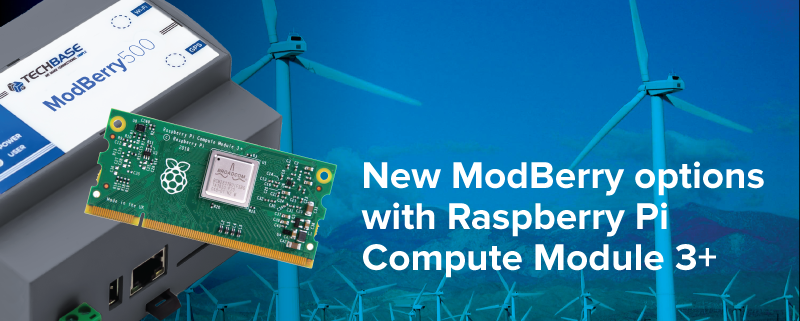
Raspberry Pi Compute Module 3+

With new Compute Module 3+ options from Raspberry Pi, we upgraded our ModBerry 500/9500 industrial computers. From now on the ModBerry 500/9500 can be supported with extended eMMC, up to 32GB. Higher memory volume brings new features available for ModBerry series.

Raspberry Pi Compute Module 3+

New Rasperry Pi’s Compute Module 3+ specs:
Processor: Broadcom BCM2837 64-bit
Core: Quad-Core ARM Cortex A53
Clock: 1.2 GHz
RAM memory: 1 GB LPDDR2
eMMC Flash memory: 8/16/32 GB (CM3 has 4GB RAM only)

RASPBERRY PI COMPATIBLE

Over 10 million Raspberry Pi’s have been sold and the Raspberry Pi is likely to stay as a new standard in the industry. Official Raspbian OS is free operating system based on Linux Debian optimized for the Raspberry Pi comes with over 35,000 packages, pre-compiled software bundled in a nice format for easy installation.

WINDOWS 10 IOT SUPPORT

Higher performance of ModBerry 500/9500 with extended eMMC flash memory, up to 32GB , powered by quad-core Cortex A53 processor allows the device to smoothly run Windows 10 IoT Core system, opening up many possibilities for data management, remote control and visualisation.

ModBerry 500/9500 devices are still available with previous Compute Module 3 (4GB RAM) and new CM3+ with 8/16/32GB RAM are available on demand. For delivery time, ask our Sales Department via Live Chat, since the small quantities of new modules are available seasonally.

SIMCom SIM7000G

TECHBASE’s Industrial IoT devices, ModBerry & Moduino series supports latest SIMCom global-band SIM7000G eMTC & NB-IoT Module. Now the latest SIM7000G as well as 7000E / 7000A versions of modem are available at IIoT-Shop.

SIMCom SIM7000G

Our ModBerry / Moduino devices equipped with latest SIM7000G modem are perfect for industrial automation solutions, e.g. data logging, metering, telemetrics, remote monitoring, security and data management through all Industrial IoT applications.

Supported bandwidths:

    • Global-Band LTE CAT-M1:  B1/B2/B3/B4/B5/B8/B12/B13/B18/B19/B20/B26/B28/B39;
    • Global-Band LTE CAT NB-IoT1:  B1/B2/B3/B5/B8/B12/B13/B17/B18/B19/B20/B26/B28;
    • GPRS/EDGE 850/900/1800/1900Mhz Control Via AT Commands

Supported data transfer:

    • LTE CAT-M1(eMTC) – Uplink up to 375kbps, Downlink up to 300kbps
    • NB-IoT – Uplink up to 66kbps, Downlink up to 34kbps
    • EDGE Class – Uplink up to 236.8Kbps, Downlink up to 236.8Kbps
    • GPRS – Uplink up to 85.6Kbps, Downlink up to 85.6Kbps

You can browse wireless modem category here: https://iiot-shop.com/product-category/modems/

Moduino X3 ESP32

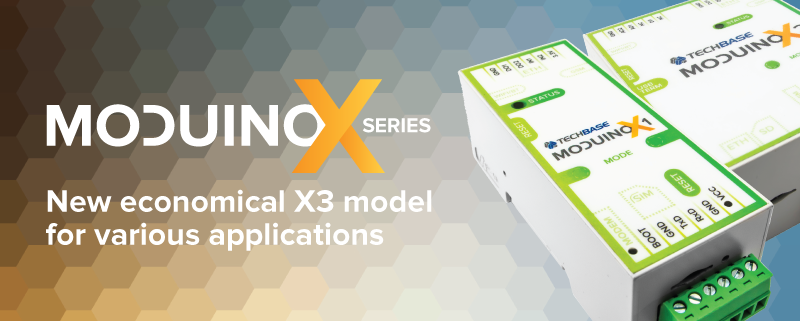
New version of Moduino ESP32, model X3 designed for various economical applications

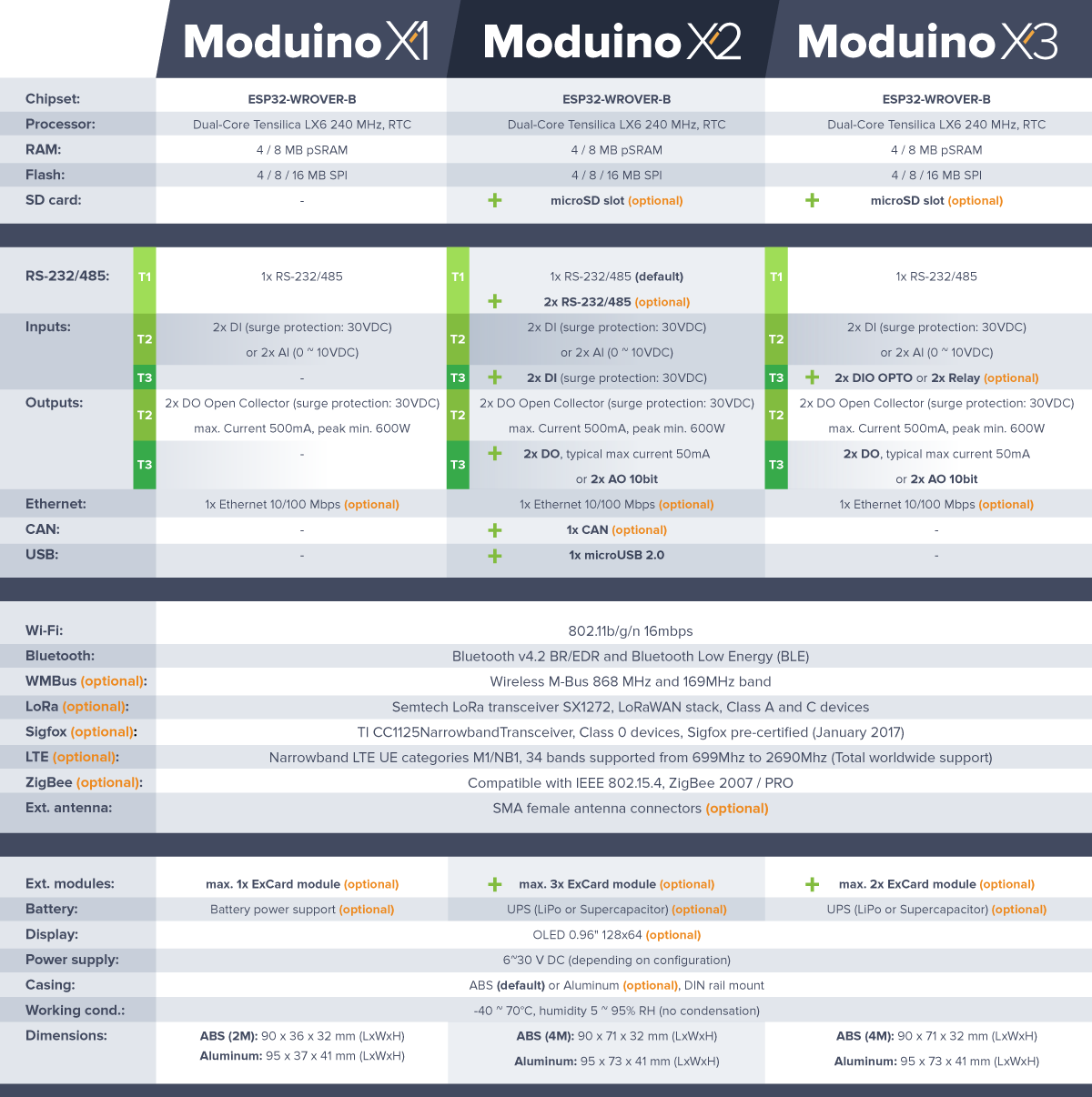
Moduino X3 model offers new approach to Industrial IoT by upgrading mainboard elements to ensure high performance and ultra-low cost of implementation. In comparison with X2 version, new X3 limits additional ExCard expansion modules, drasticly changing the price of the device, but maintaining the 3-terminal I/Os of previous model. An important change is providing opto-isolation for DIO interface (optionally interchangeable with Relay interface for that I/O).

New version of Moduino ESP32, model X3 is designed for various economical applications, such as Industrial IoT installations, data management & remote edge-devices control. Basic configurations of X3 can be purchased for a price even lower than X1/X2 models for development purposes. Please contact our Sales Department (via Chat or e-mail) to get best price for these devices.

To read more about Industrial Moduino X solution, check here: PDF datasheet

Full comparison below:

Moduino ESP32 Comparison

To order configurable devices, choose Moduino X3 option in Moduino X product configurator here:
https://iiot-shop.com/product/moduino/

ESP32-WROVER-B

Upgraded Espressif’s ESP32 module platform for Moduino X

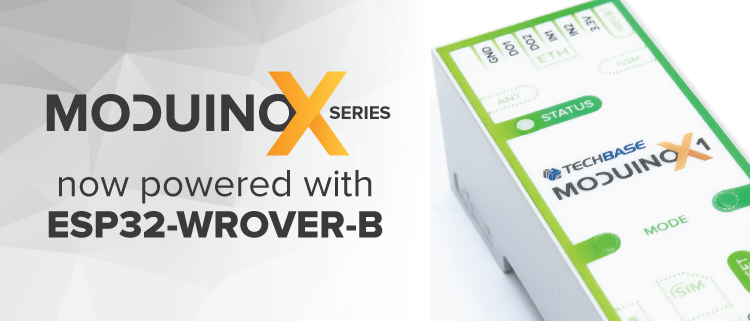
Espressif, a manufacturer of popular ESP32-based IoT solutions, has developed a new version of the ESP32-WROVER module, called ESP32-WROVER-B. Updated module, in addition to the dual-core LX6 microprocessor, has now twice the amount of RAM, compared to previous version of the WROVER module. The ESP32 module can work with Pseudo Static RAM. Up to now, modules with up to 4MB RAM have been the most common. Recently Espressif Systems introduced a new ESP32-WROVER-B module, which is equipped with up to 8MB pSRAM.

ESP32-WROVER-B

The new module is compatible with TECHBASE’s Moduino X series of IIoT devices. The system works with MicoPython, ESP-IDF (freemask based on FreeRTOS with light-weight Internet Protocol), Mongoose OS, Zephyr Project and is Arduino compatible. ESP32-WROVER-B is based on the ESP32-D0WD system with dimensions 5 x 5 mm, which replaced the earlier ESP32-D0WDQ6 (6 x 6 mm). The ESP32-D0WD model has 2 CPU cores that can be controlled independently. The CPU clock frequency can also be configured in the range of 80 to 240 MHz.

Updated Moduino X with ESP32-WROVER-B also comes with variety of Flash Memory available: 4MB and 16MB.

To read more about Industrial Moduino X solution, visit: https://moduino.techbase.eu/

To order sample devices, loor for  ESP32-WROVER-B option in Moduino X product configurator module: