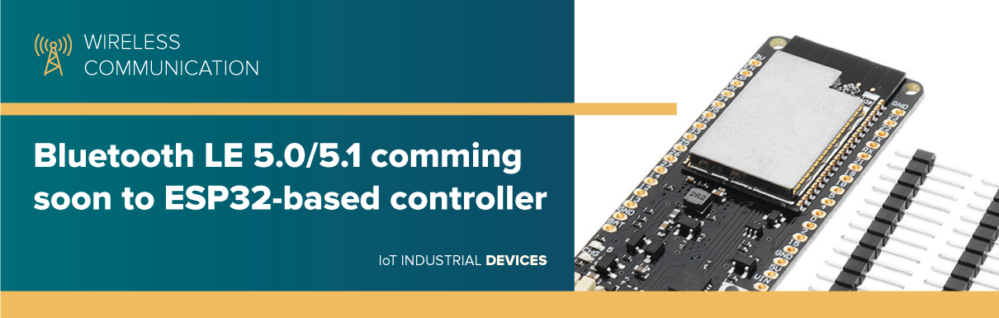
The Espressif’s flagship ESP32 chip recently passed the SIG Bluetooth LE 5.0 certification. This confirms that the version of the protocol supported by the ESP32 microcontroller has been upgraded from Bluetooth LE 4.2 to Bluetooth LE 5.0, which is more stable and compatible.
The implementation and development of the Bluetooth LE (BLE) application requires not only a system that supports this function, but also an attached Bluetooth LE protocol stack consisting of a driver and a host.
Bluetooth 5.0 update for ESP32
Thanks to Bluetooth LE 5.0 certification, ESP32 SoC not only updates the system as a whole, but also adds new features that improve the latest software after passing more stringent tests than previous certification.
Due to hardware limitations, ESP32 does not support such functions of Bluetooth LE 5.0 as 2M PHY, LE Long Range, and ADV Extensions.
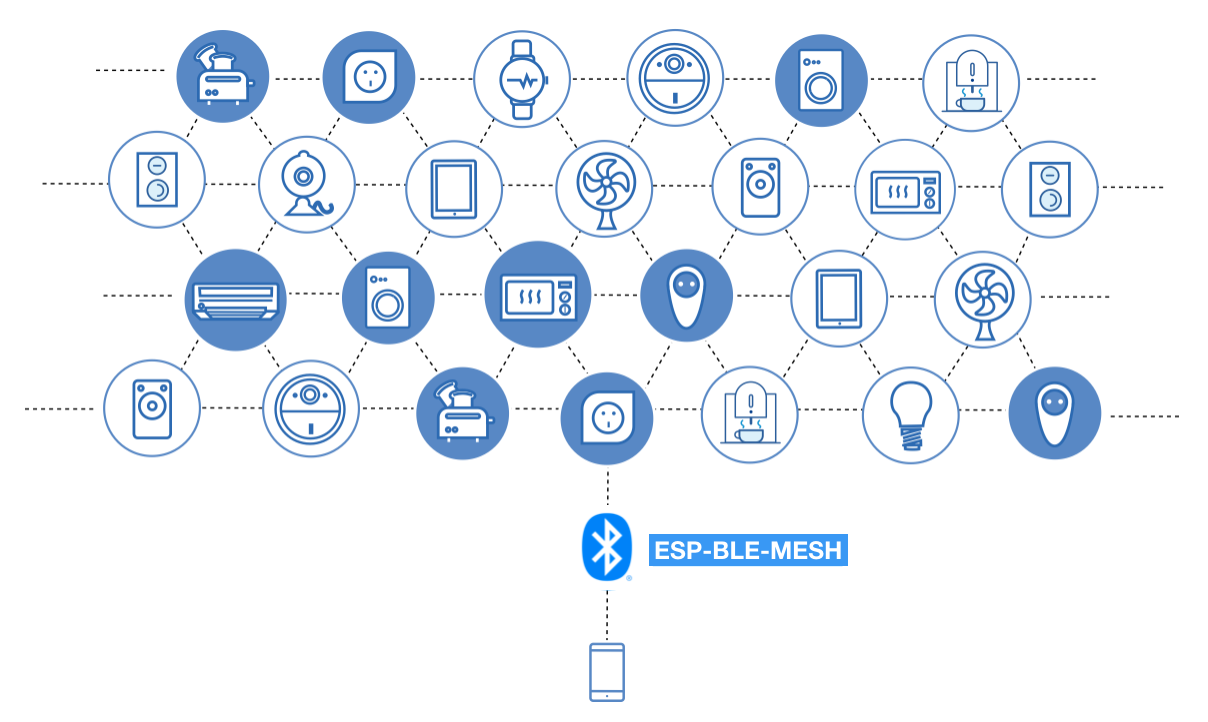
It is also worth mentioning that the combination of Bluetooth and Mesh networking is expected to become a key technology for the Internet of Things. A Bluetooth® Mesh network enables a „many-to-many” relationship among potentially thousands of wireless devices, where data are transmitted not in a direct radio range but in wide physical areas. Espressif’s contribution in this field is the ESP-BLE-MESH, which got fully certified by Bluetooth SIG in September 2019.
Several Bluetooth-operated products on the market, such as wearable devices, smart speakers, cleaning robots, smart lights/sockets, etc., provide evidence that Bluetooth 5.0 and the Bluetooth Mesh networking technology are mature enough to drive the development of interconnected IoT devices. To this end, Espressif’s chips and ESP-BLE-MESH, in particular, are designed to help customers develop easily secure and cost-effective products for smart homes, smart buildings, healthcare, new automobiles and other smart industries.
One of industrial IoT devices, supporting Espressif’s ESP32 technology is eModGATE from TECHBASE. Economical, ESP32-based solution can serve as an end-point in any installation or works well as a gateway, gathering data from scattered sensor mesh across the installation. For more information check Industrial IoT Shop with all the configuration options for eModGATE.
https://iot-industrial-devices.com/wp-content/uploads/2020/01/bluetooth-5-0.png3851210adminhttps://iot-industrial-devices.com/wp-content/uploads/2019/11/iot-industrial-devices-1.pngadmin2020-01-17 12:43:162020-01-17 12:43:18Bluetooth LE 5.0/5.1 comming soon to ESP32-based controller
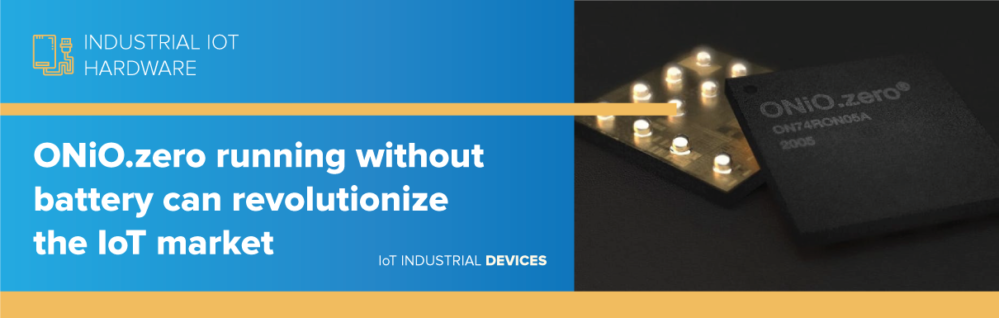
ONiO, a Norwegian specialist in the field of the Internet of Things (IoT) for the medical industry, announced ONiO.zero, a RISC-V-based microcontroller with very low power consumption, which can work completely from the energy harvested from the environment. ONiO claims that its design can take energy from the radio spectrum and operate up to 24 MHz.
„ONiO.zero is a wireless MCU with very low power consumption, which uses energy acquisition technology,” wrote the company about its creation. This means that ONiO.zero only works on ambient energy. There are no coin cells, supercaps, lithium and batteries, but still offers a lot of performance.
Battery-based solutions have an unavoidable warning about battery replacement. This leads to increased costs over the entire lifetime. ONiO.zero avoids this problem and reduces operating costs. ONiO.zero is self-powered and supports a wide range of power sources, from multi-frequency RF bands supporting GSM and ISM to optional external sources such as solar, piezoelectric, thermal and voltaic.
The microcontroller itself is based on the architecture of the RISC-V instruction set of the open source type (in particular RV32EMC) and operates up to 24 MHz with a supply voltage of 1.8 V. The controller will work if necessary with lower voltages. You can get 6 MHz at 1 V and 1 MHz at 0.8 V, and the system still runs slower, but as fast as 450 mV. Includes 1 KB ROM and 2 KB RAM, as well as 8-32 KB of ultra low power flash memory, capable of 100,000 read and write cycles up to 850 mV.
ONiO.zero contains a crystalline Low Energy Bluetooth transmitter (BLE) that can operate at a voltage as low as 850mV, an IEEE 802.15.4 (UWB) broadband transmitter operating in the 3.5-10 GHz band, and optional radio transmitter 433 MHz MICS for the industrial, scientific and medical band (ISM).
ONiO.zero hasn’t been released yet. For more information check the ONiO.zero product page.
Battery-ready IoT devices based on ESP32
Battery / SuperCap power support allows the processes and data to be securely executed, saved or transferred, and the operating system to be safely shutdown or reboot, if the power source has been restored. The power failure alert can also be sent to cloud service, to perform custom task, specified by user or self-learning AI algorithm.
The Moduino device is a comprehensive end-point controller for variety of sensors located throughout any installation. It fully supports temperature and humidity sensors and new ones are currently developed, e.g. accelerometer, gyroscope, magnetometer, etc.
Moduino–ModBerry symbiosis allows wide range of wake-up/sleep schedule customization, in order to perform best and save energy accordingly to power supply state. Arduino and MicroPython environments provide libraries to control different scenarios of data and power management.
With built-in algorithms and the possibility to program on your own, the TECHBASE’s sleep/wake addon module can wake the device using schedule/timer. Another option is wake on external trigger, e.g. change of input, etc. All the options for sleep, shutdown and wake can be configured for various scenarios to ensure constant operation of devices, safety of data and continuity of work in case of power failure in any installation.
https://iot-industrial-devices.com/wp-content/uploads/2020/01/onio-zero-iot.png3851210adminhttps://iot-industrial-devices.com/wp-content/uploads/2019/11/iot-industrial-devices-1.pngadmin2020-01-14 11:26:042020-01-14 11:26:41ONiO.zero running without battery can revolutionize the IoT market
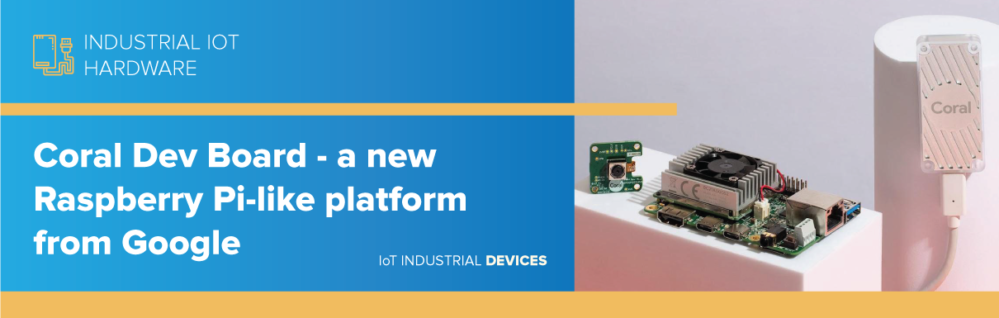
The Coral platform launched by Google is expected to contribute to the easier creation of systems in the field of the Internet of Things. During CES 2020, the manufacturer will devote a lot of attention to her.
Google presented a new, miniature accelerator module for the Coral platform. The sensor has dimensions of only 10×15 mm, so it is smaller than the American one-cent coin. Coral is a Google platform created to facilitate the construction of equipment compatible with the Internet of Things technology, equipped with artificial intelligence.
Components produced by Google have already been used to create many intelligent systems used, for example, in healthcare, agriculture or technologies supporting the functioning of cities. Coral works well also in offline mode and with limited connectivity. The new module is expected to increase its functionality.
The Coral Dev Board together with the USB and PCIe accelerator went on sale in 2019, and is now being sold in 36 countries. We can expect many innovations related to this technology during CES 2020. Google announces that it has prepared various demonstrations of the new module capabilities for this meeting.
Google’s Coral Dev Board
Coral Dev Board
Unlike popular single board, Raspberry Pi or Raspberry’s Chinese competitors, according to Google, Coral Dev Board is to be a specialized computer – it is primarily targeted at developers who want to have a device on which algorithm learning is possible. The computer is running Mendel Linux built on Debian, we will also find Tensor Flow Lite libraries with ready-to-compile models. No internet connection is required in the learning process – the entire process is done locally.
From the hardware side, the most important here is the Edge TPU coprocessor – a Google tensor system designed to be used together with the Tensor Flow library used in machine learning. In addition, the board got the ARM 4-core NXP i.MX 8M processor, GC7000 Lite Graphics, as much as 1 GB of RAM (LDPRR4) and 8 GB of eMMC memory. Coral connects to other devices via Wi-Fi oral USB Accelerator and Bluetooth 4.1.
Therefore, it cannot be said that, compared to other SBC Coral, it is hardware limited. What’s more, it has a microSD card slot, two USB type C sockets (one for power supply, the other for data transfer), minijack output, HMDI output, GPIO pins. The device can also be connected to the Internet via a cable with an RJ-45 plug. It is also possible to buy a camera useful in machine learning image processing algorithms.
Industrial use of Raspberry Pi-like development boards
Introduced in November 2017, the ModBerry M300 series, based on NanoPi NEO revolutionised the economic segment of Industrial IoT devices and proved, that automation and monitoring can be done effectively with low expenditure on industrial installations.
ModBerry M300 O1 based on OrangePi Zero Plus features Allwinner H5 (Quad-core Cortex-A53) SoC, moderate 512MB RAM, storage memory option with microSD slot, USB and Gigabit Ethernet port. The wireless communication is supported with onboard Wi-Fi module.
Offering much higher performance and wider feature range, the ModBerry M300 O2 features same SoC as M300 series, but thanks to OrangePi Zero Plus2 means, the device is equipped with onboard 8GB eMMC, extra microSD expansion slot as alternative and wired/wireless interfaces, e.g. HDMI, Wi-Fi, Bluetooth 4.0.
https://iot-industrial-devices.com/wp-content/uploads/2020/01/iiot-google-coral.png3851210adminhttps://iot-industrial-devices.com/wp-content/uploads/2019/11/iot-industrial-devices-1.pngadmin2020-01-13 10:39:002020-01-13 10:42:15Coral Dev Board - a new Raspberry Pi-like platform from Google
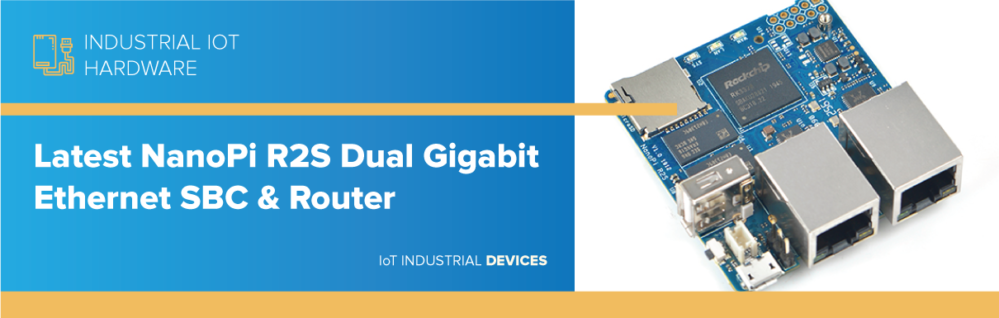
The new NanoPi R2S is based on the Rockchip RK3328 processor, adding system memory, including 1 GB DDR4 RAM, and is designed to support 4G LTE via the Huawei 8372H-155 USB dongle. R2S is equipped with two Gigabit Ethernet ports (with one deployed for WAN and the other for LAN). This board can surely be used in industrial and Internet of Things (IoT) applications.
Most features resemble an update, but NanoPi R2S does not have built-in Wi-Fi for unknown reasons and certainly seems to be a downgrade. However, instead of built-in WiFi, friendlyELEC recommends using the RTL8821CU USB dongle, which is immediately supported with the default firmware.
NanoPi R2S specifications:
SoC – Rockchip RK3328 quad-core Cortex-A53 @ 1.5 GHz with Arm Mali-450MP2
System Memory – 1GB DDR4 RAM
Storage – MicroSD Slot, SPI flash footprint
1x Gigabit Ethernet (WAN) up to 941 Mbps (measured)
1x Gigabit Ethernet (LAN) up to 941 Mbps (measured) via Realtek RTL8153 USB 3.0 to Ethernet controller
USB – 1x USB Type-A host port, 1x micro USB port (power + slave)
Debugging – 3-pin 2.54mm pitch header for serial console
Expansion – 10-pin GPIO header with GPIOs, I2C, UART, IR_Rx, 5V, 3.3V and GND
Industrial use of previous OrangePi development boards
Introduced in November 2017, the ModBerry M300 series, based on NanoPi NEO revolutionised the economic segment of Industrial IoT devices and proved, that automation and monitoring can be done effectively with low expenditure on industrial installations.
ModBerry M300 O1 based on OrangePi Zero Plus features Allwinner H5 (Quad-core Cortex-A53) SoC, moderate 512MB RAM, storage memory option with microSD slot, USB and Gigabit Ethernet port. The wireless communication is supported with onboard Wi-Fi module.
Offering much higher performance and wider feature range, the ModBerry M300 O2 features same SoC as M300 series, but thanks to OrangePi Zero Plus2 means, the device is equipped with onboard 8GB eMMC, extra microSD expansion slot as alternative and wired/wireless interfaces, e.g. HDMI, Wi-Fi, Bluetooth 4.0.
The term Internet of Things is used to describe physical objects that have sensors that enable data acquisition and communicate with each other and the Internet. They belong to the following categories:
Wearable sensors – sensors built into clothing or smartphones and smart watches
Medical parameter sensors for monitoring health
Sources of geoinformation, allowing to determine the location of objects and people
Sensors of physical parameters of the environment, e.g. temperature, pressure, insolation, dust
Sensors for the operation of technical devices, e.g. measuring power consumption, performance, including specialized sensory networks in industrial installations.
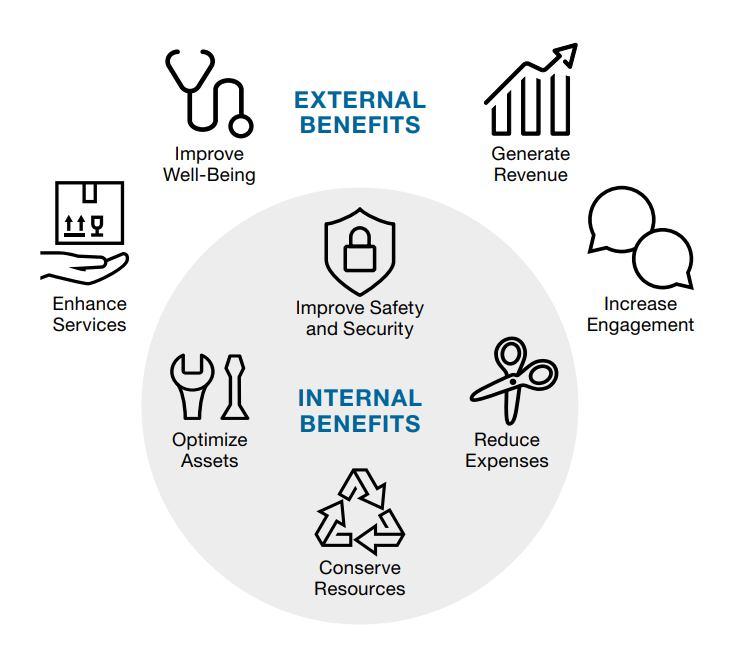
Other factors that contribute to the popularity of IoT are the versatility of use (e.g. intelligent buildings and cities, healthcare, trade, sport) as well as the benefits obtained through their implementation, e.g. streamlining the delivery process, loss prevention, and improving customer experience. Therefore, we can expect a growing number of new IoT solutions appearing on the market for various sectors. Gartner estimates that IoT product and service providers will generate growing revenue of $300 billion in 2020.
The Internet of Things (IoT) has rapidly become one of the most familiar — and perhaps most hyped — expressions across business and technology. We expect to see 20 billion internet-connected things by 2020. These “things” are not general-purpose devices, such as smartphones and PCs, but dedicated-function objects, such as vending machines, jet engines, connected cars and a myriad of other examples. The IoT will have a great impact on the economy by transforming many enterprises into digital businesses and facilitating new business models, improving efficiency and increasing employee and customer engagement.
With new possibilities, new challenges arise, such as the creation of an unprecedented amount of data. According to Oracle, there will be 40 trillion GB of IoT data by 2020.
Open source IoT solutions rushing gaining market
Referring to the results of the 2016 Future of Open Source Survey conducted by Black Duck and North Bridge, 65% of companies increased the use of open source solutions in 2016 compared to 2015. Not only small and medium enterprises use open source solutions. Open source solutions and technologies are used by large international corporations. They see no need to pay for solutions and services that they can use virtually free. Employing only people with appropriate qualifications.
Large corporations are not interested in paying for server logos, network devices, or mass storage. Instead of buying equipment from well-known suppliers, they prefer to set up an order in companies in East Europe and Asia. Companies where devices are designed and assembled (ODM original-design manufacturers).
Software-as-a-Service will be standard
As for IoT application trends, Software-as-a-Service is seen as a hot topic of discussion. SaaS is a service model. In this model, the service provider provides the desired application and makes it available to clients via the Internet. This helps organizations to outsource IT applications.
These Internet of Things trends provide companies with a marketing platform to promote their products. To this end, Stewart Butterfield, co-founder of Slack, a cloud-based instant messaging platform, said:
Every interaction with the customer is a marketing opportunity. When you go beyond the customer service page, people are more likely to recommend you.
SaaS is the preferred choice for the IT gaming industry due to the low investment cost. The emergence of SaaS has significantly contributed to the development of technology. When this trend of the Internet of Things appears on the market, people’s lives are better than ever.
From the end of 2017 to 2018, artificial intelligence-specific processors (AI) began to appear on mobile devices. The goal is to make smartphones more intelligent. As GPUs shrink, AI-related equipment becomes necessary for the Internet of Things.
Support for enterprises from platforms such as Google TensorFlow will be introduced in 2020 with equipment adapted to artificial intelligence. TensorFlow is already optimized for mobile devices and can be quickly launched on single-board computers. In many ways, AI frameworks are better than other mobile frameworks, such as ReactJS. The AI structure is not designed to work with the user interface. It’s perfect for the Internet of Things.
Until the end of 2020, artificial intelligence will be as important for IoT devices as the cloud.
https://iot-industrial-devices.com/wp-content/uploads/2020/01/industrial-iot-trends-2020.png3851210adminhttps://iot-industrial-devices.com/wp-content/uploads/2019/11/iot-industrial-devices-1.pngadmin2020-01-06 10:40:002020-01-14 10:57:20Edge of 2020 in Industrial IoT - forecast
FriendlyElec has launched a new NanoPi microcomputer that can be used in Internet of Things (IoT), automation and storage projects. The NanoPi NEO2 Black measures 40 x 40 mm, weighs 16 grams, and is equipped with an Allwinner H5 four-core processor with ARM Mali-450MP GPU, 1GB DDR3 memory, and has a connector for an eMMC storage module and a slot for a microSD card.
This microcomputer also has two 6-pin and 10-pin connectors, a USB 2.0 socket, a microUSB OTG socket, and a Gigabit Ethernet port (RTL8211E-VB-CG chip). NanoPi NEO2 Black, which can use Armbian, Ubuntu 18.04 (FriendlyCore) and OpenWrt (FriendlyWrt) operating systems, is available to order with a price starting at $ 19.99.
NanoPi NEO2 Black Layout
NanoPi NEO2 Black specifications:
SoC – Allwinner H5 quad-core Cortex A53 processor with an ARM Mali-450MP GPU
Variety of supported IoT accessories from FriendlyElec
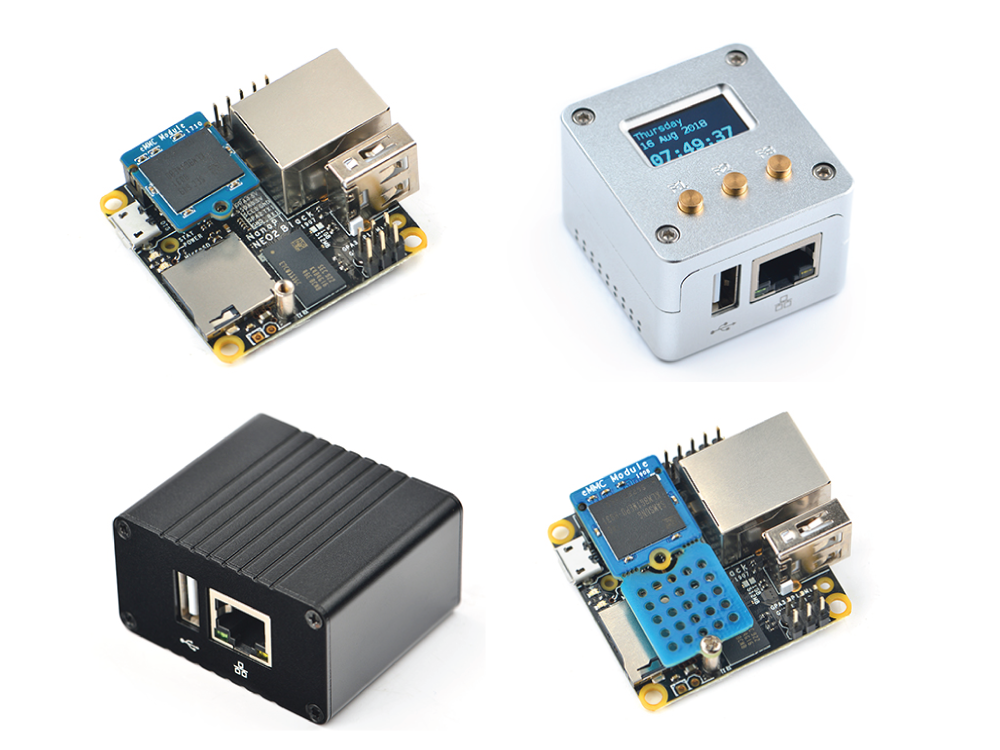
FriendlyElec released plenty of compatible accessories for NanoPi NEO2 Black, including additional eMMC modules, OLED hats and ready-to-use alluminum cases to speed up the implementation.
eMMC Modules, compatible alluminum cases and dedicated OLED accessories for NanoPi NEO2 Black
Industrial use of previous OrangePi development boards
Introduced in November 2017, the ModBerry M300 series, based on NanoPi NEO revolutionised the economic segment of Industrial IoT devices and proved, that automation and monitoring can be done effectively with low expenditure on industrial installations.
ModBerry M300 O1 based on OrangePi Zero Plus features Allwinner H5 (Quad-core Cortex-A53) SoC, moderate 512MB RAM, storage memory option with microSD slot, USB and Gigabit Ethernet port. The wireless communication is supported with onboard Wi-Fi module.
Offering much higher performance and wider feature range, the ModBerry M300 O2 features same SoC as M300 series, but thanks to OrangePi Zero Plus2 means, the device is equipped with onboard 8GB eMMC, extra microSD expansion slot as alternative and wired/wireless interfaces, e.g. HDMI, Wi-Fi, Bluetooth 4.0.
UBPorts community has released an update claiming to support Ubuntu Touch running on a Raspberry Pi 3 with an official 7-inch Raspberry Pi touchscreen. The Raspberry Pi is growing as the Ubuntu Touch programming platform, says UBports founder Marius Gripsgård in the attached video below. However, there was no demo. In this film, UBports creator Florian Leeber added that the Raspberry Pi platform can also serve as the home touch interface for the Internet of Things and other applications.
The key to Pi support is the recent merger of the libhybris project and ARM64 at the “edge” that points to the repository used by the project. This should also facilitate portability to other Arm-based platforms.
A new feature of Ubuntu Touch is the ability to run a Mir display server in Wayland using the Wayland protocol. It is said to enable user session suspension, save battery life, and improve security and privacy. This work has improved the handling of Bluetooth headsets with the upgrade to the BlueZ Bluetooth daemon and PulseAudio patch.
Ubuntu Touch’s way to 64-bit IoT applications
Ubuntu Touch is a special version of Ubuntu, which was designed for mobile devices with touch screens, and more specifically for smartphones and tablets. Unfortunately, Ubuntu was abandoned before conquering the market. However, as is the case in the Open Source world, someone has taken over and developed this project. Ubuntu Touch has just been released in the 64-bit version.
Just two years ago, Canonical was working hard on the Unity8 graphics environment and the Mir display server. Work on these projects was already in a fairly deep stage, and the British giant was tempted to add Unity8 to one of the Ubuntu versions. Unfortunately, at this point the environment was – to put it mildly – infinite and did not work very well (at least in my case). How does it connect with Ubuntu Touch? Well, Ubuntu Touch also used Unity8 and Mir, and both platforms – Desktop PC and mobile – were to be unified. Unfortunately, to the surprise of project enthusiasts, Canonical decided to abandon their work and after a few years of separation return to GNOME and leave the mobile world completely.
It is true that Canonical abandoned their projects, but there was another team that wanted to take them in. We are talking about the UBports group, which is gradually updating Ubuntu Touch and spending them on new models.
After months of announcements, the Ubuntu Touch project finally got a 64-bit compilation. Earlier, even operating on a suitable processor, this system operated only in 32-bit mode. This is a big step forward, although the compatibility list typically fails.
The change in the UI range will only be introduced by the OTA-12 update, anticipated for an undefined future. But with Ubuntu Touch 64-bit debuts Telegram client – TELEports 0.6.0.
The creators admit that they delayed 64-bit binaries, considering them unnecessary, especially for equipment with less than 4 GB RAM. Now, however, according to new observations, they have changed their minds. Of course, the system itself is not everything. You still need to recompile the apps. But this is to take place successively, based on the base in the form of an already operating system.
Ubuntu Touch for Raspberry Pi Compute Module?
Will Raspberry Pi Compute Module powered solutions get a support for Ubuntu Touch? Maybe the transition to 3rd party devices will be seamless, because of Ubuntu Touch already working on official Raspberry Pi 7-inch display. Similiar soliutions, such as TECHBASE’s TECHPANEL P500 with Compute Module 3/3+ support might be the first device with fully working Ubuntu Touch.
https://iot-industrial-devices.com/wp-content/uploads/2019/12/ubuntu.png3851210adminhttps://iot-industrial-devices.com/wp-content/uploads/2019/11/iot-industrial-devices-1.pngadmin2019-11-28 15:12:002019-12-05 15:39:43Ubuntu Touch for Raspberry Pi 7-inch display
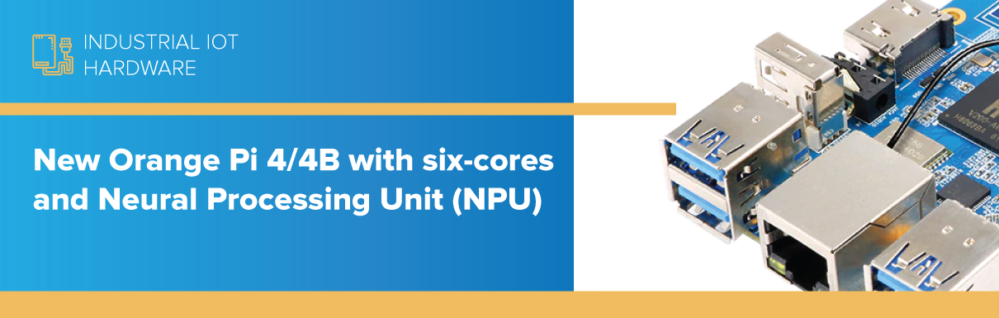
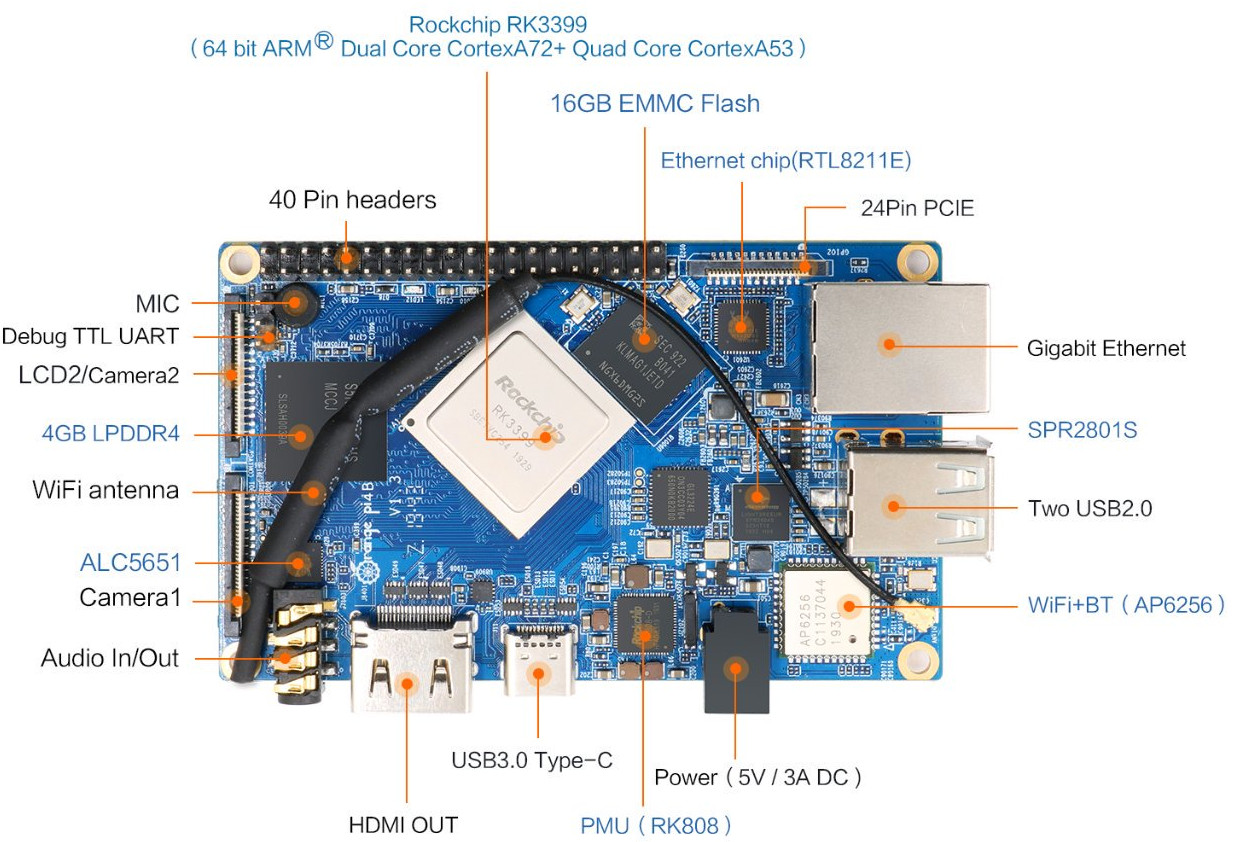
Shenzhen Xunlong Software recently introduced a new Orange Pi microcomputer. According to information provided by the Chinese company, the Orange Pi 4 measures 91 x 56 mm and features a Rockchip K3399 six-core system-on-chip SoC (ARM Mali-T860 MP4 GPU, 4GB of LPDDR4 memory, 16GB of storage). eMMC (expandable via a microSD card), a 24-pin connector, and a 40-pin General-purpose input / output (GPIO) connector.
Orange Pi 4 six-core system
Orange Pi 4B with Neural Processing Unit (NPU)
This microcomputer is also equipped with two camera connectors, one USB 3.0 jack, two USB 2.0 jacks, one USB 3.0 Type-C jack, HDMI 2.0, Gigabit Ethernet and 3.5mm audio jacks, and includes support for Wi-Fi 802.11ac and Bluetooth 4.1 LE.
The secondly introduced Orange Pi 4B model includes a Gyrfalcon Lightspeeur SPR2801S Neural Processing Unit (NPU), two USB 2.0 sockets, as well as a USB 3.0 Type-C socket.
Orange Pi 4/4B preliminary specifications:
SoC – Rockchip K3399 hexa-core big.LITTLE processor with two Arm Cortex A72 cores, four Cortex A53 cores, and an ARM Mali-T860 MP4 GPU with support for OpenGL 1.1 to 3.1 support, OpenVG1.1, OpenCL and DX 11
System Memory – 4 GB LPDDR4
Storage – 16 GB eMMC flash, micro SD card
NPU (Orange Pi 4B only) – Gyrfalcon Lightspeeur SPR2801S NPU delivering up to 2.8TOPS @ 300mW, 5.6 TOPS @ 100 MHz (peak performance)
Video Output/Display Interface
HDMI 2.0 up to 4K @ 60 Hz
LCD connector for MIPI DSI display
USB-C port with DisplayPort Alternate mode
Video Decode – 4K VP9 and 10-bit H.265 video codec support up to 60 fps
Audio – 3.5mm audio jack for headphones; HDMI digital audio output; built-in microphone; ALC5651 codec
Connectivity – Gigabit Ethernet port (via RTL8211E transceiver), dual-band 802.11ac 2×2 MIMO WiFi and Bluetooth 5.0 (Ampak AP6256 module)
USB
Orange Pi 4 – 1x USB 3.0 port, 2x USB 2.0 host ports, 1x USB 3.0 type C port
Orange Pi 4B – 2x USB 2.0 host ports, 1x USB 3.0 type C port
Industrial use of previous OrangePi development boards
Introduced in November 2017, the ModBerry M300 series, based on NanoPi NEO revolutionised the economic segment of Industrial IoT devices and proved, that automation and monitoring can be done effectively with low expenditure on industrial installations.
ModBerry M300 O1 based on OrangePi Zero Plus features Allwinner H5 (Quad-core Cortex-A53) SoC, moderate 512MB RAM, storage memory option with microSD slot, USB and Gigabit Ethernet port. The wireless communication is supported with onboard Wi-Fi module.
Offering much higher performance and wider feature range, the ModBerry M300 O2 features same SoC as M300 series, but thanks to OrangePi Zero Plus2 means, the device is equipped with onboard 8GB eMMC, extra microSD expansion slot as alternative and wired/wireless interfaces, e.g. HDMI, Wi-Fi, Bluetooth 4.0.
https://iot-industrial-devices.com/wp-content/uploads/2019/11/orange-pi.png3851210adminhttps://iot-industrial-devices.com/wp-content/uploads/2019/11/iot-industrial-devices-1.pngadmin2019-11-25 15:05:002019-11-27 15:07:25New Orange Pi 4 with six-core system and 4B with Neural Processing Unit (NPU)
Like other embedded systems, Industrial IoT design faces a constant stream of threats. As hackers adopt new attacks, developers rush to close security holes. Deployed devices need to update IoT firmware, increasing potential security vulnerabilities. For example, using a simple firmware verification check can leave the software published. In this situation, the developer may expect to be able to query external resources for verification and catch attempts to replace the firmware with hacked code. However, even relatively novice hackers can replace the firmware with code that ignores such verification checks. To secure these vurnerabilities comes Industrial Grade TPM 2.0.
Securing devices with Infineon industrial grade TPM
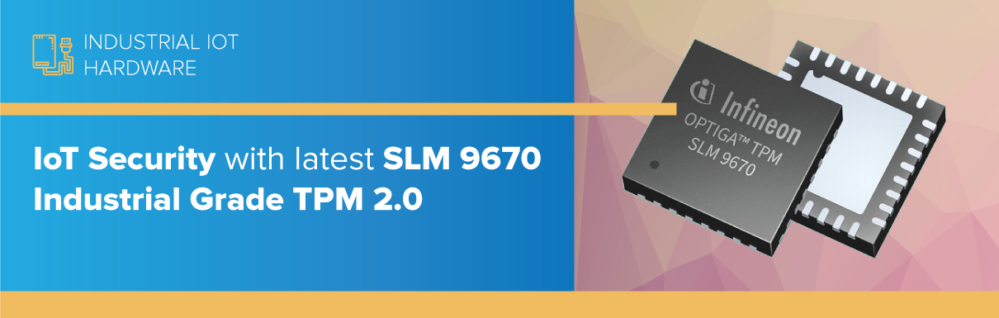
Infineon Technologies AG has unveiled a new security chip that defines the first TPM (Trusted Platform Module), designed specifically for industrial applications such as industrial computers, servers, industrial controllers and edge gates. The module protects confidential data in connected devices and reduces the risk of leakage of this information due to attacks, e.g. hackers.
The OPTIGA TPM SLM 9670 module protects the integrity of industrial systems and the identity of users using them. The system controls access to sensitive data at key locations in industrial environments, such as an automated factory. It also protects the cloud interface if the network uses one. The security system fully meets the TPM 2.0 standard developed by the Trusted Computing Group and is certified by an independent test laboratory in accordance with the criteria contained in this standard. The new module is meticulously controlled and certified by Infineon. Thanks to its use, it is possible to shorten the time of designing and introducing the device to the market, thanks to the ready security solution in the system.
The TPM system has a lifetime declared as 20 years. It allows programmers to perform firmware updates, which in turn enables them to meet the long-term security requirements in rapidly changing industrial environments. In this way, it can also reduce maintenance costs of industrial equipment thanks to secured remote software updates. The TPM chip will be available in serial production in the second half of 2019.
TPM 2.0 Key Features
Random Number Generator (RNG) according to NIST SP800-90A
TPM FW update functionality installed
6962 Bytes of free NV memory
Full personalization with Endorsement Key (EK) and EK certificate
Up to 3 keys in the volatile memory
Up to 7 keys in the NV memory
Up to 8 NV counters
Support of various cryptographic algorithms:
RSA-1024 and RSA-2048
SHA-1 and SHA-256
ECC NIST P256
ECC BN256
Security chip implementation in Industrial IoT devices
With knowledge of latest Industrial IoT security measures, the choice of proper end-point conroller or gateway is much easier than you think. Some manufacturers can implement TPM 2.0 security chip in production process, to allow users to generate certification keys after purchase, maximizing security of their installations. TECHBASE offers wide range of solutions, optionally aided with TPM system.
eModGATE with ESP32
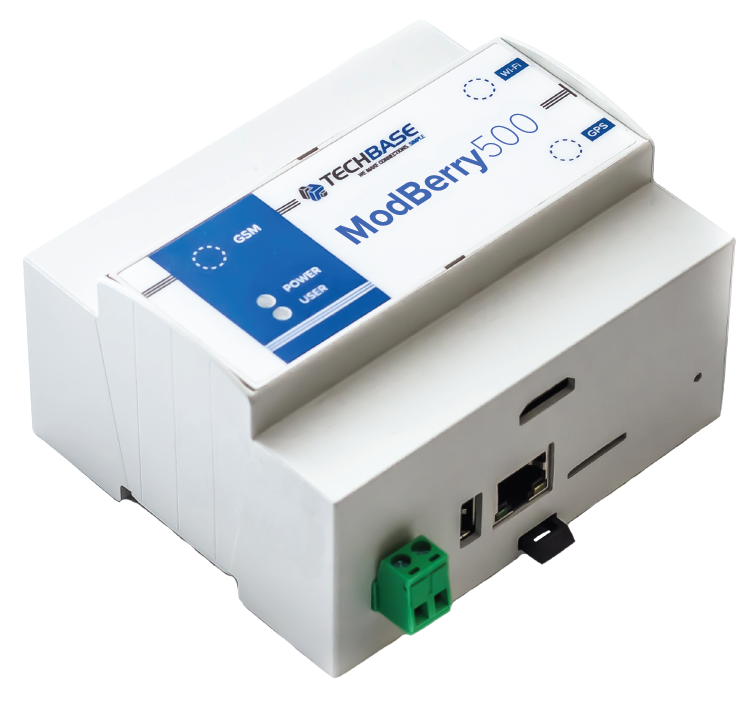
ModBerry 500 with Raspberry Pi’s Compute Module 3+
Industrial devices with TPM 2.0 support
For example, ESP-32 based solution, Moduino X series and eModGATE series products offer the support for such security measures. Read more in Industrial IoT Ecosystem brochure, to understand the importance of reliable and secure hardware for Industrial IoT.
UPDATE 22.10.20: ModBerry 500 with Compute Module 4 available for pre-order
TECHBASE’s ModBerry industrial computer series has received an update to Compute Module 4 and is available for pre-orders. TECHBASE is leading manufacturer of Industrial Raspberry Pi and Industrial Compute Module solutions. ModBerry 500 series is fully compatible with all releases of Compute Module from Rasbperry Pi foundation.
Main features of updated device are:
up to 4x faster eMMC Flash with up to 32GB storage
up to 2x faster performance of CPU apllications than previous CM3 version
up to 8x more RAM (8GB LPDDR4)
optional 1Gbit Ethernet interface
optional PCIe card support for NVMe SSD drive (via M.2)
optional second PCIe support for wireless modem solutions
First orders will be ready with subject to the availability of the CM4 module itself.
Update on Raspberry Pi’s Compute Module 4 features [15.10.2020]
According to latest leaks about Compute Module 4 specifiaction and features we can be more than sure that:
New Compute Module will feature Wi-Fi and Bluetooth on-board! Raspberry Pi Compute Module series will probably include versions with and without these modems to provide modules for variety of industrial applications.
PCI-Express line will be available externally to enable extension support via PCIe
Ethernet support will be enabled, most probably 1Gbps, since it is a standard in latest Raspberry Pi 4B.
It a matter of time before we will see Raspberry Pi Compute Module 3+ successor, probably called Compute Module 4, a new milestone of professional embedded IoT module. What might be the specification of this highly expected development board? What changes will it bring to Industrial use of IoT?
We are witnessing the fourth industrial revolution. Its key element is to create systems of interconnected sensors and actuators that operate within one global network. The so-called Internet of Things, unlike the consumer market, meet much more difficult requirements. To be able to meet harsh industrial expectations, many automation companies have already begun to offer solutions especially tailored to the application of the Internet of Things in Industry 4.0.
Although it may seem quite obvious nowadays, it is worth to be aware that just a few years ago such algorithms were practically not implemented at all in small consumer devices. It was only when people got used to smartphones that the idea of ubiquitous communication and adaptation of the way the system or device works to the environment became understandable. In fact, this confirms the validity of the idea of the Internet of Things as an important direction in the development of electronics – and in practice also automation.
Raspberry Pi is gaining recognition in Industry
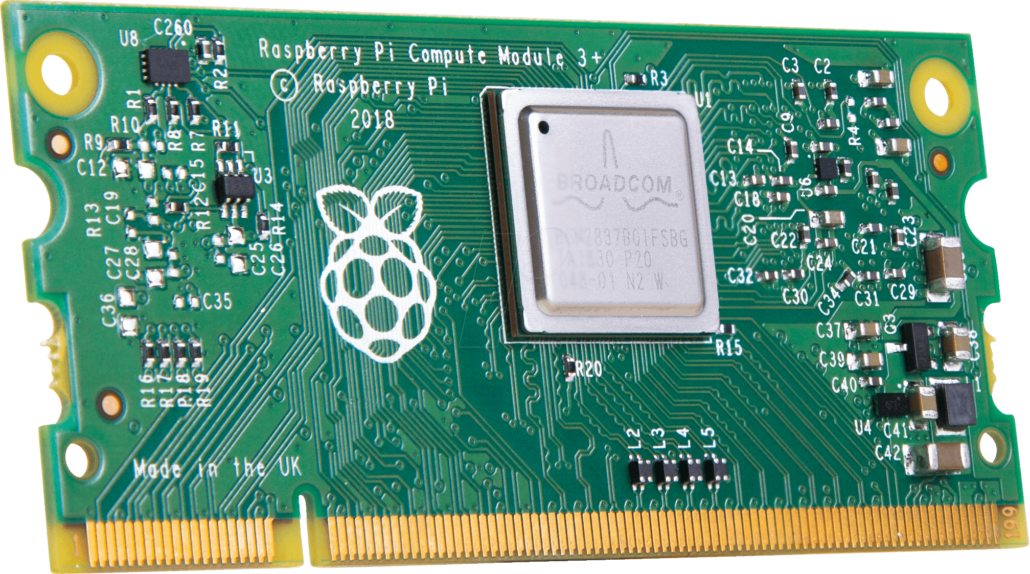
Almost a year ago, in the beginning of 2019, Raspberry Pi Foundation presented Raspberry Pi Compute Module 3+, a successor to previous CM3 version of development board, aimed at businesses and industrial users. The Compute Module uses a standard DDR2 SODIMM (small outline dual in-line memory module) form factor. GPIO and other I/O functions are routed through the 200 pins on the board.
Raspberry Pi Compute Module 3+
Only a few months later, in June 2019, came big premiere of Raspberry Pi 4 Model B, the long-awaited successor of customer RPi3+. With new processor, larger RAM options and many input/output changes, became new standard in small, embedded PC world.
It seems a matter of time before the Raspberry Pi Compute Module 3+ will get its own successor, probably called Compute Module 4, a new milestone of professional embedded IoT module. What might be the specification of this highly expected development board?
Raspberry Pi Compute Module 4 specification forecast
Compute Module 4 specifications probably will look like these:
and OpenGL ES 3.0 graphics will replace 1.1, 2.0 versions,
weight and factor will stay the same, to provide a possibility to upgrade current IoT applications of CM3 and CM3+
A Lite 4 version of Compute Module is to be expected too, without eMMC and probably limited SDRAM options.
With much higher performance, the new Raspberry Pi Compute Module 4 will, for sure, support Gigabit Ethernet, USB 3.0 expansions. We might even see wider working temperature range, if Raspberry Pi Foundation decides to make some hardware changes, to follow, for example, ESP32 – used in end-point IoT automation.
Industrial use of Compute Module
With Compute Module 3+ options from Raspberry Pi, TECHBASE upgraded their ModBerry 500/9500 industrial computers. From now on the ModBerry 500/9500 can be supported with extended eMMC, up to 32GB. Higher memory volume brings new features available for ModBerry series.
ModBerry 500 with Compute Module 3+
Higher performance of ModBerry 500/9500with extended eMMC flash memory, up to 32GB , powered by quad-core Cortex A53 processor allows the device to smoothly run Windows 10 IoT Core system, opening up many possibilities for data management, remote control and visualisation.
We may request cookies to be set on your device. We use cookies to let us know when you visit our websites, how you interact with us, to enrich your user experience, and to customize your relationship with our website.
Click on the different category headings to find out more. You can also change some of your preferences. Note that blocking some types of cookies may impact your experience on our websites and the services we are able to offer.
Essential Website Cookies
These cookies are strictly necessary to provide you with services available through our website and to use some of its features.
Because these cookies are strictly necessary to deliver the website, you cannot refuse them without impacting how our site functions. You can block or delete them by changing your browser settings and force blocking all cookies on this website.
Other external services
We also use different external services like Google Webfonts, Google Maps and external Video providers. Since these providers may collect personal data like your IP address we allow you to block them here. Please be aware that this might heavily reduce the functionality and appearance of our site. Changes will take effect once you reload the page.