The wM-Bus or Wireless Meter Bus is a European standard (EN 13757-4) that defines communication between usability meters and data loggers, hubs or intelligent meter gates. The M-Bus wireless bus has been developed as a standard to meet the needs of the European network of media meters and remote reading systems and forms the basis of a new advanced measurement infrastructure (AMI). The frequency of M-Bus and sub-GHz wireless connections has been used for several years, but is still evolving to adapt to changing environments and take advantage of technological advances, including the emergence of the Internet of Things.

2.4 GHz band vs unlicensed bands

Intelligent network devices require robust long-range wireless communication. The most common frequencies are around 868 MHz, 434 MHz and 169 MHz, which are unlicensed bands in Europe and offer better radio wave propagation compared to 2.4 GHz. By using one of these unlicensed bands, radio waves can reach difficult areas such as underground meters or the location of buildings with many walls or obstacles. Another advantage of operating in the unlicensed band is that utilities have lower solution costs.

COVID-19 and wireless technologies

In times of COVID-19 pandemic hazards, the use of wireless technologies is often a must, to prevent further spread of the coronavirus. One of obvious choices for Internet of Things and home monitorng is Wireless M-Bus implementation.

TECHBASE has added high performance module for Wireless M-Bus connectivity and multi-hop networking into Moduino series expansion options. The module is configured as an embedded micro system or simple data modem for low power applications in the metering specifically allocated band of 169 MHz or in the ISM band of 868 MHz. The device is can be configured for interoperability in a WMBus network for Industrial IoT applications.

The RF implementation guarantees best-in-class performance in terms of covered area and power consumption. The output power can be increased up to +30 dBm on the 169 MHz band (+27 dBm on optimized version for highest power efficiency) and up to +15 dBm on the 868 MHz band. The extremely reduced power consumption gives access to long lasting battery life requirement (up to 2 μA in sleep mode for wireless M-Bus module with an RTC clock running).

The Moduino devices  can be provided with a W-MBus stack specifically developed by Embit for the platform that allows to integrate the module in the desired system without effort and simplify the interaction in WMBus networks.

ESP32-based LoRa / LoRaWAN wireless network

One way of long-range and low-power data transmission is LoRa wireless technology. Since the Internet of Things market (with ESP32 – based solutions) is mainly covered with short-range Wi-Fi and Bluetooth and long-range with 3G / NarrowBand-IoT technologies, LoRa oftens is omitted or simply unknown by IoT users. Below you will find a short representation of what LoRa is and how can it be used.

What is LoRa / LoRAWAN network?

LoRaWAN® network architecture is deployed in a star-of-stars topology in which gateways relay messages between end-devices and a central network server. The gateways are connected to the network server via standard IP connections and act as a transparent bridge, simply converting RF packets to IP packets and vice versa. The wireless communication takes advantage of the Long Range characteristics of the LoRa physical layer, allowing a single-hop link between the end-device and one or many gateways. All modes are capable of bi-directional communication, and there is support for multicast addressing groups to make efficient use of spectrum during tasks such as Firmware Over-The-Air (FOTA) upgrades or other mass distribution messages.

Source: https://lora-alliance.org/about-lorawan

Industrial use of LoRa & ESP32-based solutions

One of industrial IoT devices, supporting LoRa wireless technology is ESP32 based eModGATE from TECHBASE. Economical, ESP32-based solution can serve as an end-point in any installation or works well as a gateway, gathering data from scattered sensor mesh across the installation. For more information and also Raspberry Pi based solutions check Industrial IoT Shop with all the configuration options for eModGATE.

eModGATE with ESP32
Sigfox announces changes improving IoT applications

First major announcement is that Sigfox will launch a private network (PAN) that will allow IoT customers to choose private and global services according to their needs. The service will be launched for the first time in France in the first quarter of 2020, but Sigfox will be implemented in over 65 countries.

The operator’s wide area network (WAN) will be completed next year in cooperation with Eutelsat. Sigfox provides coverage worldwide using the nano-satellite constellation launched by Eutelsat.

The Sigfox PAN offer will benefit from the existing Sigfox WAN ecosystem. Thanks to the potential to use all components on the market and the use of very low transmit power to support facilities without the need for batteries, the Sigfox PAN offer offers enormous potential,

Ludovic Le Moan, CEO and co-founder of Sigfox.

According to Sigfox, by the end of 2019, there will be more than 15 million registered facilities and over 1,500 customers using this solution in various industries around the world. Sigfox says that PAN customers can expect the same as WAN customers in terms of support and quality. PAN clients can choose to subscribe to additional „WAN Extension” services if needed if the device needs to communicate outside the local network.

Sigfox improving the accuracy of Atlas geolocation services

Internet of Things operators have now launched Atlas Native Complimentary. It is made available free of charge in exchange for the rights to process data regarding GPS data. These data are compared to the fingerprint of the Sigfox network using machine learning, which increases accuracy to 800 meters.

To further increase the accuracy of its geolocation services, Sigfox said it has completed the global implementation of Atlas WiFi in collaboration with HERE Technologies’ mapping experts.

Sigfox uses the global WiFi access point database here. Access points are checked by the Sigfox WiFi tracking module and more closely track the location of external and internal resources with less battery consumption than using GPS.

We are delighted to strengthen our partnership with Amadeus and share our combined expertise to create real digital transformation of the travel sector. Our strategic alliance named PinPoint will not only help to improve the travel experience, but this will also change completely the game for an industry looking for decades for THE technology able to save costs while improving efficiency and quality of services

Raouti Chehih, Chief Adoption Officer at Sigfox

The first services from the strategic alliance are expected to hit the market in 2020.

Industrial use of ESP32-based solutions

One of industrial IoT devices, supporting Sigfox wireless technology is eModGATE from TECHBASE. Economical, ESP32-based solution can serve as an end-point in any installation or works well as a gateway, gathering data from scattered sensor mesh across the installation. For more information check Industrial IoT Shop with all the configuration options for eModGATE.

eModGATE with ESP32
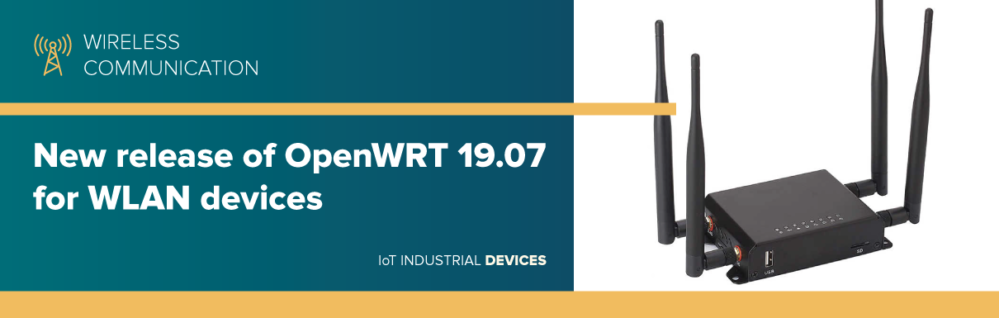
New release of OpenWRT 19.07 for WLAN devices

Good news for developers and modders of router software. A new Linux distribution, OpenWRT 19.07 has just been released, created primarily for WLAN devices, which debuted with the iconic Linksys WRT54G routers. OpenWrt 19.07 is mainly developed for devices using the AVR32, ARM, CRIS, m68k, MIPS, PowerPC, SPARC, SuperH, Ubicom32, x86 and x86-64 architecture.

What’s new in OpenWrt 19.07

A lot changed from the previous version of OpenWrt 18.06 version. Even WPA3 support has been added. However, it is not enabled by default and requires the installation of additional packages. Hostapd-openssl is needed for WPA3 to work in access point mode, it will need wpa-supplicant-openssl or wpad-openssl (additional AP) to use in Wi-Fi station mode.

Software developers have decided to switch to ath79 from ar71xx – in the future support for ar71xx will be completely withdrawn. In addition, the Linux kernel has been updated to version 4.14.162, and support for adm5120, adm8668, ar7, au1000, ixp4xx, mcs814x, omap24xx, ppc40x, ppc44x and xburst has been terminated.

A new feature is the updated LuCI, an integrated web interface for OpenWRT that implements client-side rendering. The LuCI ecosystem is large and not all LuCI applications have been adapted for this change, which can cause cbi.lua crashes. If so, install the luci-compat package.

The latest version of software can be downloaded from the project’s official website, here where you can also find the full list of changes.

Why should you try OpenWRT?

People who like to modify soft routers will confirm: OpenWRT dramatically increases the capabilities of network devices. OpenWRT is several thousand software packages that advanced users can install or remove depending on their needs. The software also improves network security – after all, the router owner will have full control over the configuration of every aspect of the hardware.

Industrial use of OpenWRT-based solutions

One of industrial IoT devices, supporting the technology and it’s varieties is ModBerry M series from TECHBASE. Economical, M300 model, based on NanoPi boards can serve as an OpenWRT modem, with optional changes in standard ModBerry controller. For more information check Industrial IoT Shop with all the configuration options for ModBerry M series .

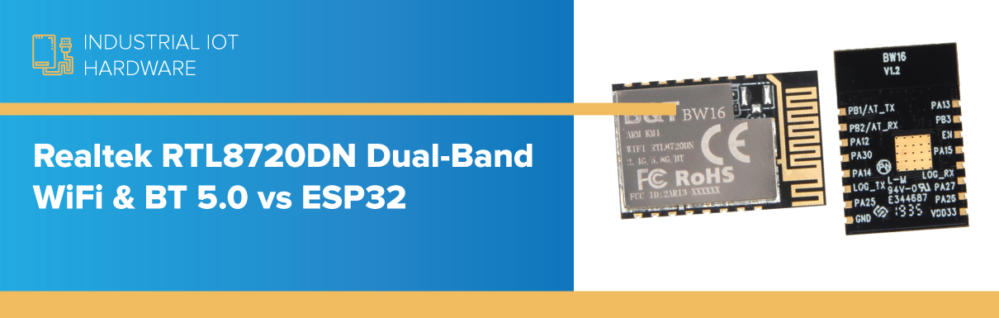
Realtek RTL8720DN Dual-Band WiFi & BT 5.0 vs ESP32

IoT market ofers wide range of small and efficient modules for Home & Industrial Internet of Things applications, equipped with 2.4GHz Wi-Fi, such as Espressif’s ESP32 or older ESP8266 modules. Additional Bluetooth 4.2/5.0 is often found on those. Dual-band Wi-Fi, on the other hand, is hard to find on low-budget IoT modules. Here comes Realtek RTL8720DN.

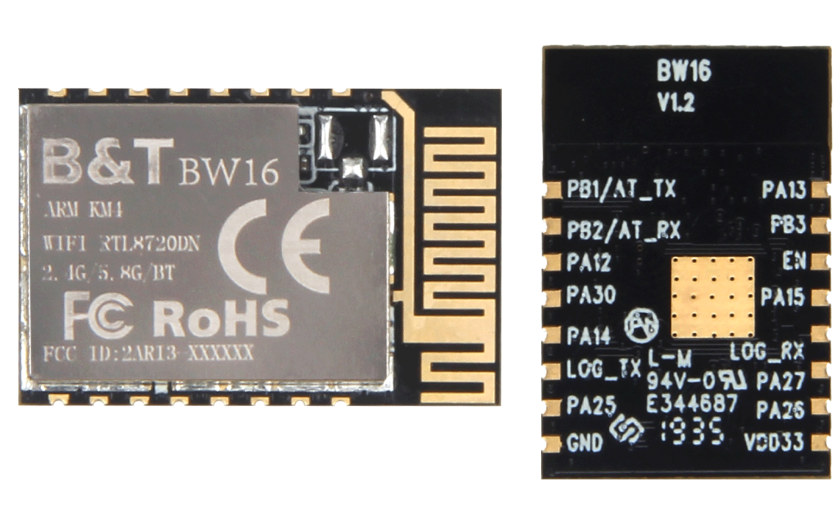
Realtek RTL2720DN module, as a part of AmebaD family, comes with ARM Cortex-M4/M0 wireless MCU with support of 802.11 b/g/n Dual-Band Wi-Fi 2.4GHz / 5GHz and extra Bluetooth 5.0 wireless connectivity.

Realtek RTL8720DN Dual-Band WiFi & Bluetooth 5.0 module

Realtek RTL8720DN specifications:

  • Wireless SoC – Realtek RTK8720DN MCU with KM4 Arm Cortex-M4 core @ 200 MHz and KM0 Arm Cortex-M0 core @ 20 MHz
  • Connectivity
    • WiFi
      • 802.11 a/b/g/n WiFi 4
      • Frequency Range – 2.412-2.484GHz & 5.180-5.825GHz
      • Data Rates
        • 802.11a: 6,9,12,18,24,36,48,54Mbps
        • 802.11b: 1,2,5.5,11Mbps
        • 802.11g: 6,9,12,18,24,36,48,54Mbps
        • 802.11n: MCS0–MCS7 @ HT20/HT40 2.4GHz and 5GHz bands
      • AP, Station, AP/Client supported
    • Bluetooth
      • Bluetooth 5.0 LE
      • Receiver Sensitivity: -92 dBm
      • Transmit Power: 7 dBm
    • Antenna – IPEX connector or PCB Antenna
  • I/O – 16x castellated holes with GPIO, 2x UART (AT commands + serial), ADC, I2C, SPI, 4x PWM, 3.3V, GND
  • Power Supply – 3.3±5% V
  • Dimensions – 24 x 16 x 3 mm
  • Temperature Range – Operating: -20°C to 85°C; storage: -40°C to 125°C
  • Relative Humidity – 10%~90% (non-condensing)
  • Certifications – FCC, CE, SRRC, RoHS

Source: https://www.cnx-software.com/2020/01/17/realtek-rtl8720dn-dual-band-wifi-bluetooth-5-0-iot-module/

Bluetooth 5.0 update for ESP32

The Espressif’s flagship ESP32 chip recently passed the SIG Bluetooth LE 5.0 certification. This confirms that the version of the protocol supported by the ESP32 microcontroller has been upgraded from Bluetooth LE 4.2 to Bluetooth LE 5.0, which is more stable and compatible.

The implementation and development of the Bluetooth LE (BLE) application requires not only a system that supports this function, but also an attached Bluetooth LE protocol stack consisting of a driver and a host.

Thanks to Bluetooth LE 5.0 certification, ESP32 SoC not only updates the system as a whole, but also adds new features that improve the latest software after passing more stringent tests than previous certification.

Industrial use of ESP32-based solutions

One of industrial IoT devices, supporting Espressif’s ESP32 technology is eModGATE from TECHBASE. Economical, ESP32-based solution can serve as an end-point in any installation or works well as a gateway, gathering data from scattered sensor mesh across the installation. For more information check Industrial IoT Shop with all the configuration options for eModGATE.

eModGATE with ESP32
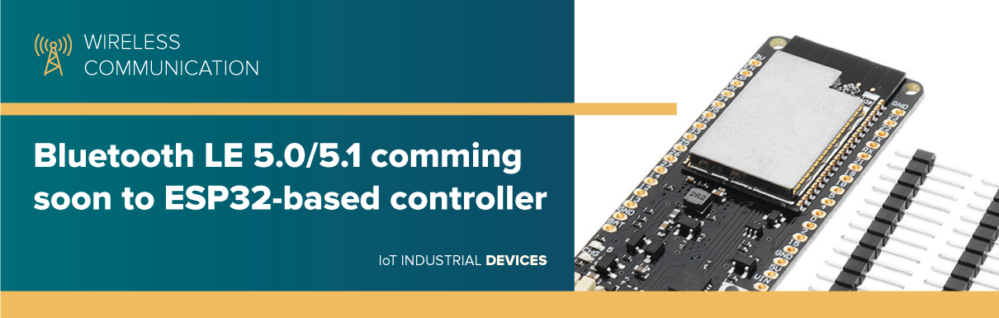
Bluetooth LE 5.0/5.1 comming soon to ESP32-based controller

The Espressif’s flagship ESP32 chip recently passed the SIG Bluetooth LE 5.0 certification. This confirms that the version of the protocol supported by the ESP32 microcontroller has been upgraded from Bluetooth LE 4.2 to Bluetooth LE 5.0, which is more stable and compatible.

The implementation and development of the Bluetooth LE (BLE) application requires not only a system that supports this function, but also an attached Bluetooth LE protocol stack consisting of a driver and a host.

Bluetooth 5.0 update for ESP32

Thanks to Bluetooth LE 5.0 certification, ESP32 SoC not only updates the system as a whole, but also adds new features that improve the latest software after passing more stringent tests than previous certification.

Due to hardware limitations, ESP32 does not support such functions of Bluetooth LE 5.0 as 2M PHY, LE Long Range, and ADV Extensions.

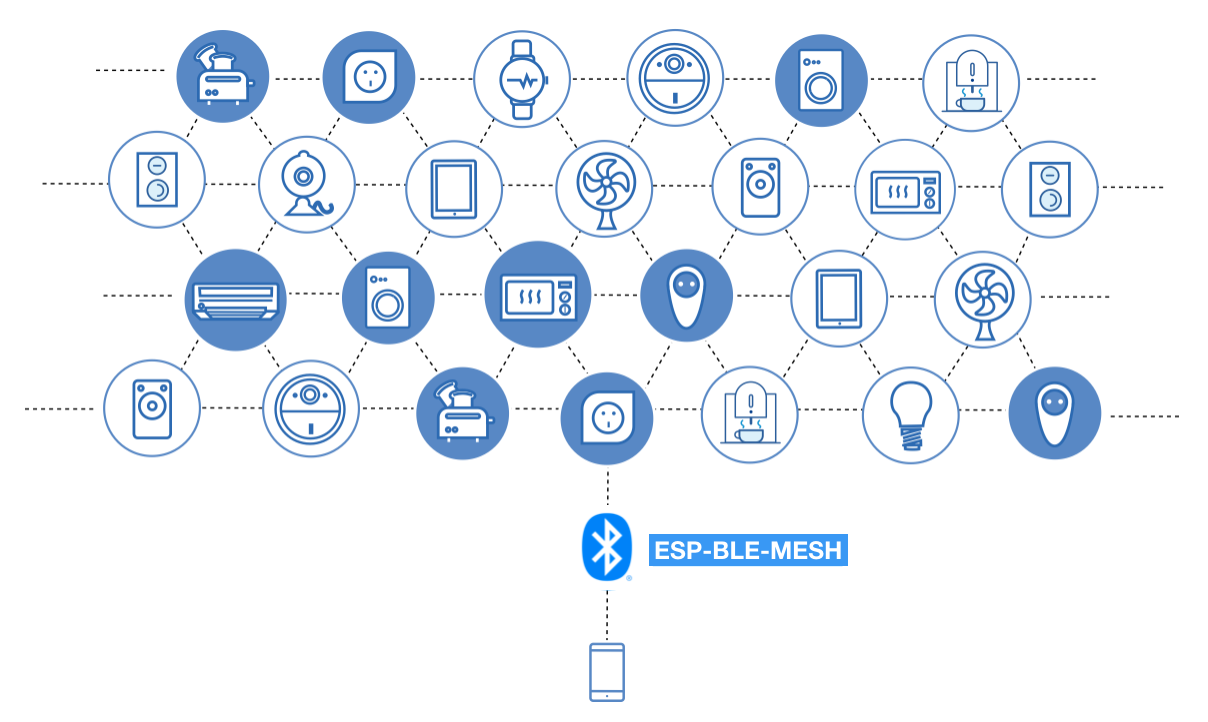
It is also worth mentioning that the combination of Bluetooth and Mesh networking is expected to become a key technology for the Internet of Things. A  Bluetooth® Mesh network enables a „many-to-many” relationship among potentially thousands of wireless devices, where data are transmitted not in a direct radio range but in wide physical areas. Espressif’s contribution in this field is the ESP-BLE-MESH, which got fully certified by Bluetooth SIG in September 2019.

Several Bluetooth-operated products on the market, such as wearable devices, smart speakers, cleaning robots, smart lights/sockets, etc., provide evidence that Bluetooth 5.0 and the Bluetooth Mesh networking technology are mature enough to drive the development of interconnected IoT devices. To this end, Espressif’s chips and ESP-BLE-MESH, in particular, are designed to help customers develop easily secure and cost-effective products for smart homes, smart buildings, healthcare, new automobiles and other smart industries.

Source: https://www.espressif.com/en/news/BLE_5.0_Certification

Industrial use of ESP32-based solutions

One of industrial IoT devices, supporting Espressif’s ESP32 technology is eModGATE from TECHBASE. Economical, ESP32-based solution can serve as an end-point in any installation or works well as a gateway, gathering data from scattered sensor mesh across the installation. For more information check Industrial IoT Shop with all the configuration options for eModGATE.

eModGATE with ESP32
NarrowBand-IoT the new black of Industrial IoT

The NB-IoT is becoming a standard in wireless communication of IoT devices, for standalone solutions and complex installations with thousands of units, coordinated with gateways. Will NarrowBand-IoT replace other wireless technologies in industrial automation?

What exactly is NarrowBand?

NarrowBand-IoT (NB-IoT) is a radio technology in the field of LPWAN (Low Power Wide Area Network) dedicated for IoT devices, operating on the licensed frequency band used by telecommunications operators.

The biggest advantages of NB-IoT include:

  • long battery life (up to 10 years),
  • efficiency in the amount of data transferred,
  • intra-building penetration,
  • the ability to connect even tens of thousands of devices in one system,
  • a global standard,
  • a high level of security and low cost

You can build mass solutions and those that until now were considered unprofitable. NB-IoT technology works in the licensed band, so there is no risk of interference and blocking communication by competing networks.

The service life of devices powered by two AA batteries is up to 10 years. However, the devices themselves are constructed in such a way that they can work for many years without the need for technical supervision and recharging the battery.

NB-IoT used in industrial solutions

One of many uses of NarrowBand-IoT wireless modems can be communication of edge devices, dedicated to data management, process control (e.g. with MQTT protocol) and monitoring. Latest ESP32-based eModGATE controller from TECHBASE company is a series utilizing MicroPython environment to provide data management solutions for end-points applications. The eModGATE has built-in Wi-Fi/BT modem and can be equipped with additional NarrowBand-IoT modems

eModGATE eqipped with wireless NB-IoT modem are perfect for industrial automation solutions, e.g. data logging, metering, telemetrics, remote monitoring, security and data management through all Industrial IoT applications.

Supported bandwidths:

  • Global-Band LTE CAT-M1:  B1/B2/B3/B4/B5/B8/B12/B13/B18/B19/B20/B26/B28/B39;
  • Global-Band LTE CAT NB-IoT1:  B1/B2/B3/B5/B8/B12/B13/B17/B18/B19/B20/B26/B28;
  • GPRS/EDGE 850/900/1800/1900Mhz Control Via AT Commands

Supported data transfer:

  • LTE CAT-M1(eMTC) – Uplink up to 375kbps, Downlink up to 300kbps
  • NB-IoT – Uplink up to 66kbps, Downlink up to 34kbps
  • EDGE Class – Uplink up to 236.8Kbps, Downlink up to 236.8Kbps
  • GPRS – Uplink up to 85.6Kbps, Downlink up to 85.6Kbps

Arduino ESP32 Serial Port to TCP Converter via WiFi

TECHBASE posted new class, in which you will create serial port to TCP converter using Arduino code running on ESP32 processor. We will use one of device which uses such processor: Moduino X ESP32. For TCP communication WiFi module will be used.

You will need:

  • Moduino X2 (may be also X1) ESP32 device (check this website to find out more)
  • PC with Linux operating system
  • socat application
  • RS-232/RS-485 port in your computer or USB to RS-232/RS-485 converter (for programmming and testing)

Introduction

In example, data sent to serial port (which is used as terminal port in regular Micropython ESP32 device) will be send via WiFi using TCP protocol. It also decodes incomming TCP packets and writes them to serial port. Then virtual serial port can be opened for that TCP packets and perform serial communication. We will use socat application for that.

You can read the complete tutorial at Hackster.io:

SIMCom SIM7000G

TECHBASE’s Industrial IoT devices, ModBerry & Moduino series supports latest SIMCom global-band SIM7000G eMTC & NB-IoT Module. Now the latest SIM7000G as well as 7000E / 7000A versions of modem are available at IIoT-Shop.

SIMCom SIM7000G

Our ModBerry / Moduino devices equipped with latest SIM7000G modem are perfect for industrial automation solutions, e.g. data logging, metering, telemetrics, remote monitoring, security and data management through all Industrial IoT applications.

Supported bandwidths:

    • Global-Band LTE CAT-M1:  B1/B2/B3/B4/B5/B8/B12/B13/B18/B19/B20/B26/B28/B39;
    • Global-Band LTE CAT NB-IoT1:  B1/B2/B3/B5/B8/B12/B13/B17/B18/B19/B20/B26/B28;
    • GPRS/EDGE 850/900/1800/1900Mhz Control Via AT Commands

Supported data transfer:

    • LTE CAT-M1(eMTC) – Uplink up to 375kbps, Downlink up to 300kbps
    • NB-IoT – Uplink up to 66kbps, Downlink up to 34kbps
    • EDGE Class – Uplink up to 236.8Kbps, Downlink up to 236.8Kbps
    • GPRS – Uplink up to 85.6Kbps, Downlink up to 85.6Kbps

You can browse wireless modem category here: https://iiot-shop.com/product-category/modems/

Various data connection protocols & MQTT data management solutions

To take full advantage of the TECHBASE’s Industrial IoT Ecosystem’s capabilities, you can build your own installation, depending on project requirements, choosing from variety of Gateways (Gateway Layer) to control data collected from an array of Moduino edge devices (Sensor Layer). Moduino can be programmed in one of open software platforms, e.g. MicroPython to gather the data and send it, using MQTT standard protocol, further to Gateway and/or cloud service.

Both Moduino ESP32 and Pycom-based Moduino supports open & free libraries, shared by Pycom, tested and approved by constantly growing ESP32/Arduino community. TECHBASE company has plans to provide an open-source platform for managing services & remote configuration and control of endpoint Moduino devices using MicroPython.

MQTT Data Management

Wide range of protocol support

All TECHBASE’s solution can be empowered with iMod software incl. protocol support for industrial interfaces, e.g. M-Bus, Modbus, SNMP, MQTT. iMod software works seamlessly with Node-RED using MQTT protocol, allowing use of bacnet and direct control over devices I/Os with Google’s platform-neutral protobuf – extensible mechanism for serializing structured data and zeroMQ controls to connect the code in any modern language, on any platform. The protocol drivers library can be expanded with CODESYS development system to support PROFIBUS, CANopen, EtherCAT, PROFINET and EtherNet/IP.