Wpisy

The NB-IoT is becoming a standard in wireless communication of IoT devices, for standalone solutions and complex installations with thousands of units, coordinated with gateways. Will NarrowBand-IoT replace other wireless technologies in industrial automation?

What exactly is NarrowBand?

NarrowBand-IoT (NB-IoT) is a radio technology in the field of LPWAN (Low Power Wide Area Network) dedicated for IoT devices, operating on the licensed frequency band used by telecommunications operators.

The biggest advantages of NB-IoT include:

  • long battery life (up to 10 years),
  • efficiency in the amount of data transferred,
  • intra-building penetration,
  • the ability to connect even tens of thousands of devices in one system,
  • a global standard,
  • a high level of security and low cost

You can build mass solutions and those that until now were considered unprofitable. NB-IoT technology works in the licensed band, so there is no risk of interference and blocking communication by competing networks.

The service life of devices powered by two AA batteries is up to 10 years. However, the devices themselves are constructed in such a way that they can work for many years without the need for technical supervision and recharging the battery.

NB-IoT used in industrial solutions

One of many uses of NarrowBand-IoT wireless modems can be communication of edge devices, dedicated to data management, process control (e.g. with MQTT protocol) and monitoring. Latest ESP32-based eModGATE controller from TECHBASE company is a series utilizing MicroPython environment to provide data management solutions for end-points applications. The eModGATE has built-in Wi-Fi/BT modem and can be equipped with additional NarrowBand-IoT modems

eModGATE with ESP32

eModGATE eqipped with wireless NB-IoT modem are perfect for industrial automation solutions, e.g. data logging, metering, telemetrics, remote monitoring, security and data management through all Industrial IoT applications.

Supported bandwidths:

  • Global-Band LTE CAT-M1:  B1/B2/B3/B4/B5/B8/B12/B13/B18/B19/B20/B26/B28/B39;
  • Global-Band LTE CAT NB-IoT1:  B1/B2/B3/B5/B8/B12/B13/B17/B18/B19/B20/B26/B28;
  • GPRS/EDGE 850/900/1800/1900Mhz Control Via AT Commands

Supported data transfer:

  • LTE CAT-M1(eMTC) – Uplink up to 375kbps, Downlink up to 300kbps
  • NB-IoT – Uplink up to 66kbps, Downlink up to 34kbps
  • EDGE Class – Uplink up to 236.8Kbps, Downlink up to 236.8Kbps
  • GPRS – Uplink up to 85.6Kbps, Downlink up to 85.6Kbps

Espressif Systems and Amazon recently announced the ESP32-PICO-V3-ZERO Alexa Connect Kit (ACK) module, which provides support for features such as out-of-the-box connectivity to the cloud service ACK, Alexa control, „seamless setup”, and Amazon Dash completion for connected devices.

This new module is as much as 50% lower in cost.

Source: https://developer.amazon.com/en-US/blogs/alexa/device-makers/2020/07/Introducing-the-New-Alexa-Connect-Kit-Module-with-Espressif-Chipset
ESP32-PICO-V3-ZERO

How Alexa Connect Kit Works

With Alexa Connect Kit, you can make nearly any device with power into an Alexa-compatible smart device your customers will love, all at a fixed per-device cost. You simply integrate an Amazon-managed ACK module into your device, connect it to your device’s microcontroller (MCU) over a serial interface, and add interface code to your device’s firmware to interpret control messages from the ACK module. The ACK module adds Wi-Fi, Bluetooth LE, and all the software needed for Alexa control, Frustration Free Setup, security, and log and metric collection – managed and updated by Amazon. For your customers, products built with ACK include Alexa control through voice and the Alexa app, and the option to support Amazon Dash Replenishment. For developers, ACK enables you to connect your devices to Alexa without the need to operate a cloud, create and maintain an Alexa skill, develop a companion app, or deal with IoT firmware integration. With an ACK module on your device, you can focus on building great hardware.

Source: https://developer.amazon.com/en-US/blogs/alexa/device-makers/2020/07/Introducing-the-New-Alexa-Connect-Kit-Module-with-Espressif-Chipset

Industrial use of LoRa & ESP32-based solutions

One of industrial IoT devices, supporting LoRa wireless technology is ESP32 based eModGATE from TECHBASE. Economical, ESP32-based solution can serve as an end-point in any installation or works well as a gateway, gathering data from scattered sensor mesh across the installation. For more information and also Raspberry Pi based solutions check Industrial IoT Shop with all the configuration options for eModGATE.

eModGATE with ESP32

ESP-MESH is a network protocol based on the Wi-Fi protocol. ESP-MESH enables the connection of a large number of devices (hereinafter nodes) covering a large physical area (both inside and outside) over a single WLAN (wireless local area network). ESP-MESH self-organizes and self-heals, allowing you to build and maintain networks autonomously.

Traditional Wi-Fi Network Architecture. Source: espressif.com

Traditional Infrastructure of Wi-Fi network is a point-to-multipoint network in which a single central node called an Access Point (AP) is directly connected to all other nodes called stations. The AP is responsible for arbitrating and forwarding transmissions between stations. Some access points relay transmissions to and from external IP networks through routers.

Traditional Infrastructure Wi-Fi networks have the downside of having a limited coverage area as all stations need to be in range to connect directly to the access point. In addition, the maximum number of stations allowed in the network is limited by the bandwidth of the access point, making traditional Wi-Fi networks prone to overload.

ESP-MESH vs traditional Wi-Fi infrastucture

ESP-MESH differs from traditional Wi-Fi infrastructure networks in that the nodes do not have to connect to a central node. Instead, the node can connect with its neighbors. Nodes are responsible for relaying transmissions to each other. This allows for achieving interconnections without the need for nodes to be within the range of the central node, which significantly extends the coverage area of the ESP-MESH network. Likewise, ESP-MESH is less prone to congestion as the number of allowed nodes in the network is no longer limited by a single central node.

ESP-MESH Network Architecture. Source: espressif.com

Industrial use of ESP32-based solutions

One of industrial IoT devices, supporting Espressif’s ESP32 technology is eModGATE from TECHBASE. Economical, ESP32-based solution can serve as an end-point in any installation or works well as a gateway, gathering data from scattered sensor mesh across the installation. For more information check Industrial IoT Shop with all the configuration options for eModGATE.

eModGATE with ESP32

Silicon Labs recently announced two hardware modules based on its BG22 Secure Bluetooth 5.2 SoC: 6x6mm BGM220S system bundled (SiP) and slightly optimized for wireless performance with a better link budget. BGM220P introduced, large PCB variant, wider range.

Both modules can be integrated into products with a battery life of up to 10 years using a single coin cell battery. All variants of BGM220S/P can support Bluetooth directional discovery, and some components can also support Bluetooth mesh low power protocol.

Main features

  • Silicon Labs EFR32BG22 Arm Cortex-M33 with DSP instructions and floating-point unit, up to 512 kB Flash, 32 kB RAM, 2.4 GHz radio with TX power up to 8 dBm, and Embedded Trace Macrocell (ETM) for advanced debugging
  • Supported Protocols
    • Bluetooth Low Energy (Bluetooth 5.2)
    • Direction-finding
    • Bluetooth mesh Low Power Node

Source: https://www.cnx-software.com/2020/09/14/silicon-labs-bluetooth-5-2-bgm220s-sip-and-bgm220p-pcb-module/

Industrial use of ESP32-based solutions

One of industrial IoT devices, supporting Espressif’s ESP32 and Bluetooth technology is eModGATE from TECHBASE. Economical, ESP32-based solution can serve as an end-point in any installation or works well as a gateway, gathering data from scattered sensor mesh across the installation. For more information check Industrial IoT Shop with all the configuration options for eModGATE.

eModGATE with ESP32
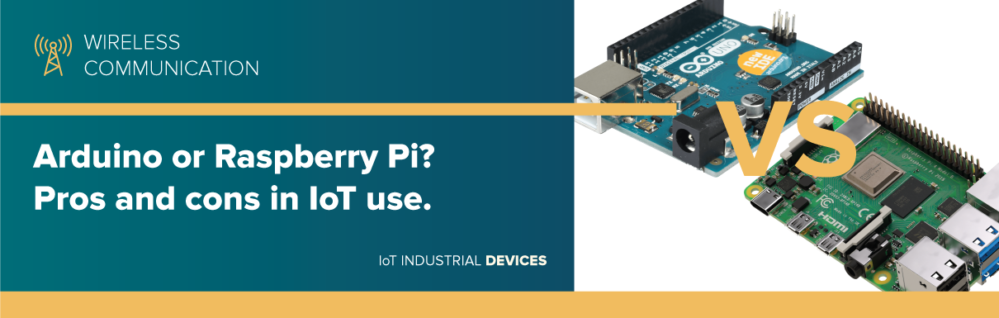
Arduino or Raspberry Pi? Pros and cons in IoT use.

Some people consider the Arduino platform to be the best for beginners, however, the novice will handle both Arduino and Raspberry Pi board. The choice between platforms should mainly depend on the characteristics of the project.

The origin of both platfoms

The founder of Arduino is Massimo Banzi, a lecturer at the now-defunct Italian Interaction Design Institute Ivrea, who developed a microcontroller in cooperation with students from this university. The Arduino programming language, based on the Wiring environment and basically on the C/C++ language, was designed by Hernando Barragán, a student of Banzi. The site prepared by Hernando Barragán presents exactly all the work on the project, which clearly shows that this success has more than one father.

In the case of Rasberry Pi, the project also had its source at the university. More specifically, at the University of Cambridge. Three lecturers: Jack Lang, Alan Mycroft and Robert Mullins came up with the idea of ​​developing a simple and above all cheap computer for learning programming. The first prototypes were created between 2006 and 2008. In the next step, seeing the potential of their solution, the men established cooperation with Pete Lamas, an integrated circuit designer at BroadCom, and David Braben, one of the developers of the Elite game, and together they founded the Raspberry Pi Foundation.

As a result, both platforms, which were originally intended to be used for learning by students, due to their low price and simplicity of use, became extremely popular among amateur users of consumer electronics and control, and appeared in mass sales.

So what should you choose – Arduino or Raspberry Pi?

The answer is basically simple – Arduino is ideal for simpler projects. Raspberry Pi will be useful for solutions that require more computing power. Arduino has only 2 kilobytes of RAM. Raspberry Pi has a RAM size of 1 GB. So Arduino is a simple microcontroller, meanwhile Raspberry is actually a small computer. Not without significance is the fact that the Arduino IDE is easier to use than Linux. So if you need a simple control of watering your garden, Arduino will work perfectly. Several sensors and a few lines of code will do the trick. For Raspberry Pi, to achieve the same effect, you will first need to install the system and the necessary libraries. There will be a lot more work and the effect will be the same – watering the garden at a specific time.

So choose Arduino when you need to use a simple solution for frequently repeated activities, e.g. controlling the watering of the garden, switching on and off the external lighting at a specific time, opening the gate, etc. However, because Raspberry can run many tasks at the same time, it is a computer, work simultaneously as a home printer server and operate the monitoring system. Home weather stations are popular and Raspberry will be perfect for this application because of the need to collect information from several sensors (temperature, wind strength, humidity). Raspberry Pi will therefore be a good choice for anyone interested in IoT, i.e. the Internet of Things at home. Examples of ready projects can be found here: https://modberry.techbase.eu/

Why not both?

Nothing prevents you from starting with Arduino and continuing with Raspberry Pi. By using Arduino or ESP32-based solutions you will learn the basics and you will get the effect quickly and relatively easily. But only Rasbperry Pi will allow you to make much more difficult projects. And both platforms can be combined with each other. Arduino/ESP32 can be used to read information from sensors and control e.g. motors (for example a garage door). Raspberry Pi will control all devices and send the collected data, e.g. to a mobile phone. You can do more together.

The NB-IoT is becoming a standard in wireless communication of IoT devices, for standalone solutions and complex installations with thousands of units, coordinated with gateways. Will NarrowBand-IoT replace other wireless technologies in industrial automation?

What exactly is NarrowBand?

NarrowBand-IoT (NB-IoT) is a radio technology in the field of LPWAN (Low Power Wide Area Network) dedicated for IoT devices, operating on the licensed frequency band used by telecommunications operators.

The biggest advantages of NB-IoT include:

  • long battery life (up to 10 years),
  • efficiency in the amount of data transferred,
  • intra-building penetration,
  • the ability to connect even tens of thousands of devices in one system,
  • a global standard,
  • a high level of security and low cost

You can build mass solutions and those that until now were considered unprofitable. NB-IoT technology works in the licensed band, so there is no risk of interference and blocking communication by competing networks.

The service life of devices powered by two AA batteries is up to 10 years. However, the devices themselves are constructed in such a way that they can work for many years without the need for technical supervision and recharging the battery.

NB-IoT used in industrial solutions

One of many uses of NarrowBand-IoT wireless modems can be communication of edge devices, dedicated to data management, process control (e.g. with MQTT protocol) and monitoring. Latest ESP32-based eModGATE controller from TECHBASE company is a series utilizing MicroPython environment to provide data management solutions for end-points applications. The eModGATE has built-in Wi-Fi/BT modem and can be equipped with additional NarrowBand-IoT modems

eModGATE eqipped with wireless NB-IoT modem are perfect for industrial automation solutions, e.g. data logging, metering, telemetrics, remote monitoring, security and data management through all Industrial IoT applications.

Supported bandwidths:

  • Global-Band LTE CAT-M1:  B1/B2/B3/B4/B5/B8/B12/B13/B18/B19/B20/B26/B28/B39;
  • Global-Band LTE CAT NB-IoT1:  B1/B2/B3/B5/B8/B12/B13/B17/B18/B19/B20/B26/B28;
  • GPRS/EDGE 850/900/1800/1900Mhz Control Via AT Commands

Supported data transfer:

  • LTE CAT-M1(eMTC) – Uplink up to 375kbps, Downlink up to 300kbps
  • NB-IoT – Uplink up to 66kbps, Downlink up to 34kbps
  • EDGE Class – Uplink up to 236.8Kbps, Downlink up to 236.8Kbps
  • GPRS – Uplink up to 85.6Kbps, Downlink up to 85.6Kbps

Bulgarian open equipment specialist, Olimex, has started stocking compact modules to add Low-Power NarrowBand-IoT (NB-IoT) connectivity (LPWAN) to the project: the NB-IoT-BC66 family.

NB-IoT is low power wide area networking technology which uses existing GSM LTE technology and has many advantages versa LoRa,” the company explains. „GSM network quality of service; single GSM cell can talk to up to 100,000 devices; high; communication speed 25.5kbps up and downlink; secure communication using LTE encryption; better range than LoRa both in urban and rural area (* depend on cell operating frequency – best range is on 850MHz.)

Source: https://olimex.wordpress.com/2020/04/07/new-nb-iot-bc66-modules-with-size-only-26×26-mm-contain-everything-you-need-to-add-nb-iot-functionality-in-your-next-project/

Olimex has launched four NB-IoT breakout boards. They are all based on the Quectel BC-66 module. NB-IoT-BC66 is the basic model, NB-IoT-BC66-ANT includes an attached GSM antenna, NB-IoT-BC66H contains a pre-soldered header, NB-IoT-BC66 and NB-IoT-BC66H-ANT combines both a soldered header and an attached antenna.

Olimex BC66 breakout board’s features and specifications:

  • NB-IoT Connectivity
    • Quectel BC-66 with worldwide GSM bands coverage
    • 25.5 kbps uplink and downlink
    • nano SIM card slot
    • u.FL antenna connector + optional antenna
  • I/O Expansion – 3x 10-pin header either unpopulated or fitted with male headers; Level shifters for 5x GPIOs, I2C, SPI, UART
  • Misc – Status LEDs
  • Power Supply –
  • Dimensions – 26×26 mm

Source: https://www.cnx-software.com/2020/04/08/olimex-quectel-bc66-breakout-board/

eModGATE with ESP32

NB-IoT used in industrial solutions

One of many uses of NarrowBand-IoT wireless modems can be communication of edge devices, dedicated to data management, process control (e.g. with MQTT protocol) and monitoring. Latest ESP32-based eModGATE controller from TECHBASE company is a series utilizing MicroPython environment to provide data management solutions for end-points applications. The eModGATE has built-in Wi-Fi/BT modem and can be equipped with additional NarrowBand-IoT modems

eModGATE eqipped with wireless NB-IoT modem are perfect for industrial automation solutions, e.g. data logging, metering, telemetrics, remote monitoring, security and data management through all Industrial IoT applications.

Supported bandwidths:

  • Global-Band LTE CAT-M1:  B1/B2/B3/B4/B5/B8/B12/B13/B18/B19/B20/B26/B28/B39;
  • Global-Band LTE CAT NB-IoT1:  B1/B2/B3/B5/B8/B12/B13/B17/B18/B19/B20/B26/B28;
  • GPRS/EDGE 850/900/1800/1900Mhz Control Via AT Commands

Supported data transfer:

  • LTE CAT-M1(eMTC) – Uplink up to 375kbps, Downlink up to 300kbps
  • NB-IoT – Uplink up to 66kbps, Downlink up to 34kbps
  • EDGE Class – Uplink up to 236.8Kbps, Downlink up to 236.8Kbps
  • GPRS – Uplink up to 85.6Kbps, Downlink up to 85.6Kbps

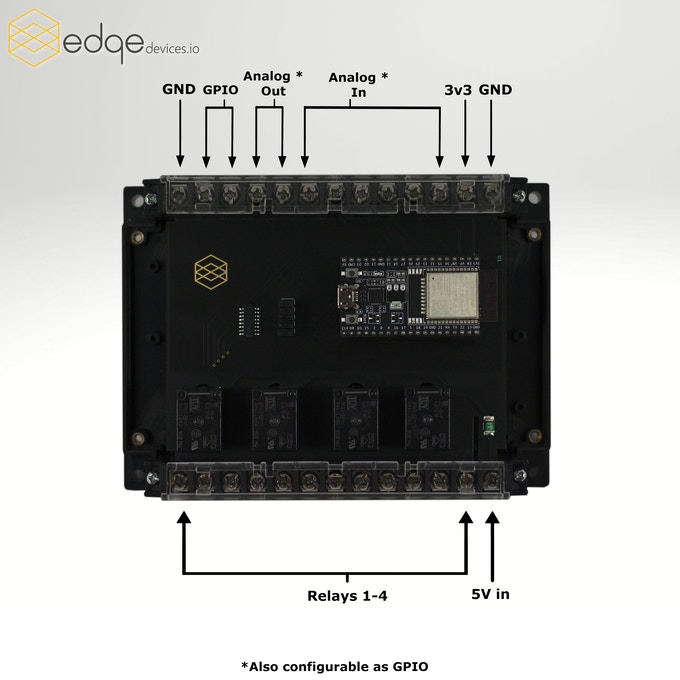
The creators of the Pi-oT module returned to Kickstarter and launched a new module based on ESP32. Thanks to this, users familiar with Arduino programming or preferring lighter architecture can enjoy all the advantages of the IoT module for enterprises.

Pi-oT ESP module key features and specification:

  • Board – ESP32-DevKitC-D32 based on ESP32-WROOM-D32 module with ESP32 dual-core processor, 32Mbit SPI flash
  • Relays – 4x Panasonic SPDT relays controlled via GPIO pins
  • Screws terminals for
    • Relay outputs
    • 6x analog inputs configurable as GPIO if needed
    • 2x analog outputs configurable as GPIO if needed
    • 2x GPIO
    • 5V input, 3.3V, and GND
  • Power Supply – 5V input via terminal or Micro USB port?; 5V circuitry protection
  • Dimensions – DIN rail enclosure

Source: https://www.cnx-software.com/2020/05/04/pi-ot-esp-module-leverages-esp32-screw-terminals-iot-automation/

The ESP Module is a microcontroller based IoT Module which offers the same great features as our Pi-oT Module, but based off on an ESP32 platform. The ESP Module is powered by an ESP32 DEVKITC-32D microcontroller which is included in each reward.

Source: https://www.kickstarter.com/projects/pi-ot/esp-module

Additionally 10 GPIO pins are routed to the housing terminals to utilize the power of ESP32 in a wide range of applications. The flexibility of the ESP32s system allows easy configuration of 6 of these pins as analogue inputs and 2 as analogue outputs.

Industrial use of LoRa & ESP32-based solutions

One of industrial IoT devices, supporting LoRa wireless technology is ESP32 based eModGATE from TECHBASE. Economical, ESP32-based solution can serve as an end-point in any installation or works well as a gateway, gathering data from scattered sensor mesh across the installation. For more information and also Raspberry Pi based solutions check Industrial IoT Shop with all the configuration options for eModGATE.

eModGATE with ESP32
ESP32-based LoRa / LoRaWAN wireless network

One way of long-range and low-power data transmission is LoRa wireless technology. Since the Internet of Things market (with ESP32 – based solutions) is mainly covered with short-range Wi-Fi and Bluetooth and long-range with 3G / NarrowBand-IoT technologies, LoRa oftens is omitted or simply unknown by IoT users. Below you will find a short representation of what LoRa is and how can it be used.

What is LoRa / LoRAWAN network?

LoRaWAN® network architecture is deployed in a star-of-stars topology in which gateways relay messages between end-devices and a central network server. The gateways are connected to the network server via standard IP connections and act as a transparent bridge, simply converting RF packets to IP packets and vice versa. The wireless communication takes advantage of the Long Range characteristics of the LoRa physical layer, allowing a single-hop link between the end-device and one or many gateways. All modes are capable of bi-directional communication, and there is support for multicast addressing groups to make efficient use of spectrum during tasks such as Firmware Over-The-Air (FOTA) upgrades or other mass distribution messages.

Source: https://lora-alliance.org/about-lorawan

Industrial use of LoRa & ESP32-based solutions

One of industrial IoT devices, supporting LoRa wireless technology is ESP32 based eModGATE from TECHBASE. Economical, ESP32-based solution can serve as an end-point in any installation or works well as a gateway, gathering data from scattered sensor mesh across the installation. For more information and also Raspberry Pi based solutions check Industrial IoT Shop with all the configuration options for eModGATE.

eModGATE with ESP32