Wpisy

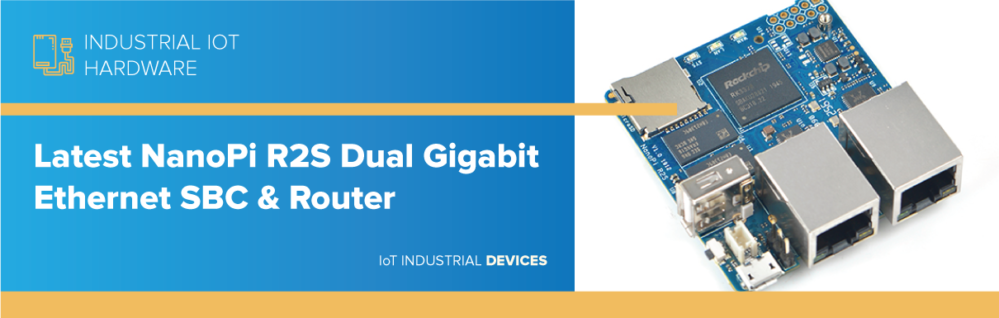
Latest NanoPi R2S Dual Gigabit Ethernet SBC & Router

The new NanoPi R2S is based on the Rockchip RK3328 processor, adding system memory, including 1 GB DDR4 RAM, and is designed to support 4G LTE via the Huawei 8372H-155 USB dongle. R2S is equipped with two Gigabit Ethernet ports (with one deployed for WAN and the other for LAN). This board can surely be used in industrial and Internet of Things (IoT) applications.

Most features resemble an update, but NanoPi R2S does not have built-in Wi-Fi for unknown reasons and certainly seems to be a downgrade. However, instead of built-in WiFi, friendlyELEC recommends using the RTL8821CU USB dongle, which is immediately supported with the default firmware.

NanoPi R2S specifications:

  • SoC – Rockchip RK3328 quad-core Cortex-A53 @ 1.5 GHz with Arm Mali-450MP2
  • System Memory – 1GB DDR4 RAM
  • Storage – MicroSD Slot, SPI flash footprint
  • 1x Gigabit Ethernet (WAN) up to 941 Mbps (measured)
  • 1x Gigabit Ethernet (LAN) up to 941 Mbps (measured) via Realtek RTL8153 USB 3.0 to Ethernet controller
  • USB – 1x USB Type-A host port, 1x micro USB port (power + slave)
  • Debugging – 3-pin 2.54mm pitch header for serial console
  • Expansion – 10-pin GPIO header with GPIOs, I2C, UART, IR_Rx, 5V, 3.3V and GND
  • Misc – 3x LEDs (WAN, LAN, SYS), K1 reset button, fan header
  • Power Supply – 5VDC/3A via micro USB port
  • Dimensions – 55.6 x 52mm
  • Temperature Range – -20℃ to 70℃

Source: https://www.cnx-software.com/2020/01/16/nanopi-r2s-dual-gigabit-ethernet-sbc-router-is-powered-by-rockchip-rk3328-soc/

NanoPi R2S layout
NanoPi R2S layout

Industrial use of previous OrangePi development boards

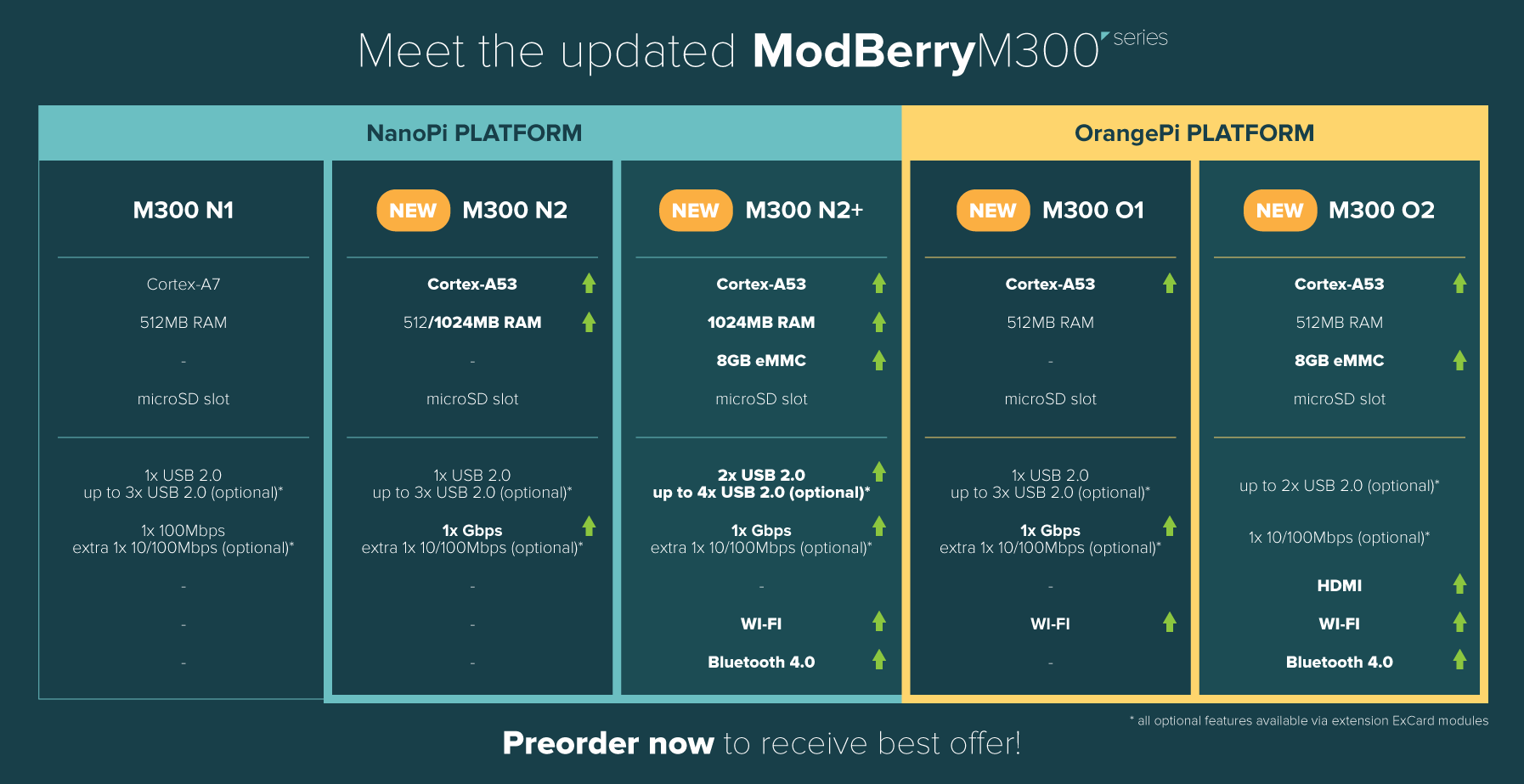
Introduced in November 2017, the ModBerry M300 series, based on NanoPi NEO revolutionised the economic segment of Industrial IoT devices and proved, that automation and monitoring can be done effectively with low expenditure on industrial installations.

ModBerry M300 O1 based on OrangePi Zero Plus features Allwinner H5 (Quad-core Cortex-A53) SoC, moderate 512MB RAM, storage memory option with microSD slot, USB and Gigabit Ethernet port. The wireless communication is supported with onboard Wi-Fi module.

Offering much higher performance and wider feature range, the ModBerry M300 O2 features same SoC as M300 series, but thanks to OrangePi Zero Plus2 means, the device is equipped with onboard 8GB eMMC, extra microSD expansion slot as alternative and wired/wireless interfaces, e.g. HDMI, Wi-Fi, Bluetooth 4.0.

Latest NanoPi NEO2 Black with IoT accessories & hats

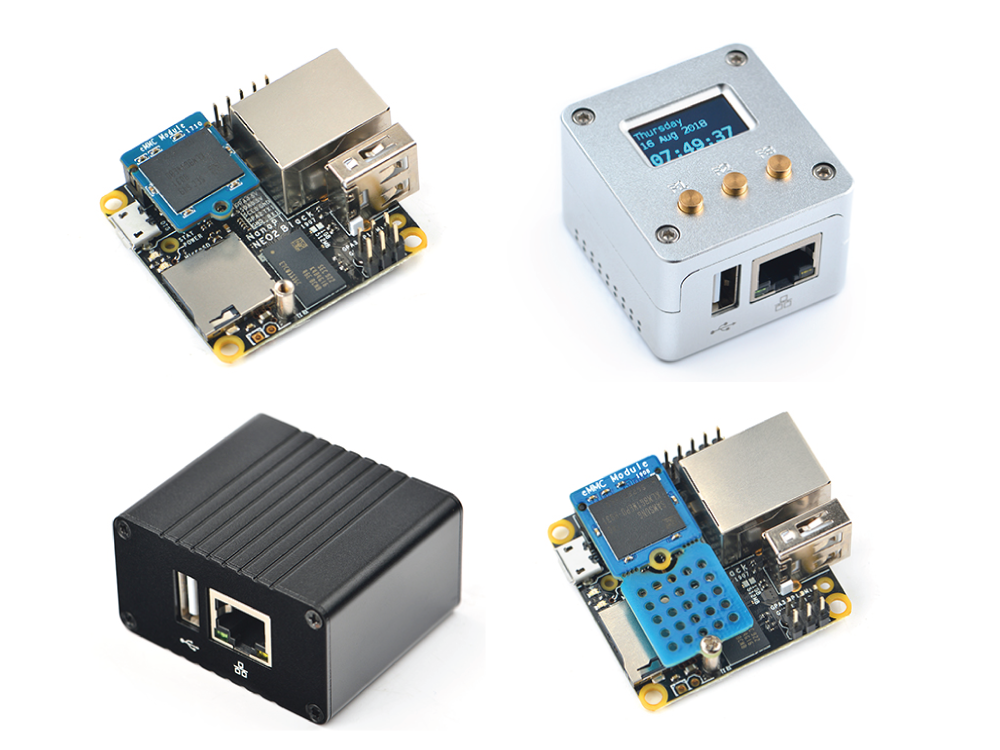
FriendlyElec has launched a new NanoPi microcomputer that can be used in Internet of Things (IoT), automation and storage projects. The NanoPi NEO2 Black measures 40 x 40 mm, weighs 16 grams, and is equipped with an Allwinner H5 four-core processor with ARM Mali-450MP GPU, 1GB DDR3 memory, and has a connector for an eMMC storage module and a slot for a microSD card.

This microcomputer also has two 6-pin and 10-pin connectors, a USB 2.0 socket, a microUSB OTG socket, and a Gigabit Ethernet port (RTL8211E-VB-CG chip). NanoPi NEO2 Black, which can use Armbian, Ubuntu 18.04 (FriendlyCore) and OpenWrt (FriendlyWrt) operating systems, is available to order with a price starting at $ 19.99.

NanoPi NEO2 Black Layout

NanoPi NEO2 Black specifications:

  • SoC – Allwinner H5 quad-core Cortex A53 processor with an ARM Mali-450MP GPU
  • System Memory – 1GB DDR3
  • Storage – MicroSD card slot, eMMC flash module connector
  • Connectivity – Gigabit Ethernet (via RTL8211E-VB-CG chip)
  • USB – 1x USB 2.0 host port, 1x micro USB OTG port, 1x USB via headers
  • Expansion headers10-pin header with I2C, UART, GPIOs, and power signals (5V in/out + GND)
  • 6-pin header with 1x USB, Line Out (stereo), 1x GPIO
  • Debugging – 2-pin unpopulated header for serial console / debugging
  • Misc – Power and system LEDs
  • Power Supply – 5V via micro USB port or VDD pin on headers.
  • Dimensions – 40 x 40 mm
  • Weight – ~16 grams

Source: https://www.cnx-software.com/2019/11/27/buy-nanopi-neo2-black-sbc/

Variety of supported IoT accessories from FriendlyElec

FriendlyElec released plenty of compatible accessories for NanoPi NEO2 Black, including additional eMMC modules, OLED hats and ready-to-use alluminum cases to speed up the implementation.

Latest NanoPi NEO2 Black with IoT accessories & hats
eMMC Modules, compatible alluminum cases and dedicated OLED accessories for NanoPi NEO2 Black

Industrial use of previous OrangePi development boards

Introduced in November 2017, the ModBerry M300 series, based on NanoPi NEO revolutionised the economic segment of Industrial IoT devices and proved, that automation and monitoring can be done effectively with low expenditure on industrial installations.

ModBerry M300 O1 based on OrangePi Zero Plus features Allwinner H5 (Quad-core Cortex-A53) SoC, moderate 512MB RAM, storage memory option with microSD slot, USB and Gigabit Ethernet port. The wireless communication is supported with onboard Wi-Fi module.

Offering much higher performance and wider feature range, the ModBerry M300 O2 features same SoC as M300 series, but thanks to OrangePi Zero Plus2 means, the device is equipped with onboard 8GB eMMC, extra microSD expansion slot as alternative and wired/wireless interfaces, e.g. HDMI, Wi-Fi, Bluetooth 4.0.

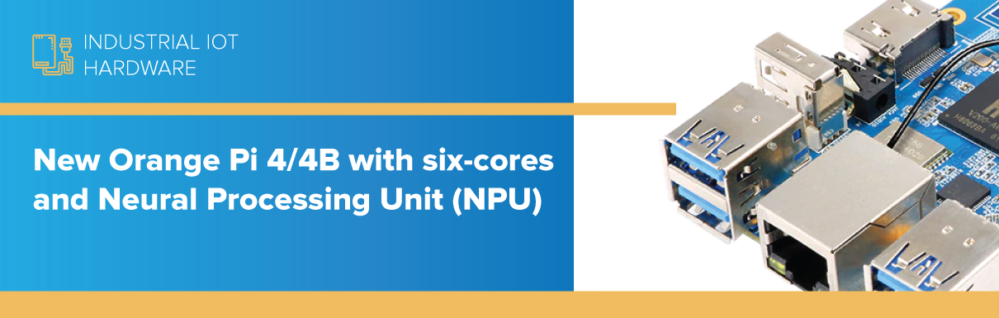
New Orange Pi 4/4B with six-cores and Neural Processing Unit (NPU)

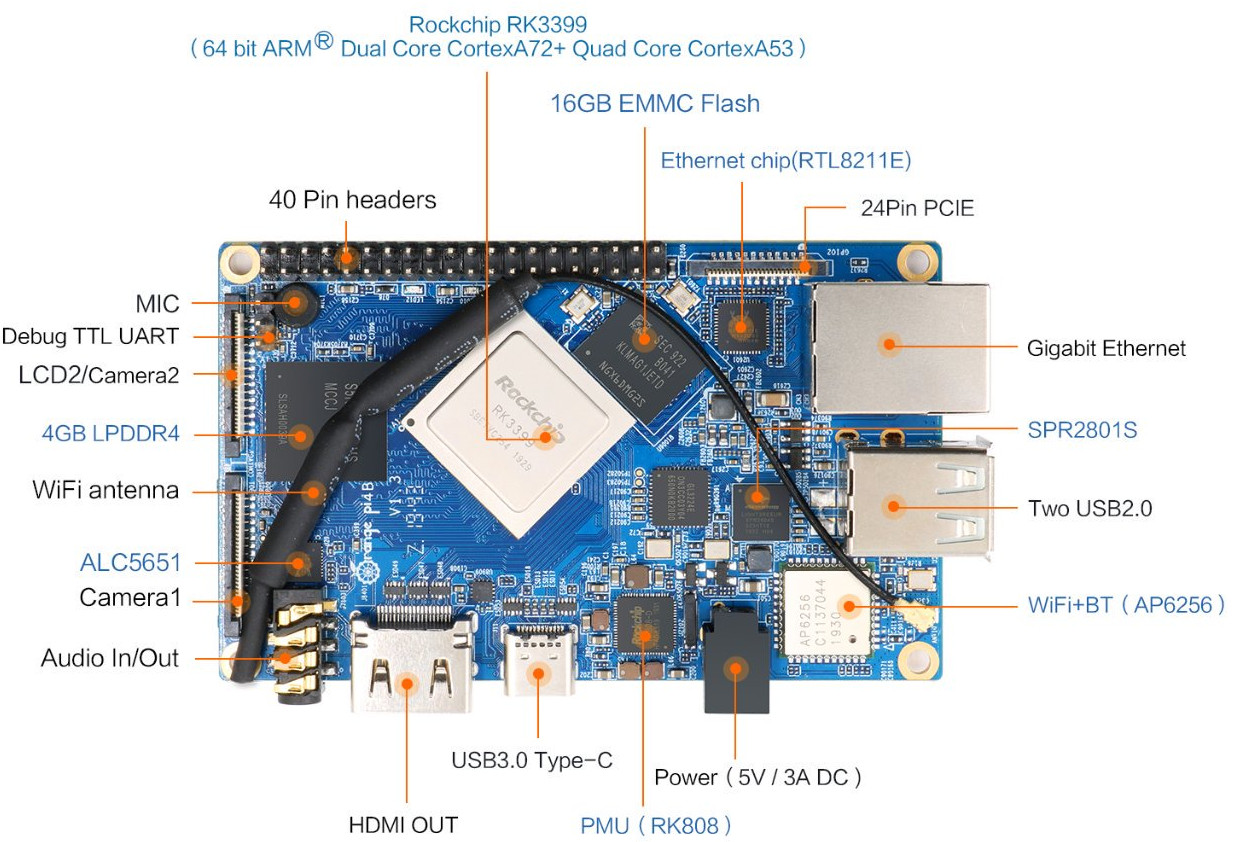
Shenzhen Xunlong Software recently introduced a new Orange Pi microcomputer. According to information provided by the Chinese company, the Orange Pi 4 measures 91 x 56 mm and features a Rockchip K3399 six-core system-on-chip SoC (ARM Mali-T860 MP4 GPU, 4GB of LPDDR4 memory, 16GB of storage). eMMC (expandable via a microSD card), a 24-pin connector, and a 40-pin General-purpose input / output (GPIO) connector.

Orange Pi 4 six-core system
Orange Pi 4B with Neural Processing Unit (NPU)

This microcomputer is also equipped with two camera connectors, one USB 3.0 jack, two USB 2.0 jacks, one USB 3.0 Type-C jack, HDMI 2.0, Gigabit Ethernet and 3.5mm audio jacks, and includes support for Wi-Fi 802.11ac and Bluetooth 4.1 LE.

The secondly introduced Orange Pi 4B model includes a Gyrfalcon Lightspeeur SPR2801S Neural Processing Unit (NPU), two USB 2.0 sockets, as well as a USB 3.0 Type-C socket.

Orange Pi 4/4B preliminary specifications:

  • SoC – Rockchip K3399 hexa-core big.LITTLE processor with two Arm Cortex A72 cores, four Cortex A53 cores, and an ARM Mali-T860 MP4 GPU with support for OpenGL 1.1 to 3.1 support, OpenVG1.1, OpenCL and DX 11
  • System Memory – 4 GB LPDDR4
  • Storage – 16 GB eMMC flash, micro SD card
  • NPU (Orange Pi 4B only) – Gyrfalcon Lightspeeur SPR2801S NPU delivering up to 2.8TOPS @ 300mW, 5.6 TOPS @ 100 MHz (peak performance)
  • Video Output/Display Interface
    • HDMI 2.0 up to 4K @ 60 Hz
    • LCD connector for MIPI DSI display
    • USB-C port with DisplayPort Alternate mode
  • Video Decode – 4K VP9 and 10-bit H.265 video codec support up to 60 fps
  • Audio – 3.5mm audio jack for headphones; HDMI digital audio output; built-in microphone; ALC5651 codec
  • Connectivity – Gigabit Ethernet port (via  RTL8211E transceiver), dual-band 802.11ac 2×2 MIMO WiFi and Bluetooth 5.0 (Ampak AP6256 module)
  • USB
    • Orange Pi 4 – 1x USB 3.0 port, 2x USB 2.0 host ports, 1x USB 3.0 type C port
    • Orange Pi 4B – 2x USB 2.0 host ports, 1x USB 3.0 type C port
  • Camera – 2x camera headers
  • Debugging – 3-pin serial header
  • Expansion
    • 40-pin GPIO 2.54mm pitch female header with 2x I2C, 1x SPI/UART, 8x GPIO, etc…
    • 24-pin connector for PCIe signals
  • Power Supply
    • 5V/3A via DC jack
    • 5V via type C portRK808 PMU
  • Dimensions – 91 x 56 mm

Source: https://www.cnx-software.com/2019/11/19/orange-pi-4-4b-sbc-rockchip-rk3399-soc-gyrfalcon-2801s-npu/

Industrial use of previous OrangePi development boards

Introduced in November 2017, the ModBerry M300 series, based on NanoPi NEO revolutionised the economic segment of Industrial IoT devices and proved, that automation and monitoring can be done effectively with low expenditure on industrial installations.

ModBerry M300 O1 based on OrangePi Zero Plus features Allwinner H5 (Quad-core Cortex-A53) SoC, moderate 512MB RAM, storage memory option with microSD slot, USB and Gigabit Ethernet port. The wireless communication is supported with onboard Wi-Fi module.

Offering much higher performance and wider feature range, the ModBerry M300 O2 features same SoC as M300 series, but thanks to OrangePi Zero Plus2 means, the device is equipped with onboard 8GB eMMC, extra microSD expansion slot as alternative and wired/wireless interfaces, e.g. HDMI, Wi-Fi, Bluetooth 4.0.
SIMCom SIM7000G

TECHBASE’s Industrial IoT devices, ModBerry & Moduino series supports latest SIMCom global-band SIM7000G eMTC & NB-IoT Module. Now the latest SIM7000G as well as 7000E / 7000A versions of modem are available at IIoT-Shop.

SIMCom SIM7000G

Our ModBerry / Moduino devices equipped with latest SIM7000G modem are perfect for industrial automation solutions, e.g. data logging, metering, telemetrics, remote monitoring, security and data management through all Industrial IoT applications.

Supported bandwidths:

    • Global-Band LTE CAT-M1:  B1/B2/B3/B4/B5/B8/B12/B13/B18/B19/B20/B26/B28/B39;
    • Global-Band LTE CAT NB-IoT1:  B1/B2/B3/B5/B8/B12/B13/B17/B18/B19/B20/B26/B28;
    • GPRS/EDGE 850/900/1800/1900Mhz Control Via AT Commands

Supported data transfer:

    • LTE CAT-M1(eMTC) – Uplink up to 375kbps, Downlink up to 300kbps
    • NB-IoT – Uplink up to 66kbps, Downlink up to 34kbps
    • EDGE Class – Uplink up to 236.8Kbps, Downlink up to 236.8Kbps
    • GPRS – Uplink up to 85.6Kbps, Downlink up to 85.6Kbps

You can browse wireless modem category here: https://iiot-shop.com/product-category/modems/

Welcome to the series of configuration instructions for ModBerry and Moduino ESP32 devices. In this class, you will program ESP32 processor to be Modbus TCP Master.

We will use two devices, which contain this processor: Moduino ESP32 and Pycom. Both devices are running in MicroPytthon environment. Our Modbus Slave will be PC computer with Modbus simulator software running on it.

You will need:

  • Moduino ESP32 or Moduino Pycom device (check this website to find out more about Moduino ESP32 device and this to check Pycom device)
  • PC with Linux operating system
  • RS-232/RS-485 port in your computer or USB to RS-232/RS-485 converter

You can read the complete tutorial at Instructables.com:


Sleep functionality for ModBerry/Raspberry Pi devices

TECHBASE company designed new extension module for RaspberryPi-based devices, ModBerry series for better power management in changing conditions of industrial environments. With the use of GPIO the module can manage sleep mode or safe shutdown of device in terms of unexpected drop in the power network.

In last few years developers marketed wide range of ARM-based development boards, lacking in enhanced power management, especially sleep and wake up modes, commonly used in PC-grade computing. These boards are not adjusted for battery power supply, so it’s natural that sleep/wake functions should be implemented. In connection with the development of solutions based on Linux-SBC, key factor is adding sleep modes to any remote installation

With built-in algorithms and the possibility to program on your own, the TECHBASE’s sleep/wake addon module can wake the device using schedule/timer. Another option is wake on external trigger, e.g. change of input, etc. All the options for sleep, shutdown and wake can be configured for various scenarios to ensure constant operation of devices, safety of data and continuity of work in case of power failure in any installation.

The preliminary module for ModBerry devices is available on request and delivery time will be specified by Sales Dept. depending on the size of the project.

Sleep mode with additional power backup

Additional power management option for ModBerry devices is sleep functionality enhanced with SuperCap UPS energy backup device. This solution allows programming scenarios including the execution of chosen actions, in order to save data, send a notification and restart/shutdown the controller after completion.

Advanced power management solution

Most advanced configuration includes use of Moduino ESP32 device for extra logic for wake up / sleep scripts. This addon will allow the RaspberryPi-based ModBerry device to be woken up by Moduino controller via Wi-Fi/GSM/LAN networks.

Moduino-ModBerry symbiosis allows wide range of wake-up/sleep schedule customization, in order to perform best and save energy accordingly to power supply state. Arduino and MicroPython environments provide libraries to control different scenarios of data and power management.

New SuperCap options for Moduino/ModBerry

The SuperCap UPS-SC01 backup power supply is equipped with a highly available backup feature to safely bridge fluctuations, drops or failures accompanying standard 9~30VDC supply voltage and avoid interruption of output voltage in industrial and automation environments. For this purpose SuperCap UPS-SC01 utilizes two supercapacitors (so-called supercaps) as a durable, cycle-resistant and maintenance-free solution for backup energy storage and failure safety.

The UPS-SC01 model is available for purchase at price set to 90€. SuperCap family offers now preliminary and revised models: UPS-SC02 with twice the capacity at 135€ and UPS-SC04 respectively at 180€ with quadrupled capacity of the base device, which can be preordered at our new Industrial IoT Shop, here: https://iiot-shop.com/product/supercap-ups/

TECHBASE’s Industrial IoT devices, ModBerry & Moduino series, now supports latest SIMCom global-band SIM7000G eMTC & NB-IoT Module. New SIM7000G supersedes previous 7000E / 7000A / 7000C versions of modem and provides a universal band set with global coverage, in opposite to Europe, America and China-only solutions.

Our ModBerry / Moduino devices equipped with latest SIM7000G modem are perfect for industrial automation solutions, e.g. data logging, metering, telemetrics, remote monitoring, security and data management through all Industrial IoT applications.

Supported bandwidths:

  • Global-Band LTE CAT-M1:  B1/B2/B3/B4/B5/B8/B12/B13/B18/B19/B20/B26/B28/B39;
  • Global-Band LTE CAT NB-IoT1:  B1/B2/B3/B5/B8/B12/B13/B17/B18/B19/B20/B26/B28;
  • GPRS/EDGE 850/900/1800/1900Mhz Control Via AT Commands

Supported data transfer:

  • LTE CAT-M1(eMTC) – Uplink up to 375kbps, Downlink up to 300kbps
  • NB-IoT – Uplink up to 66kbps, Downlink up to 34kbps
  • EDGE Class – Uplink up to 236.8Kbps, Downlink up to 236.8Kbps
  • GPRS – Uplink up to 85.6Kbps, Downlink up to 85.6Kbps

Our ModBerry / Moduino devices with global-band SIM7000G are available for testing and developing purposes, due to pending certifications of this module. For more information please contact our sales managers via live chat or contact forms.


The new SuperCap UPS-SC01 backup power supply is equipped with a highly available backup feature to safely bridge fluctuations, drops or failures accompanying standard 9~30VDC supply voltage and avoid interruption of output voltage in industrial and automation environments. For this purpose SuperCap UPS-SC01 utilizes two supercapacitors (so-called supercaps) as a durable, cycle-resistant and maintenance-free solution for backup energy storage and failure safety.

As an addition to Industrial IoT family of TECHBASE’s products, such as ModBerry (Raspberry Pi Compute Module 3 powered) industrial gateways and Moduino (ESP32 powered) end-point devices, the SuperCap UPS-SC01 serves well as an additional, highly efficient and fanless power source to allow continuous operation of connected devices in difficult conditions, such as extended industrial temperature range. Perfect solution for a multi-range applications, especially for embedded IIoT / Industry 4.0 systems, where stability and high availability is most important.

Czytaj dalej

Introduced in November 2017, the ModBerry M300 series, based on NanoPi NEO revolutionised the economic segment of Industrial IoT devices and proved, that automation and monitoring can be done effectively with low expenditure on industrial installations.

Read more: http://linuxgizmos.com/automation-controller-runs-linux-on-a-nanopi-neo-sbc/

https://www.cnx-software.com/2017/11/15/techbase-modberry%E2%80%8B-m300-linux-iot-gateway-%E2%80%8Bis-powered-by-nanopi-neo-board/

To ensure constant development of TECHBASE’s solutions and cutting-edge technology, the NanoPi platform part of ModBerry series is expanded by updated ModBerry M300 N2 product, based on NanoPi NEO2. The new addition features Quad-core Cortex-A53, twice more RAM than previous version of NanoPi NEO and Gigabit Ethernet for fast communication.

For even wider range of communication interfaces and application possibilities, TECHBASE offers now ModBerry M300 N2+ based on the NanoPi NEO Plus2. M300 N2+ is equipped with 8GB eMMC, features more USB ports, Gigabit Ethernet port like M300 N2 and is supported with onboard Wi-Fi/Blutetooth 4.0 to ensure many channels of data management.

ModBerry M300 series can optionally support an external 2.5″ SATA hard disk and 2242 SSD storage units with M.2 interface thanks to onboard JMS567 USB to SATA controller. With extra storage space, data management of specific installations would be more convenient than sending all unprocessed data into cloud or directly to user.

OrangePi capabilities

To meet the Industrial IoT market demands the ModBerry family joined new embedded computer platform, offering adjustable solutions for every industrial installation. ModBerry M300 O1/O2 series is formed by two OrangePi module boards offering different approach to IoT than NanoPi solutions.

ModBerry M300 O1 based on OrangePi Zero Plus features Allwinner H5 (Quad-core Cortex-A53) SoC, moderate 512MB RAM, storage memory option with microSD slot, USB and Gigabit Ethernet port. The wireless communication is supported with onboard Wi-Fi module.

Offering much higher performance and wider feature range, the ModBerry M300 O2 features same SoC as M300 series, but thanks to OrangePi Zero Plus2 means, the device is equipped with onboard 8GB eMMC, extra microSD expansion slot as alternative and wired/wireless interfaces, e.g. HDMI, Wi-Fi, Bluetooth 4.0.
ExCard modules to peak the performance

Every TECHBASE’s industrial computer is supported by ExCard add-on modules for extra RS-232/485 serial ports, Ethernet ports, PCIe slots, analog input and output, digital I/Os, relays, M-Bus interface, opto-isolation, accelerometer, etc. To provide specific communication paths, ModBerry can be rigged with additional Wi-Fi/Bluetooth module, 3G/LTE, NarrowBand-IoT, LoRa, ZigBee, GPS and Wireless M-Bus.

The latest options for ModBerry series are:

  • SuperCap expansion, to provide constant power supply as a UPS option
  • OLED 0.96” & new OLED 1,3″ screen, allowing the control without the need of connecting into the device
  • ESP32 module as a security chip, to add a firewall into control installation and ensure constant operation of the device, even with power drops and random events
  • Aluminum case, to grant much higher durability for extra harsh industrial conditions
  • Mentioned earlier SATA/M.2 SSD controller for extra data storage

The updated M300 availability

Currently all the updated M300 samples, including M300 N2, N2+, O1, O2 are available on demand. Please contact TECHBASE’s sales department via https://iot-industrial-devices.com/ contact form with specific requirements to receive an offer that will suit the project’s needs. Since the M300 update is still under the development, specific datasheets will be available in mid-February. The pricing of each unit may vary on the basis of configuration and order quota.

The latest configuration of ModBerry 500 device presents the important milestone in TECHBASE’s offer. The introduction of two platform symbiosis, RaspberryPi Compute Module 3 assisted with Espressif’s ESP32 module brings new possibilities of application to life. High performance of CM3, if compromised by exposition to harsh environmental conditions or sudden drop of power, is aided with low-powered ESP32’s real-time system to continue operation of the device. ESP32 module can be battery powered, same as standalone Moduino series, based on similar solution.

ESP32 subsystem for ModBerry 500

Main difference between ESP32-aided ModBerry device and ESP32-based Moduino is that the first one benefits from low-power module aid to prevent errors and downtimes. ESP32 compared to Compute Module 3 works much longer on battery power supply and offers extended sleep modes. Real-time system of ESP32 and simplified communication between ESP32-aided ModBerry device and Moduino controllers drastically shortens the time needed for the system implementation and the cost of maintaining the application. It also enables the use of Espressif’s Wi-Fi-based technology in the ESP-NOW and ESP-MESH networks.

The separate ModBerry-Moduino Ecosystem, working as a separate devices is a solution for scattered object and installations monitoring – with the use of wireless communication interfaces (e.g. LoRa, NarrowBand-IoT, ZigBee, Wi-Fi, Bluetooth, etc.), rather than standard wired networks. For more information ask TECHBASE via one of contact form at: https://iot-industrial-devices.com/ & http://moduino.techbase.eu/

Coming soon

TECHBASE plans further development of the product, particularly the issue of remote access to input/output resources and use of ESP32 as a Security Chip – hardware layer protection against hacking (very important issue in current IoT business).