Wpisy

The ODROID-C4 is a new generation single board computer that is more energy efficient and faster than the ODROID-C2, which was introduced as the world’s first inexpensive 64-bit ARM computer more than four years ago. ODROID concept and format mimic Raspberry Pi 4 but features extended capabilities as a next level competitor to the most popular SBC on the market

The main ODROID-C4 processor is built on a Cortex-A55 quad-core cluster with a new generation Mali-G31 graphics processor. The A55 core uses basic heat sinks and operates at 2.0 GHz without thermal throttling, making it a solid and quiet computer. The performance of multi-core processors is about 40% faster than ODROID-C2, and the system DRAM memory performance is 50% faster.

RPi4 & ODROID-C4 comparison: https://www.cnx-software.com/2020/04/24/raspberry-pi-4-vs-odroid-c4-features-comparison/

Benchmark comparison. Source: https://www.hardkernel.com/shop/odroid-c4/

Raspberry Pi increase in IoT significance

More and more engineers and technology providers believe that it is suitable for industrial applications in the real world. Over the past few years, there has been a lot of discussion about the use of Raspberry Pi in industry, most of which emphasize that Raspberry Pi is a great tool for engineering experiments, but not so much for industrial applications in the real world. While it is true that the Raspberry Pi is not considered the best choice for mission-critical applications, it is also true that the Raspberry Pi is no longer a platform for experimentation.

Latest Raspberry Pi 4 development board, equipped with a 1.5GHz quad-core 64-bit ARM Cortex-A72 processor (approximately 3 times better performance than previous Cortex-A53 powering Raspberry Pi 3+ Model B and Compute Module 3 and 3+). can be chosen from 1GB / 2GB / 4GB LPDDR4 SDRAM options.

Raspberry Pi 4 continues the tradition of one of the most versatile and cheapest computer devices. It can be used for virtually anything from proprietary IoT solutions to a full-fledged desktop computer. The new Malinka has two micro-HDMI ports, a Gigabit Ethernet port, two USB 3.0 type A ports and two USB 2.0 type A ports.

Industrial use of Raspberry Pi 4

A year ago, TECHBASE released an updated version of the ModBerry M500 industrial IoT computer, replacing the aging Raspberry Pi 3 with a 3B+, giving it better performance. With the recent launch of the Raspberry Pi 4, TECHBASE has yet again, announced another upgrade to the M500, which now packs the latest single-board computer.

Raspberry Pi 4, with 2xHDMI, Gigabit Ethernet and 2xUSB3.0

Over 10 million Raspberry Pi’s have been sold and the Raspberry Pi is likely to stay as a new standard in the industry. Official Raspbian OS is free operating system based on Linux Debian optimized for the Raspberry Pi comes with over 35,000 packages, pre-compiled software bundled in a nice format for easy installation. ModBerry devices are compatible with Raspberry Pi accessories, supported by Raspberry Pi Foundation. ModBerry M500 now with Raspberry Pi 3 Model B+ / Raspberry Pi 4 Model B support.
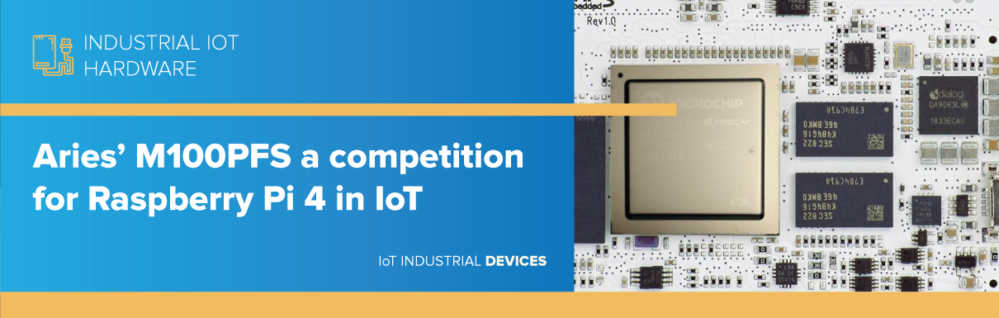
Aries Embedded announced one of the first computing modules with the SoF PolarFire function. It is equipped with a Linux RISC-V SoC chip with a Microchip Microsemi FPGA processor. The M100PFS has the same dimensions of 74 x 42 mm as the similar M100PF module from Aries and is equipped with PolarFire FPGAs without RISC-V core for Linux.

The two major M100PFS SKUs are:

  • M100PFS-025ADA0 — MPFS025T FPGA with 23K LE, 68 math blocks, 4x SERDES; 1GB LPDDR4 RAM for HMS (RISC-V/Linux); 4GB eMMC
  • M100PFS-250AECC — MPFS250T FPGA with 254K LE, 784 blocks, 16x SERDES; 4GB LPDDR4 each for HMS and FPGA; 8GB eMMC

Source: http://linuxgizmos.com/linux-powered-module-charges-up-the-risc-v-polarfire-soc/

Aries’ M100PFS a competition for Raspberry Pi 4 in IoT
M100PFS

PolarFire SoC from Microchip combines the previously introduced PolarFire FPGA card with 4x RISC-V U54-MC SiFive core. Microchip claims that PolarFire SoCs are superior to hybrid SoCs with an arm / FPGA, such as Xilinx Zynq, with more configurable and open RISC-V designs, lower power consumption and much better real-time deterministic functions. I am In December, the company called it „the first FPGA SoC chip with deterministic and consistent RISC-V processor clusters and the deterministic L2 memory subsystem enabling the use of Linux and real-time applications.”

Industrial use of market Raspberry Pi 4 SBCs

A year ago, TECHBASE released an updated version of the ModBerry M500 industrial IoT computer, replacing the aging Raspberry Pi 3 with a 3B+, giving it better performance. With the recent launch of the Raspberry Pi 4, TECHBASE has yet again, announced another upgrade to the M500, which now packs the latest single-board computer.

ModBerry M500 with Raspberry Pi’s 4

ModBerry M500 also utilizes many more SBC platforms, such as Orange Pi, NanoPi and Intel-based UpBoard. Find more information here: https://iiot-shop.com/product/modberry-m-series/

Boosted Raspberry Pi 4 with SSD support

Many developement boards can be used in home and industrial applications to control and manage data. Check out latest video from open-tech infuencer, Andreas Spiess, in which he uses Raspberry Pi and SSD drive with Berryboot to enhance Raspberry Pi data storage capacity.

Industrial use of Raspberry Pi 4

A year ago, TECHBASE released an updated version of the ModBerry M500 industrial IoT computer, replacing the aging Raspberry Pi 3 with a 3B+, giving it better performance. With the recent launch of the Raspberry Pi 4, TECHBASE has yet again, announced another upgrade to the M500, which now packs the latest single-board computer.

Raspberry Pi 4

Over 10 million Raspberry Pi’s have been sold and the Raspberry Pi is likely to stay as a new standard in the industry. Official Raspbian OS is free operating system based on Linux Debian optimized for the Raspberry Pi comes with over 35,000 packages, pre-compiled software bundled in a nice format for easy installation. ModBerry devices are compatible with Raspberry Pi accessories, supported by Raspberry Pi Foundation. ModBerry M500 now with Raspberry Pi 3 Model B+ / Raspberry Pi 4 Model B support.

Raspberry Pi 4 no longer available with 1GB RAM

The Raspberry Pi platform, with introduced in 2019 Raspberry Pi 4 is no longer available with lowest, 1GB RAM configuration. Since the price of 2GB version dropped by $10 to the $35 — the same as the 1GB version. Therefore the 1GB is no longer available for puchase. Also the USB type C problems were fixed with the latest revision.

In latest announcement, Eben Upton, co-founder and CEO of Raspberry Pi Trading, admitted that most people already know that Raspberry Pi 4 requires at least 2 GB of RAM to be the first Pi to replace desktop computers. Upton also says, that comared to original original Raspberry Pi, the new RPI 4 has 40x processor performance, 10x bandwidth and 4x screen pixels. The SBC also has 4 to 8 times more RAM than the previous 512 MB model.

Raspberry Pi increase in IoT significance

More and more engineers and technology providers believe that it is suitable for industrial applications in the real world. Over the past few years, there has been a lot of discussion about the use of Raspberry Pi in industry, most of which emphasize that Raspberry Pi is a great tool for engineering experiments, but not so much for industrial applications in the real world. While it is true that the Raspberry Pi is not considered the best choice for mission-critical applications, it is also true that the Raspberry Pi is no longer a platform for experimentation.

Latest Raspberry Pi 4 development board, equipped with a 1.5GHz quad-core 64-bit ARM Cortex-A72 processor (approximately 3 times better performance than previous Cortex-A53 powering Raspberry Pi 3+ Model B and Compute Module 3 and 3+). can be chosen from 1GB / 2GB / 4GB LPDDR4 SDRAM options.

Raspberry Pi 4, with 2xHDMI, Gigabit Ethernet and 2xUSB3.0

Raspberry Pi 4 continues the tradition of one of the most versatile and cheapest computer devices. It can be used for virtually anything from proprietary IoT solutions to a full-fledged desktop computer. The new Malinka has two micro-HDMI ports, a Gigabit Ethernet port, two USB 3.0 type A ports and two USB 2.0 type A ports.

Industrial use of Raspberry Pi 4

A year ago, TECHBASE released an updated version of the ModBerry M500 industrial IoT computer, replacing the aging Raspberry Pi 3 with a 3B+, giving it better performance. With the recent launch of the Raspberry Pi 4, TECHBASE has yet again, announced another upgrade to the M500, which now packs the latest single-board computer.

Over 10 million Raspberry Pi’s have been sold and the Raspberry Pi is likely to stay as a new standard in the industry. Official Raspbian OS is free operating system based on Linux Debian optimized for the Raspberry Pi comes with over 35,000 packages, pre-compiled software bundled in a nice format for easy installation. ModBerry devices are compatible with Raspberry Pi accessories, supported by Raspberry Pi Foundation. ModBerry M500 now with Raspberry Pi 3 Model B+ / Raspberry Pi 4 Model B support.

Linux Kernel 5.5 brings changes to ARM, RISC-V and MIPS

At the end of last week, Linus Torvalds brought a complete list of Linux 5.5 changes for ARM, MIPS and RISC-V architectures. Io_uring asynchronous I/O has been improved, adding the ability to modify the set of files being operated on without starting over, user-specifiable completion-ring sizes, absolute timeouts, and support for accept() calls among others.

Also the Airtime Queue Limits (AQL) for WiFi that make CoDel work more effectively with wireless drivers that utilized firmware/hardware offloading. KUnit unit testing framework for the Linux kernel with tests can now be run locally on a developer’s workstation without any VM or special hardware. Another change is SMB rootfs and multichannel support using SMB as root file systems, and support for using multiple network connections for the same SMB session.

For more information about changes to different architectures, check out the article exploring the subject: https://www.cnx-software.com/2020/01/27/linux-5-5-release-main-changes-arm-mips-and-risc-v-architectures/

Linux 5.5 changes announcement

So this last week was pretty quiet, and while we had a late network update with some (mainly iwl wireless) network driver and netfilter module loading fixes, David didn’t think that warranted another -rc. And outside of that, it’s really been very quiet indeed – there’s a panfrost driver update too, but again it didn’t really seem to make sense to delay the final release by another week.

Outside of those, it’s all really tiny, even if some of those tiny changes touched some core files.

So despite the slight worry that the holidays might have affected the schedule, 5.5 ended up with the regular rc cadence and is out now.

That means that the merge window for 5.6 will open tomorrow, and I already have a couple of pull requests pending. The timing for this next merge window isn’t optimal for me – I have some travel and other things going on during the same two weeks, but hopefully it won’t be all that noticeable. But there might be random timezones, odd hours, and random delays because of that. I try to avoid scheduling things during the merge window, but hey, it doesn’t always work out, and I’d have to delay things by two weeks to avoid the conflicts, which just doesn’t seem worth it.

Particularly since it’s not necessarily going to be a problem to begin with. We’ll see.

Anyway. Go out and test 5.5, and start sending me those pull requests for all the new development that is ready,

Source: https://lkml.org/lkml/2020/1/26/232

Ubuntu 19.10 for latest Raspberry Pi applications

With 19.10 release of Ubuntu Server, Canonical announced official support for the Raspberry Pi 4. The latest board from the Raspberry Pi Foundation sports a faster system-on-a-chip with a processor that uses the Cortex-A72 architecture (quad-core 64-bit ARMv8 at 1.5GHz). Additionally, it offers up to 4GB of RAM. We are supporting the Raspberry Pi 4 to give developers access to a low-cost board, powerful enough to consolidate compute workloads at the edge. 

The Raspberry Pi has established itself as a most accessible platform for innovators in the embedded space. Canonical is dedicated to empowering innovators with open-source software. Consequently, Canonical endeavors to offer full official support for all the boards in the Raspberry Pi family. Canonical will therefore enable both Ubuntu Server and Ubuntu Core for existing and upcoming Pi boards.

Ubuntu Roadmap. Source: https://ubuntu.com/blog/roadmap-for-official-support-for-the-raspberry-pi-4

Industrial use of Raspberry Pi 4

A year ago, TECHBASE released an updated version of the ModBerry M500 industrial IoT computer, replacing the aging Raspberry Pi 3 with a 3B+, giving it better performance. With the recent launch of the Raspberry Pi 4, TECHBASE has yet again, announced another upgrade to the M500, which now packs the latest single-board computer.

Raspberry Pi 4

Over 10 million Raspberry Pi’s have been sold and the Raspberry Pi is likely to stay as a new standard in the industry. Official Raspbian OS is free operating system based on Linux Debian optimized for the Raspberry Pi comes with over 35,000 packages, pre-compiled software bundled in a nice format for easy installation. ModBerry devices are compatible with Raspberry Pi accessories, supported by Raspberry Pi Foundation. ModBerry M500 now with Raspberry Pi 3 Model B+ / Raspberry Pi 4 Model B support.
Docker VPN-based Raspberry Pi Server tutorial

Many developement boards can be used in home and industrial applications to control and manage data. Get secure remote access from anywhere via your own VPN based on Docker containers. Check out latest video from open-tech infuencer, Andreas Spiess, in which he uses Raspberry Pi and Docker, Node-RED, influxDB and Grafana to build custom Raspberry Pi data server.

Industrial use of Raspberry Pi 4

A year ago, TECHBASE released an updated version of the ModBerry M500 industrial IoT computer, replacing the aging Raspberry Pi 3 with a 3B+, giving it better performance. With the recent launch of the Raspberry Pi 4, TECHBASE has yet again, announced another upgrade to the M500, which now packs the latest single-board computer.

Raspberry Pi 4

Over 10 million Raspberry Pi’s have been sold and the Raspberry Pi is likely to stay as a new standard in the industry. Official Raspbian OS is free operating system based on Linux Debian optimized for the Raspberry Pi comes with over 35,000 packages, pre-compiled software bundled in a nice format for easy installation. ModBerry devices are compatible with Raspberry Pi accessories, supported by Raspberry Pi Foundation. ModBerry M500 now with Raspberry Pi 3 Model B+ / Raspberry Pi 4 Model B support.

Raspberry Pi & ESP32 use-hack of OpenMQTTGateway

Many developement boards can be used in home and industrial applications to control and manage data. Check out latest video from open-tech infuencer, Andreas Spiess, in which he uses Raspberry Pi and ESP32 boards to build and visualize weight loss system using Xiaomi scale and Node-RED, influxDB and Grafana. Open MQTT Gateway might come in handy too.

Industrial use of Raspberry Pi & ESP32-based solutions

One of industrial IoT devices, supporting Espressif’s ESP32 technology is eModGATE from TECHBASE. Economical, ESP32-based solution can serve as an end-point in any installation or works well as a gateway, gathering data from scattered sensor mesh across the installation. For more information and also Raspberry Pi based solutions check Industrial IoT Shop with all the configuration options for eModGATE.

eModGATE with ESP32
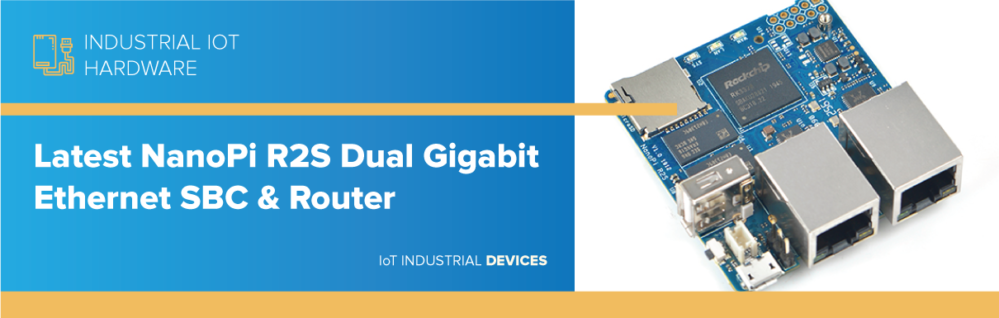
Latest NanoPi R2S Dual Gigabit Ethernet SBC & Router

The new NanoPi R2S is based on the Rockchip RK3328 processor, adding system memory, including 1 GB DDR4 RAM, and is designed to support 4G LTE via the Huawei 8372H-155 USB dongle. R2S is equipped with two Gigabit Ethernet ports (with one deployed for WAN and the other for LAN). This board can surely be used in industrial and Internet of Things (IoT) applications.

Most features resemble an update, but NanoPi R2S does not have built-in Wi-Fi for unknown reasons and certainly seems to be a downgrade. However, instead of built-in WiFi, friendlyELEC recommends using the RTL8821CU USB dongle, which is immediately supported with the default firmware.

NanoPi R2S specifications:

  • SoC – Rockchip RK3328 quad-core Cortex-A53 @ 1.5 GHz with Arm Mali-450MP2
  • System Memory – 1GB DDR4 RAM
  • Storage – MicroSD Slot, SPI flash footprint
  • 1x Gigabit Ethernet (WAN) up to 941 Mbps (measured)
  • 1x Gigabit Ethernet (LAN) up to 941 Mbps (measured) via Realtek RTL8153 USB 3.0 to Ethernet controller
  • USB – 1x USB Type-A host port, 1x micro USB port (power + slave)
  • Debugging – 3-pin 2.54mm pitch header for serial console
  • Expansion – 10-pin GPIO header with GPIOs, I2C, UART, IR_Rx, 5V, 3.3V and GND
  • Misc – 3x LEDs (WAN, LAN, SYS), K1 reset button, fan header
  • Power Supply – 5VDC/3A via micro USB port
  • Dimensions – 55.6 x 52mm
  • Temperature Range – -20℃ to 70℃

Source: https://www.cnx-software.com/2020/01/16/nanopi-r2s-dual-gigabit-ethernet-sbc-router-is-powered-by-rockchip-rk3328-soc/

NanoPi R2S layout
NanoPi R2S layout

Industrial use of previous OrangePi development boards

Introduced in November 2017, the ModBerry M300 series, based on NanoPi NEO revolutionised the economic segment of Industrial IoT devices and proved, that automation and monitoring can be done effectively with low expenditure on industrial installations.

ModBerry M300 O1 based on OrangePi Zero Plus features Allwinner H5 (Quad-core Cortex-A53) SoC, moderate 512MB RAM, storage memory option with microSD slot, USB and Gigabit Ethernet port. The wireless communication is supported with onboard Wi-Fi module.

Offering much higher performance and wider feature range, the ModBerry M300 O2 features same SoC as M300 series, but thanks to OrangePi Zero Plus2 means, the device is equipped with onboard 8GB eMMC, extra microSD expansion slot as alternative and wired/wireless interfaces, e.g. HDMI, Wi-Fi, Bluetooth 4.0.

Latest NanoPi NEO2 Black with IoT accessories & hats

FriendlyElec has launched a new NanoPi microcomputer that can be used in Internet of Things (IoT), automation and storage projects. The NanoPi NEO2 Black measures 40 x 40 mm, weighs 16 grams, and is equipped with an Allwinner H5 four-core processor with ARM Mali-450MP GPU, 1GB DDR3 memory, and has a connector for an eMMC storage module and a slot for a microSD card.

This microcomputer also has two 6-pin and 10-pin connectors, a USB 2.0 socket, a microUSB OTG socket, and a Gigabit Ethernet port (RTL8211E-VB-CG chip). NanoPi NEO2 Black, which can use Armbian, Ubuntu 18.04 (FriendlyCore) and OpenWrt (FriendlyWrt) operating systems, is available to order with a price starting at $ 19.99.

NanoPi NEO2 Black Layout

NanoPi NEO2 Black specifications:

  • SoC – Allwinner H5 quad-core Cortex A53 processor with an ARM Mali-450MP GPU
  • System Memory – 1GB DDR3
  • Storage – MicroSD card slot, eMMC flash module connector
  • Connectivity – Gigabit Ethernet (via RTL8211E-VB-CG chip)
  • USB – 1x USB 2.0 host port, 1x micro USB OTG port, 1x USB via headers
  • Expansion headers10-pin header with I2C, UART, GPIOs, and power signals (5V in/out + GND)
  • 6-pin header with 1x USB, Line Out (stereo), 1x GPIO
  • Debugging – 2-pin unpopulated header for serial console / debugging
  • Misc – Power and system LEDs
  • Power Supply – 5V via micro USB port or VDD pin on headers.
  • Dimensions – 40 x 40 mm
  • Weight – ~16 grams

Source: https://www.cnx-software.com/2019/11/27/buy-nanopi-neo2-black-sbc/

Variety of supported IoT accessories from FriendlyElec

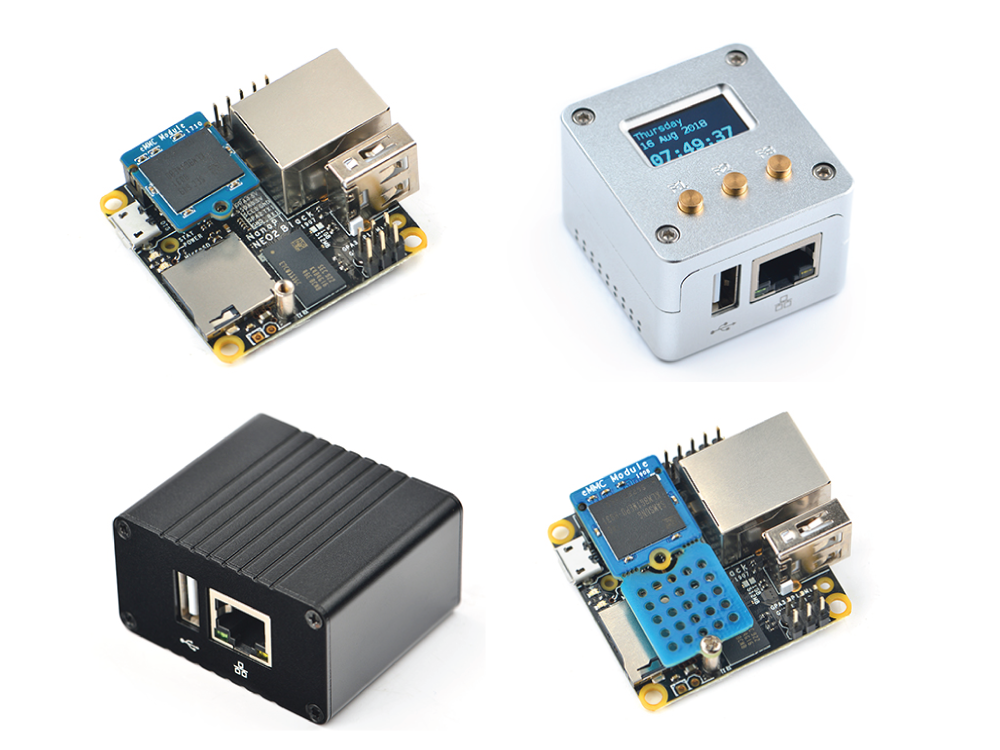
FriendlyElec released plenty of compatible accessories for NanoPi NEO2 Black, including additional eMMC modules, OLED hats and ready-to-use alluminum cases to speed up the implementation.

Latest NanoPi NEO2 Black with IoT accessories & hats
eMMC Modules, compatible alluminum cases and dedicated OLED accessories for NanoPi NEO2 Black

Industrial use of previous OrangePi development boards

Introduced in November 2017, the ModBerry M300 series, based on NanoPi NEO revolutionised the economic segment of Industrial IoT devices and proved, that automation and monitoring can be done effectively with low expenditure on industrial installations.

ModBerry M300 O1 based on OrangePi Zero Plus features Allwinner H5 (Quad-core Cortex-A53) SoC, moderate 512MB RAM, storage memory option with microSD slot, USB and Gigabit Ethernet port. The wireless communication is supported with onboard Wi-Fi module.

Offering much higher performance and wider feature range, the ModBerry M300 O2 features same SoC as M300 series, but thanks to OrangePi Zero Plus2 means, the device is equipped with onboard 8GB eMMC, extra microSD expansion slot as alternative and wired/wireless interfaces, e.g. HDMI, Wi-Fi, Bluetooth 4.0.

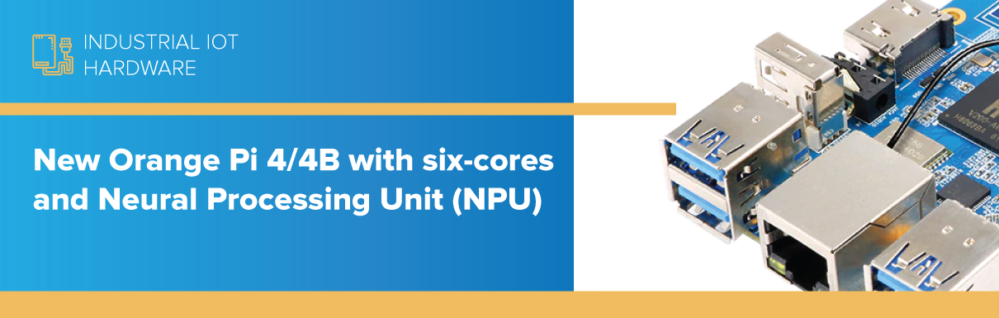
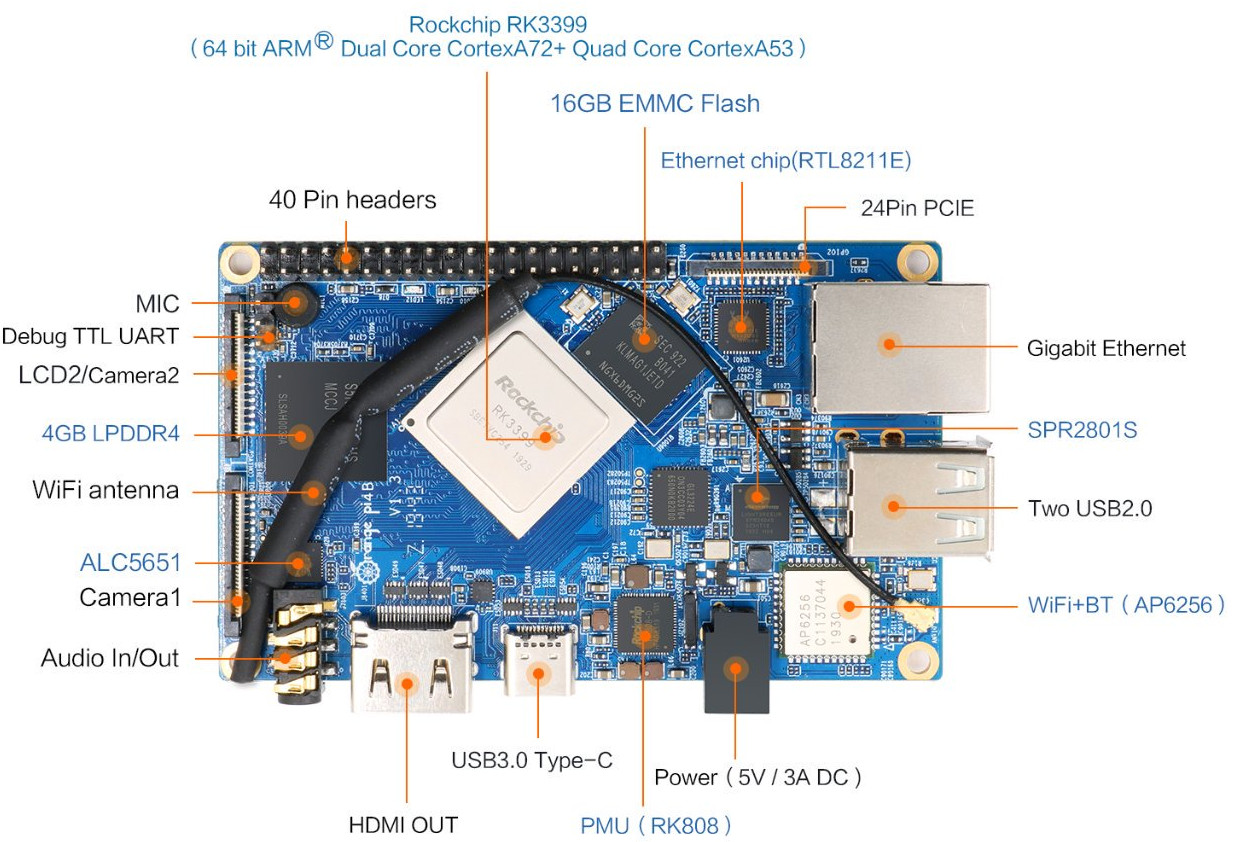
New Orange Pi 4/4B with six-cores and Neural Processing Unit (NPU)

Shenzhen Xunlong Software recently introduced a new Orange Pi microcomputer. According to information provided by the Chinese company, the Orange Pi 4 measures 91 x 56 mm and features a Rockchip K3399 six-core system-on-chip SoC (ARM Mali-T860 MP4 GPU, 4GB of LPDDR4 memory, 16GB of storage). eMMC (expandable via a microSD card), a 24-pin connector, and a 40-pin General-purpose input / output (GPIO) connector.

Orange Pi 4 six-core system
Orange Pi 4B with Neural Processing Unit (NPU)

This microcomputer is also equipped with two camera connectors, one USB 3.0 jack, two USB 2.0 jacks, one USB 3.0 Type-C jack, HDMI 2.0, Gigabit Ethernet and 3.5mm audio jacks, and includes support for Wi-Fi 802.11ac and Bluetooth 4.1 LE.

The secondly introduced Orange Pi 4B model includes a Gyrfalcon Lightspeeur SPR2801S Neural Processing Unit (NPU), two USB 2.0 sockets, as well as a USB 3.0 Type-C socket.

Orange Pi 4/4B preliminary specifications:

  • SoC – Rockchip K3399 hexa-core big.LITTLE processor with two Arm Cortex A72 cores, four Cortex A53 cores, and an ARM Mali-T860 MP4 GPU with support for OpenGL 1.1 to 3.1 support, OpenVG1.1, OpenCL and DX 11
  • System Memory – 4 GB LPDDR4
  • Storage – 16 GB eMMC flash, micro SD card
  • NPU (Orange Pi 4B only) – Gyrfalcon Lightspeeur SPR2801S NPU delivering up to 2.8TOPS @ 300mW, 5.6 TOPS @ 100 MHz (peak performance)
  • Video Output/Display Interface
    • HDMI 2.0 up to 4K @ 60 Hz
    • LCD connector for MIPI DSI display
    • USB-C port with DisplayPort Alternate mode
  • Video Decode – 4K VP9 and 10-bit H.265 video codec support up to 60 fps
  • Audio – 3.5mm audio jack for headphones; HDMI digital audio output; built-in microphone; ALC5651 codec
  • Connectivity – Gigabit Ethernet port (via  RTL8211E transceiver), dual-band 802.11ac 2×2 MIMO WiFi and Bluetooth 5.0 (Ampak AP6256 module)
  • USB
    • Orange Pi 4 – 1x USB 3.0 port, 2x USB 2.0 host ports, 1x USB 3.0 type C port
    • Orange Pi 4B – 2x USB 2.0 host ports, 1x USB 3.0 type C port
  • Camera – 2x camera headers
  • Debugging – 3-pin serial header
  • Expansion
    • 40-pin GPIO 2.54mm pitch female header with 2x I2C, 1x SPI/UART, 8x GPIO, etc…
    • 24-pin connector for PCIe signals
  • Power Supply
    • 5V/3A via DC jack
    • 5V via type C portRK808 PMU
  • Dimensions – 91 x 56 mm

Source: https://www.cnx-software.com/2019/11/19/orange-pi-4-4b-sbc-rockchip-rk3399-soc-gyrfalcon-2801s-npu/

Industrial use of previous OrangePi development boards

Introduced in November 2017, the ModBerry M300 series, based on NanoPi NEO revolutionised the economic segment of Industrial IoT devices and proved, that automation and monitoring can be done effectively with low expenditure on industrial installations.

ModBerry M300 O1 based on OrangePi Zero Plus features Allwinner H5 (Quad-core Cortex-A53) SoC, moderate 512MB RAM, storage memory option with microSD slot, USB and Gigabit Ethernet port. The wireless communication is supported with onboard Wi-Fi module.

Offering much higher performance and wider feature range, the ModBerry M300 O2 features same SoC as M300 series, but thanks to OrangePi Zero Plus2 means, the device is equipped with onboard 8GB eMMC, extra microSD expansion slot as alternative and wired/wireless interfaces, e.g. HDMI, Wi-Fi, Bluetooth 4.0.