
Wpisy

LoRa vs NarrowBand-IoT. What is better for Industrial IoT?

Low-power wide-area (LPWA) technology meets the needs of multiple IoT markets for low-cost devices that maintain long battery life and low-cost, large-area networks that support large numbers of connections. However, LoRa (LoRaWAN) and NarrowBand-IoT have the most momentum and will gain the largest share in the LPWA market in the next few years.

Many technology articles compare LoRa and NB-IoT technologies as if they were battling it out for dominance in the IoT market. In reality, these technologies are two branches within an emerging technology ecosystem. Similar to WiFi and Bluetooth, they will most likely to diverge into different niches, rather than directly compete with each other. This article will dive deeper into the capabilities, costs, longevity, maturity, and other differentiators of NB-IoT and LoRa-based technology.

Source: https://www.linkedin.com/pulse/nb-iot-vs-lora-its-ecosystem-race-art-reed

Sigfox/LoRa and NB-IoT in direct comparison

As a result of the research, performed by Tauron, it was found that SigFox and LoRaWAN technologies have limited applications due to the use of the unlicensed ISM band (868 MHz). In addition, each of the three technologies tested has a limit on the transmission channel speed. LoRaWAN, unlike others, allows the construction of an autonomous, separate network dedicated to the needs of the owner.

LTE NarrowBand-IoT technology, as a 3GPP standard, is being increasingly implemented by subsequent mobile operators in the world and in European countries like Poland. For example, polish main frequencies of NB-IoT implementation are 800 MHz and 900 MHz, which allows achieving high coverage of the country.

Research carried out by Tauron has shown that, considering the security of the solution, the availability of telecommunications infrastructure, or the speed of data transmission (important for meter reading), LTE NB IoT technology is closest to use in the energy sector.

Source: https://www.telko.in/tauron-lepiej-ocenia-nb-iot-niz-lora-i-sigfox

Both LoRa and NB-IoT standards were developed to improve security, power efficiency, and interoperability for IoT devices. Each features bidirectional communication (meaning the network can send data to the IoT device, and the IoT device can send data back), and both are designed to scale well, from a few devices to millions of devices.

Source: https://www.linkedin.com/pulse/nb-iot-vs-lora-its-ecosystem-race-art-reed

Use of LoRa/NB-IoT in industrial automation

Use of wireless connection makes life and work easier for us every day – from radio stations and GSM to Wi-Fi wireless networks, Zigbee, short-range Bluetooth connectivity and LoRa / NarrowBand-IoT wireless solutions. With the spread of internet access, the possibility of using wireless connectivity for a new type of service and application has opened.
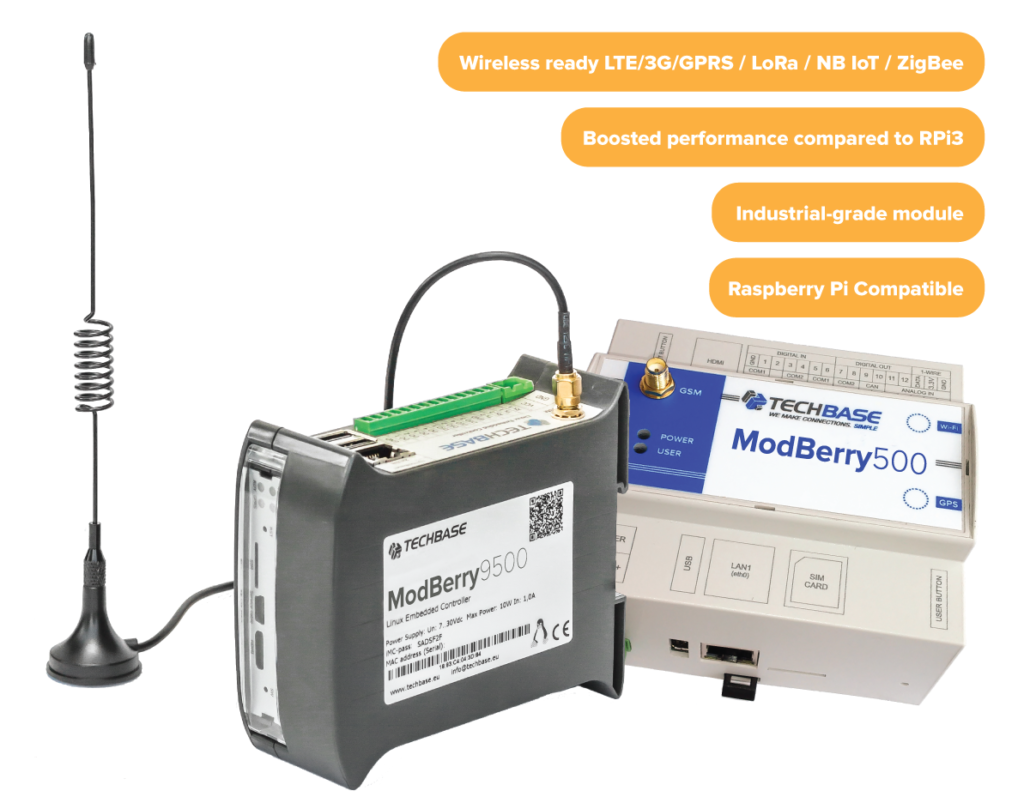
ModBerry 500 / ModBerry 9500

Device equipped with LoRa module is delivered with a LoRaWAN protocol stack, so it can be easily connected to the existing, fast-growing LoRa Alliance infrastructure – both in privately managed local area networks (LAN) and public telecommunications networks to create wide area low power WAN (LPWAN) on a national scale. LoRaWAN stack integration also allows connection to any microcontroller, such as ModBerry industrial device from TECHBASE. Such solutions offer also NarrowBand-IoT and full 4G/LTE support.

The wM-Bus or Wireless Meter Bus is a European standard (EN 13757-4) that defines communication between usability meters and data loggers, hubs or intelligent meter gates. The M-Bus wireless bus has been developed as a standard to meet the needs of the European network of media meters and remote reading systems and forms the basis of a new advanced measurement infrastructure (AMI). The frequency of M-Bus and sub-GHz wireless connections has been used for several years, but is still evolving to adapt to changing environments and take advantage of technological advances, including the emergence of the Internet of Things.

2.4 GHz band vs unlicensed bands

Intelligent network devices require robust long-range wireless communication. The most common frequencies are around 868 MHz, 434 MHz and 169 MHz, which are unlicensed bands in Europe and offer better radio wave propagation compared to 2.4 GHz. By using one of these unlicensed bands, radio waves can reach difficult areas such as underground meters or the location of buildings with many walls or obstacles. Another advantage of operating in the unlicensed band is that utilities have lower solution costs.

COVID-19 and wireless technologies

In times of COVID-19 pandemic hazards, the use of wireless technologies is often a must, to prevent further spread of the coronavirus. One of obvious choices for Internet of Things and home monitorng is Wireless M-Bus implementation.

TECHBASE has added high performance module for Wireless M-Bus connectivity and multi-hop networking into Moduino series expansion options. The module is configured as an embedded micro system or simple data modem for low power applications in the metering specifically allocated band of 169 MHz or in the ISM band of 868 MHz. The device is can be configured for interoperability in a WMBus network for Industrial IoT applications.

The RF implementation guarantees best-in-class performance in terms of covered area and power consumption. The output power can be increased up to +30 dBm on the 169 MHz band (+27 dBm on optimized version for highest power efficiency) and up to +15 dBm on the 868 MHz band. The extremely reduced power consumption gives access to long lasting battery life requirement (up to 2 μA in sleep mode for wireless M-Bus module with an RTC clock running).

The Moduino devices  can be provided with a W-MBus stack specifically developed by Embit for the platform that allows to integrate the module in the desired system without effort and simplify the interaction in WMBus networks.

The wM-Bus or Wireless Meter Bus is a European standard (EN 13757-4) that defines communication between usability meters and data loggers, hubs or intelligent meter gates. The M-Bus wireless bus has been developed as a standard to meet the needs of the European network of media meters and remote reading systems and forms the basis of a new advanced measurement infrastructure (AMI). The frequency of M-Bus and sub-GHz wireless connections has been used for several years, but is still evolving to adapt to changing environments and take advantage of technological advances, including the emergence of the Internet of Things.

2.4 GHz band vs unlicensed bands

Intelligent network devices require robust long-range wireless communication. The most common frequencies are around 868 MHz, 434 MHz and 169 MHz, which are unlicensed bands in Europe and offer better radio wave propagation compared to 2.4 GHz. By using one of these unlicensed bands, radio waves can reach difficult areas such as underground meters or the location of buildings with many walls or obstacles. Another advantage of operating in the unlicensed band is that utilities have lower solution costs.

COVID-19 and wireless technologies

In times of COVID-19 pandemic hazards, the use of wireless technologies is often a must, to prevent further spread of the coronavirus. One of obvious choices for Internet of Things and home monitorng is Wireless M-Bus implementation.

TECHBASE has added high performance module for Wireless M-Bus connectivity and multi-hop networking into Moduino series expansion options. The module is configured as an embedded micro system or simple data modem for low power applications in the metering specifically allocated band of 169 MHz or in the ISM band of 868 MHz. The device is can be configured for interoperability in a WMBus network for Industrial IoT applications.

The RF implementation guarantees best-in-class performance in terms of covered area and power consumption. The output power can be increased up to +30 dBm on the 169 MHz band (+27 dBm on optimized version for highest power efficiency) and up to +15 dBm on the 868 MHz band. The extremely reduced power consumption gives access to long lasting battery life requirement (up to 2 μA in sleep mode for wireless M-Bus module with an RTC clock running).

The Moduino devices  can be provided with a W-MBus stack specifically developed by Embit for the platform that allows to integrate the module in the desired system without effort and simplify the interaction in WMBus networks.