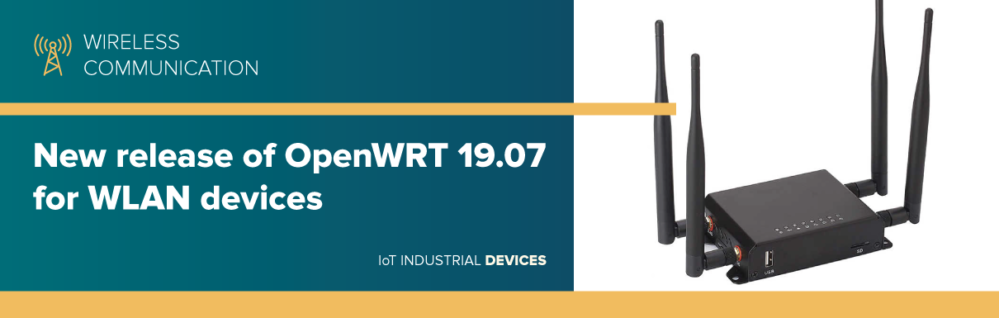
New release of OpenWRT 19.07 for WLAN devices

Good news for developers and modders of router software. A new Linux distribution, OpenWRT 19.07 has just been released, created primarily for WLAN devices, which debuted with the iconic Linksys WRT54G routers. OpenWrt 19.07 is mainly developed for devices using the AVR32, ARM, CRIS, m68k, MIPS, PowerPC, SPARC, SuperH, Ubicom32, x86 and x86-64 architecture.

What’s new in OpenWrt 19.07

A lot changed from the previous version of OpenWrt 18.06 version. Even WPA3 support has been added. However, it is not enabled by default and requires the installation of additional packages. Hostapd-openssl is needed for WPA3 to work in access point mode, it will need wpa-supplicant-openssl or wpad-openssl (additional AP) to use in Wi-Fi station mode.

Software developers have decided to switch to ath79 from ar71xx – in the future support for ar71xx will be completely withdrawn. In addition, the Linux kernel has been updated to version 4.14.162, and support for adm5120, adm8668, ar7, au1000, ixp4xx, mcs814x, omap24xx, ppc40x, ppc44x and xburst has been terminated.

A new feature is the updated LuCI, an integrated web interface for OpenWRT that implements client-side rendering. The LuCI ecosystem is large and not all LuCI applications have been adapted for this change, which can cause cbi.lua crashes. If so, install the luci-compat package.

The latest version of software can be downloaded from the project’s official website, here where you can also find the full list of changes.

Why should you try OpenWRT?

People who like to modify soft routers will confirm: OpenWRT dramatically increases the capabilities of network devices. OpenWRT is several thousand software packages that advanced users can install or remove depending on their needs. The software also improves network security – after all, the router owner will have full control over the configuration of every aspect of the hardware.

Industrial use of OpenWRT-based solutions

One of industrial IoT devices, supporting the technology and it’s varieties is ModBerry M series from TECHBASE. Economical, M300 model, based on NanoPi boards can serve as an OpenWRT modem, with optional changes in standard ModBerry controller. For more information check Industrial IoT Shop with all the configuration options for ModBerry M series .

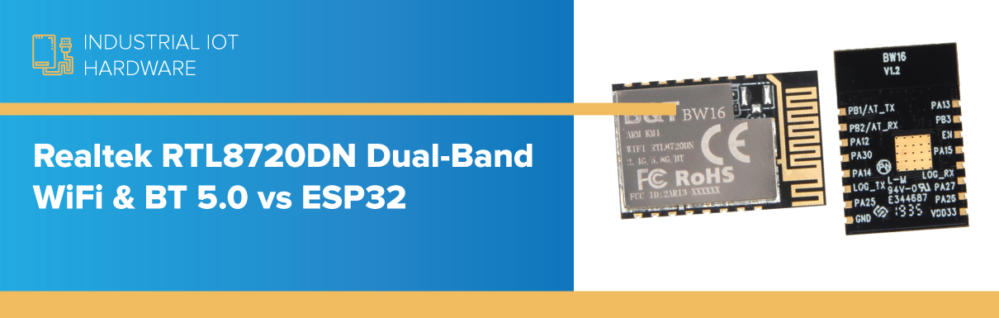
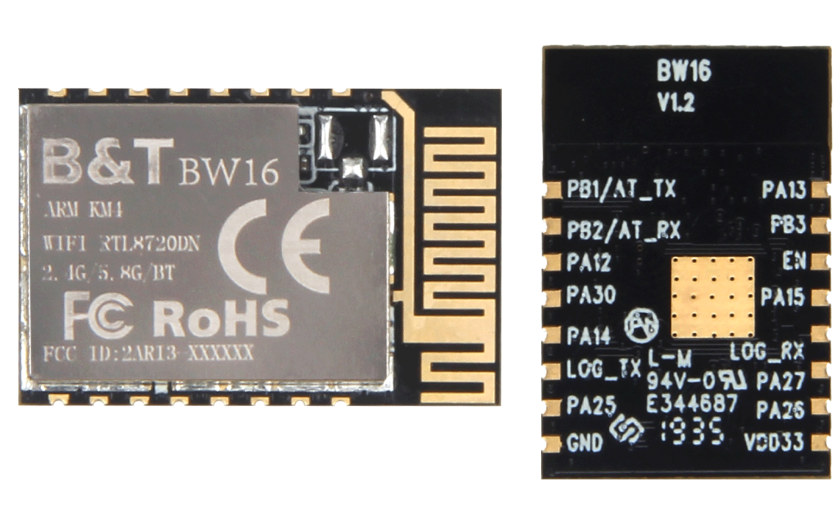
Realtek RTL8720DN Dual-Band WiFi & BT 5.0 vs ESP32

IoT market ofers wide range of small and efficient modules for Home & Industrial Internet of Things applications, equipped with 2.4GHz Wi-Fi, such as Espressif’s ESP32 or older ESP8266 modules. Additional Bluetooth 4.2/5.0 is often found on those. Dual-band Wi-Fi, on the other hand, is hard to find on low-budget IoT modules. Here comes Realtek RTL8720DN.

Realtek RTL2720DN module, as a part of AmebaD family, comes with ARM Cortex-M4/M0 wireless MCU with support of 802.11 b/g/n Dual-Band Wi-Fi 2.4GHz / 5GHz and extra Bluetooth 5.0 wireless connectivity.

Realtek RTL8720DN Dual-Band WiFi & Bluetooth 5.0 module

Realtek RTL8720DN specifications:

  • Wireless SoC – Realtek RTK8720DN MCU with KM4 Arm Cortex-M4 core @ 200 MHz and KM0 Arm Cortex-M0 core @ 20 MHz
  • Connectivity
    • WiFi
      • 802.11 a/b/g/n WiFi 4
      • Frequency Range – 2.412-2.484GHz & 5.180-5.825GHz
      • Data Rates
        • 802.11a: 6,9,12,18,24,36,48,54Mbps
        • 802.11b: 1,2,5.5,11Mbps
        • 802.11g: 6,9,12,18,24,36,48,54Mbps
        • 802.11n: MCS0–MCS7 @ HT20/HT40 2.4GHz and 5GHz bands
      • AP, Station, AP/Client supported
    • Bluetooth
      • Bluetooth 5.0 LE
      • Receiver Sensitivity: -92 dBm
      • Transmit Power: 7 dBm
    • Antenna – IPEX connector or PCB Antenna
  • I/O – 16x castellated holes with GPIO, 2x UART (AT commands + serial), ADC, I2C, SPI, 4x PWM, 3.3V, GND
  • Power Supply – 3.3±5% V
  • Dimensions – 24 x 16 x 3 mm
  • Temperature Range – Operating: -20°C to 85°C; storage: -40°C to 125°C
  • Relative Humidity – 10%~90% (non-condensing)
  • Certifications – FCC, CE, SRRC, RoHS

Source: https://www.cnx-software.com/2020/01/17/realtek-rtl8720dn-dual-band-wifi-bluetooth-5-0-iot-module/

Bluetooth 5.0 update for ESP32

The Espressif’s flagship ESP32 chip recently passed the SIG Bluetooth LE 5.0 certification. This confirms that the version of the protocol supported by the ESP32 microcontroller has been upgraded from Bluetooth LE 4.2 to Bluetooth LE 5.0, which is more stable and compatible.

The implementation and development of the Bluetooth LE (BLE) application requires not only a system that supports this function, but also an attached Bluetooth LE protocol stack consisting of a driver and a host.

Thanks to Bluetooth LE 5.0 certification, ESP32 SoC not only updates the system as a whole, but also adds new features that improve the latest software after passing more stringent tests than previous certification.

Industrial use of ESP32-based solutions

One of industrial IoT devices, supporting Espressif’s ESP32 technology is eModGATE from TECHBASE. Economical, ESP32-based solution can serve as an end-point in any installation or works well as a gateway, gathering data from scattered sensor mesh across the installation. For more information check Industrial IoT Shop with all the configuration options for eModGATE.

eModGATE with ESP32
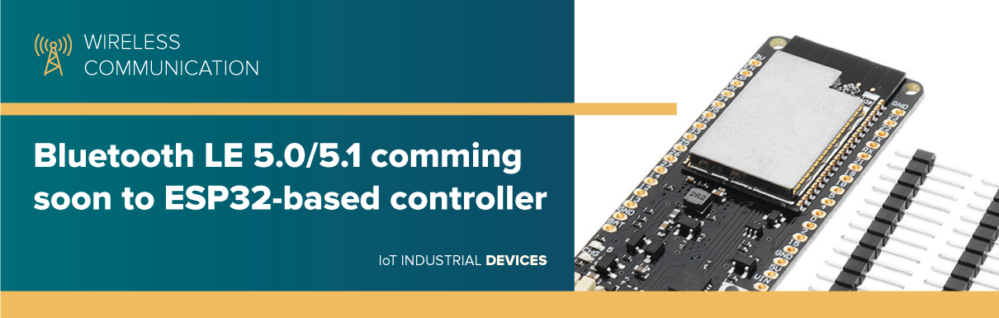
Bluetooth LE 5.0/5.1 comming soon to ESP32-based controller

The Espressif’s flagship ESP32 chip recently passed the SIG Bluetooth LE 5.0 certification. This confirms that the version of the protocol supported by the ESP32 microcontroller has been upgraded from Bluetooth LE 4.2 to Bluetooth LE 5.0, which is more stable and compatible.

The implementation and development of the Bluetooth LE (BLE) application requires not only a system that supports this function, but also an attached Bluetooth LE protocol stack consisting of a driver and a host.

Bluetooth 5.0 update for ESP32

Thanks to Bluetooth LE 5.0 certification, ESP32 SoC not only updates the system as a whole, but also adds new features that improve the latest software after passing more stringent tests than previous certification.

Due to hardware limitations, ESP32 does not support such functions of Bluetooth LE 5.0 as 2M PHY, LE Long Range, and ADV Extensions.

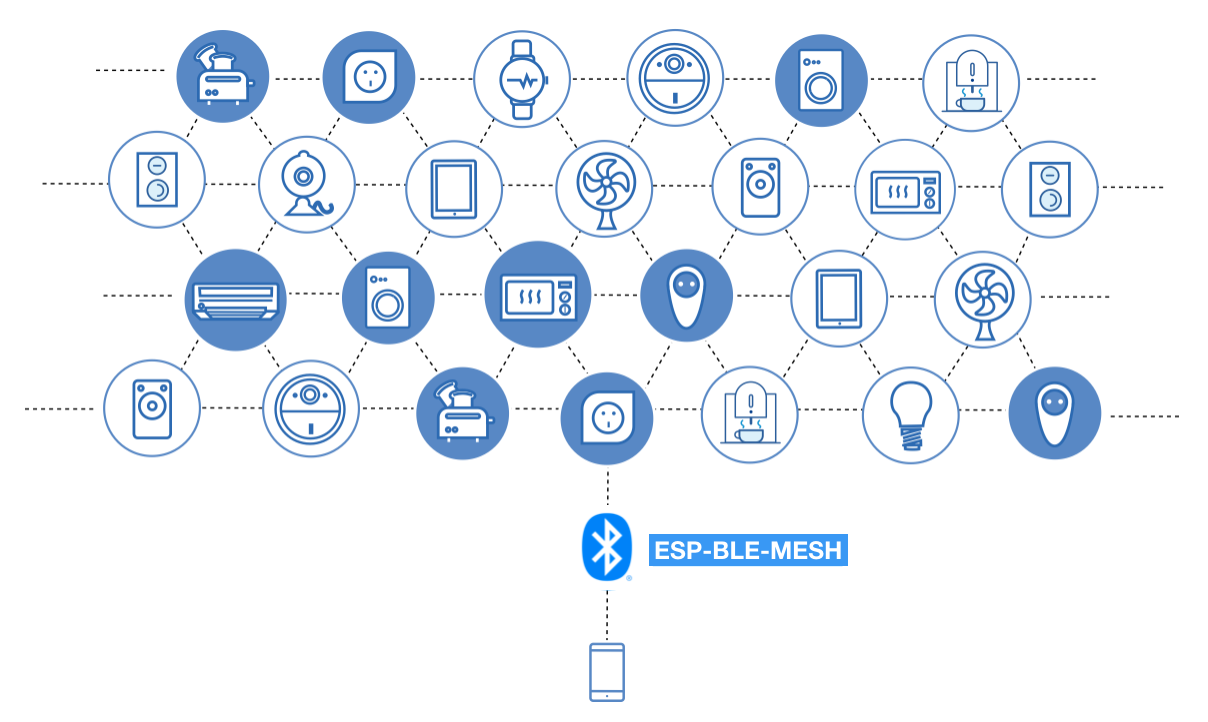
It is also worth mentioning that the combination of Bluetooth and Mesh networking is expected to become a key technology for the Internet of Things. A  Bluetooth® Mesh network enables a „many-to-many” relationship among potentially thousands of wireless devices, where data are transmitted not in a direct radio range but in wide physical areas. Espressif’s contribution in this field is the ESP-BLE-MESH, which got fully certified by Bluetooth SIG in September 2019.

Several Bluetooth-operated products on the market, such as wearable devices, smart speakers, cleaning robots, smart lights/sockets, etc., provide evidence that Bluetooth 5.0 and the Bluetooth Mesh networking technology are mature enough to drive the development of interconnected IoT devices. To this end, Espressif’s chips and ESP-BLE-MESH, in particular, are designed to help customers develop easily secure and cost-effective products for smart homes, smart buildings, healthcare, new automobiles and other smart industries.

Source: https://www.espressif.com/en/news/BLE_5.0_Certification

Industrial use of ESP32-based solutions

One of industrial IoT devices, supporting Espressif’s ESP32 technology is eModGATE from TECHBASE. Economical, ESP32-based solution can serve as an end-point in any installation or works well as a gateway, gathering data from scattered sensor mesh across the installation. For more information check Industrial IoT Shop with all the configuration options for eModGATE.

eModGATE with ESP32
New industrial single-board computer from Banana Pi

A new industrial-class single-board computer, called Banana Pi BPI-F2S, was released with Linux 4.19. Banana Pi BPI-F2S is a new SBC from BPI Tech – a daughter company of SinoVoIP. The heart of Banana Pi BPI-F2S is the SP7021 chip from SunPlus containing a 1GHz Cortex-A7 quad-core ARM processor, A962 type ARM coprocessor and 8051 controller. More information about the SP7021 chip is available in the Wiki.

Industrial Banana Pi BPI-F2S
Banana Pi BPI-F2S

For storage, the Banana Pi BPI-F2S has an 8 GB eMMC flash and a microSD card slot. Here is the rest of the list of specifications:

  • Video output: HDMI 1.4
  • I / F camera: MIPI CSI connector
  • Connectivity: two 10/100 Ethernet
  • USB: two USB 2.0 ports, one micro USB port
  • Power supply: 12 VDC
  • Expansion: 40-pin GPIO compatible with Raspberry Pi
  • Two 50-pin FPGA interfaces for Trenz Electronic Trix Electronic TE0725LP-01-100-2D Artix 7 board

Banana Pi BPI-F2S a new industrial SoC on the market

SunPlus SP7021 is a revolutionary SoC that has the power of a Linux-grade chip and the integration simplicity of a microcontroller. With ARM Cortex-A7 Quad core, ARM926 real-time core. Designed by Sunplus Technology in collaboration with Tibbo Technology, PLUS1 takes all the sophisticated elements typically found in modern industrial-grade embedded Linux chips, adds a plethora of features targeting IoT and industrial control applications, and delivers the resulting design in a simple microcontroller-like package that needs few external components, simplifies the schematic diagram, and reduces the PCB complexity.”

Industrial Banana Pi BPI-F2S
Banana Pi BPI-F2S (SP7021)

SP7021 is a SoC solution of industrial control. It meets customers’ full demand on function but with low cost so that will improve customers’ competitiveness in the market. SP7021 provides rich GPIOs, storage and USB interface. And it provides MIPI CSI interface for video input and HDMI interface for video output. It also provides FPGA interface for function extension. SP7021 also has 4 Ethernet ports providing customers a high competitive solution.

Source: https://www.hackster.io/bananapi/banana-pi-bpi-f2s-with-sunplus-sp7021-chip-design-e108ff

Industrial use of previous BananaPi-like development boards

Introduced in November 2017, the ModBerry M300 series, based on NanoPi NEO revolutionised the economic segment of Industrial IoT devices and proved, that automation and monitoring can be done effectively with low expenditure on industrial installations.

ModBerry M300 O1 based on OrangePi Zero Plus features Allwinner H5 (Quad-core Cortex-A53) SoC, moderate 512MB RAM, storage memory option with microSD slot, USB and Gigabit Ethernet port. The wireless communication is supported with onboard Wi-Fi module.

Offering much higher performance and wider feature range, the ModBerry M300 O2 features same SoC as M300 series, but thanks to OrangePi Zero Plus2 means, the device is equipped with onboard 8GB eMMC, extra microSD expansion slot as alternative and wired/wireless interfaces, e.g. HDMI, Wi-Fi, Bluetooth 4.0.

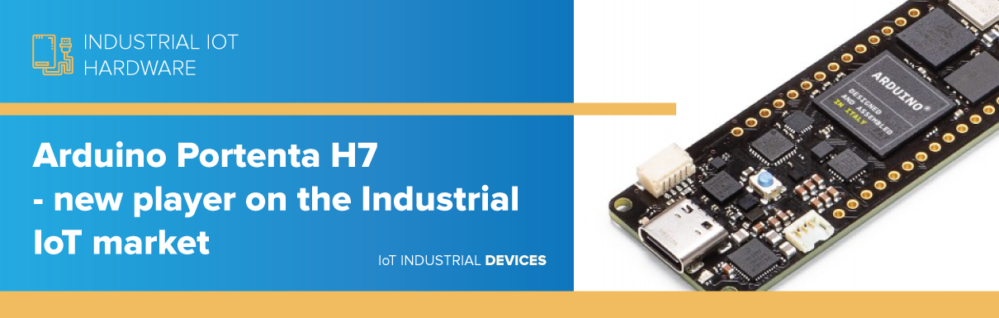
Arduino Portenta H7 - new player on the Industrial IoT market

At the Consumer Electronics Show 2020, Arduino has made a possibly groundbreaking announcement with the Arduino Pro IDE. This could bring the maker scene and classic industrial companies closer together.

Arduino Portenta H7 features

The Portenta H7 is equipped with an STM32H747Xi with a Cortex-M7 and a Cortex-M4. Portenta H7 has 2 megabytes of RAM and a 16 MByte NOR flash. An SD card can be connected via an adapter. The connection to a wireless network is via WiFi 802.11 b/g/n or Bluetooth 5.1. The charging electronics for a 3.7 volt LiPo battery are already integrated.

With the Arduino Portenta H7, the first model of the new Portenta family was announced. This should be tailored specifically to the needs of industrial applications, AI and robotics scenarios.

Arduino Portenta H7
Arduino Portenta H7

The model is equipped with two 80-pin connectors, plus four UART ports. USB Type-C port can output image signals via DisplayPort. The Portenta H7 is also programmable with an interpreter in MicroPython, JavaScript and TensorFlow Light. The single-platinum calculator should be available from February for 90 euros.

Source: https://www.linuxinsider.com/story/86448.html

What the world says about Arduino Portenta?

Fabio Violante, CEO of Arduino, said manufacturers will be able to create modules for robotics, 3D printer and more:

Portenta H7 is directly compatible with other Arduino libraries and offers new features that will benefit hardware manufacturers, such as a DisplayPorl output, much faster ADC multi-channel and high-speed timers.

Arduino Portenta Carrier

Meanwhile, Charlene Marini, vice president of strategy for Arm’s IoT Services Group commented:

SMEs with industrial requirements require simplified development through secure development tools, software and hardware to economically realize their IoT use cases.

ARM Partnership cooperation

ARM works with Arduino to provide secure, easy-to-manage and manageable devices to a wide range of programmers. Two innovations to date show the results of this partnership.

„Mbed OS Portenty is one of the concrete achievements of the partnership,” said Marini. „Another example is the Arduino SIM card, which uses Pelion connection management.”

She said companies have the ability to provide secure Internet of Things on a large scale. This is the foundation of machine learning, automation and the rapid evolution of applications that cross the physical and digital world.

eModGATE with ESP32

Industrial use of Arduino-like solutions

One of industrial IoT devices, supporting Arduino-like technology is eModGATE from TECHBASE. Economical, ESP32-based solution can serve as an end-point in any installation or works well as a gateway, gathering data from scattered sensor mesh across the installation. For more information check Industrial IoT Shop with all the configuration options for eModGATE.

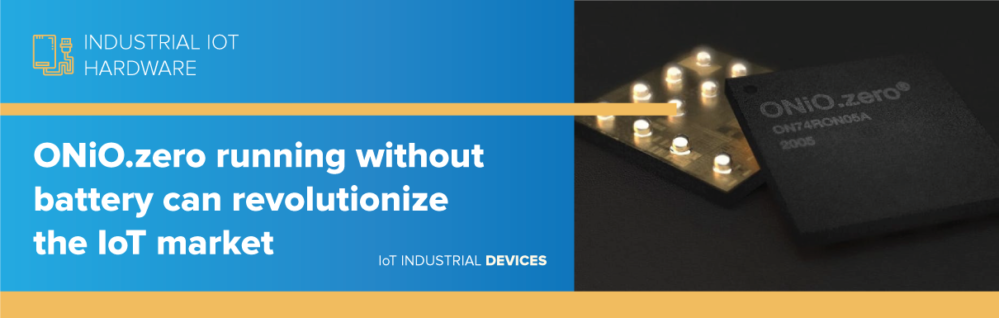
ONiO.zero running without battery can revolutionize the IoT market

ONiO, a Norwegian specialist in the field of the Internet of Things (IoT) for the medical industry, announced ONiO.zero, a RISC-V-based microcontroller with very low power consumption, which can work completely from the energy harvested from the environment. ONiO claims that its design can take energy from the radio spectrum and operate up to 24 MHz.

„ONiO.zero is a wireless MCU with very low power consumption, which uses energy acquisition technology,” wrote the company about its creation. This means that ONiO.zero only works on ambient energy. There are no coin cells, supercaps, lithium and batteries, but still offers a lot of performance.

Battery-based solutions have an unavoidable warning about battery replacement. This leads to increased costs over the entire lifetime. ONiO.zero avoids this problem and reduces operating costs. ONiO.zero is self-powered and supports a wide range of power sources, from multi-frequency RF bands supporting GSM and ISM to optional external sources such as solar, piezoelectric, thermal and voltaic.

Source: https://www.hackster.io/news/onio-zero-offers-up-to-24mhz-of-risc-v-microcontroller-performance-on-nothing-but-harvested-energy-70285321d50d

The microcontroller itself is based on the architecture of the RISC-V instruction set of the open source type (in particular RV32EMC) and operates up to 24 MHz with a supply voltage of 1.8 V. The controller will work if necessary with lower voltages. You can get 6 MHz at 1 V and 1 MHz at 0.8 V, and the system still runs slower, but as fast as 450 mV. Includes 1 KB ROM and 2 KB RAM, as well as 8-32 KB of ultra low power flash memory, capable of 100,000 read and write cycles up to 850 mV.

ONIO.zero running without battery can revolutionize the IoT market

ONiO.zero contains a crystalline Low Energy Bluetooth transmitter (BLE) that can operate at a voltage as low as 850mV, an IEEE 802.15.4 (UWB) broadband transmitter operating in the 3.5-10 GHz band, and optional radio transmitter 433 MHz MICS for the industrial, scientific and medical band (ISM).

ONiO.zero hasn’t been released yet. For more information check the ONiO.zero product page.

Battery-ready IoT devices based on ESP32

Battery / SuperCap power support allows the processes and data to be securely executed, saved or transferred, and the operating system to be safely shutdown or reboot, if the power source has been restored. The power failure alert can also be sent to cloud service, to perform custom task, specified by user or self-learning AI algorithm.

The Moduino device is a comprehensive end-point controller for variety of sensors located throughout any installation. It fully supports temperature and humidity sensors and new ones are currently developed, e.g. accelerometer, gyroscope, magnetometer, etc.

Battery powered Moduino ESP32
Battery powered IoT installation. Source: https://moduino.techbase.eu/

ModuinoModBerry symbiosis allows wide range of wake-up/sleep schedule customization, in order to perform best and save energy accordingly to power supply state. Arduino and MicroPython environments provide libraries to control different scenarios of data and power management.

With built-in algorithms and the possibility to program on your own, the TECHBASE’s sleep/wake addon module can wake the device using schedule/timer. Another option is wake on external trigger, e.g. change of input, etc. All the options for sleep, shutdown and wake can be configured for various scenarios to ensure constant operation of devices, safety of data and continuity of work in case of power failure in any installation.


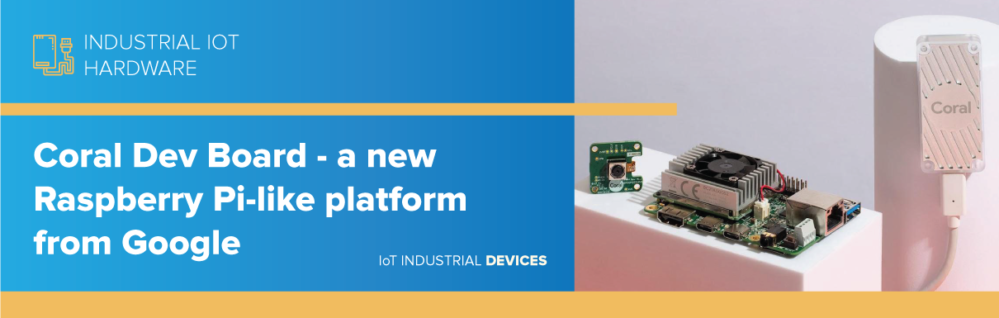
Coral Dev Board - a new Raspberry Pi-like platform from Google

The Coral platform launched by Google is expected to contribute to the easier creation of systems in the field of the Internet of Things. During CES 2020, the manufacturer will devote a lot of attention to her.

Google presented a new, miniature accelerator module for the Coral platform. The sensor has dimensions of only 10×15 mm, so it is smaller than the American one-cent coin. Coral is a Google platform created to facilitate the construction of equipment compatible with the Internet of Things technology, equipped with artificial intelligence.

Components produced by Google have already been used to create many intelligent systems used, for example, in healthcare, agriculture or technologies supporting the functioning of cities. Coral works well also in offline mode and with limited connectivity. The new module is expected to increase its functionality.

The Coral Dev Board together with the USB and PCIe accelerator went on sale in 2019, and is now being sold in 36 countries. We can expect many innovations related to this technology during CES 2020. Google announces that it has prepared various demonstrations of the new module capabilities for this meeting.

Google’s Coral Dev Board

Coral Dev Board

Unlike popular single board, Raspberry Pi or Raspberry’s Chinese competitors, according to Google, Coral Dev Board is to be a specialized computer – it is primarily targeted at developers who want to have a device on which algorithm learning is possible. The computer is running Mendel Linux built on Debian, we will also find Tensor Flow Lite libraries with ready-to-compile models. No internet connection is required in the learning process – the entire process is done locally.

From the hardware side, the most important here is the Edge TPU coprocessor – a Google tensor system designed to be used together with the Tensor Flow library used in machine learning. In addition, the board got the ARM 4-core NXP i.MX 8M processor, GC7000 Lite Graphics, as much as 1 GB of RAM (LDPRR4) and 8 GB of eMMC memory. Coral connects to other devices via Wi-Fi oral USB Accelerator and Bluetooth 4.1.

Therefore, it cannot be said that, compared to other SBC Coral, it is hardware limited. What’s more, it has a microSD card slot, two USB type C sockets (one for power supply, the other for data transfer), minijack output, HMDI output, GPIO pins. The device can also be connected to the Internet via a cable with an RJ-45 plug. It is also possible to buy a camera useful in machine learning image processing algorithms.

Industrial use of Raspberry Pi-like development boards

Introduced in November 2017, the ModBerry M300 series, based on NanoPi NEO revolutionised the economic segment of Industrial IoT devices and proved, that automation and monitoring can be done effectively with low expenditure on industrial installations.

ModBerry M300 O1 based on OrangePi Zero Plus features Allwinner H5 (Quad-core Cortex-A53) SoC, moderate 512MB RAM, storage memory option with microSD slot, USB and Gigabit Ethernet port. The wireless communication is supported with onboard Wi-Fi module.

Offering much higher performance and wider feature range, the ModBerry M300 O2 features same SoC as M300 series, but thanks to OrangePi Zero Plus2 means, the device is equipped with onboard 8GB eMMC, extra microSD expansion slot as alternative and wired/wireless interfaces, e.g. HDMI, Wi-Fi, Bluetooth 4.0.

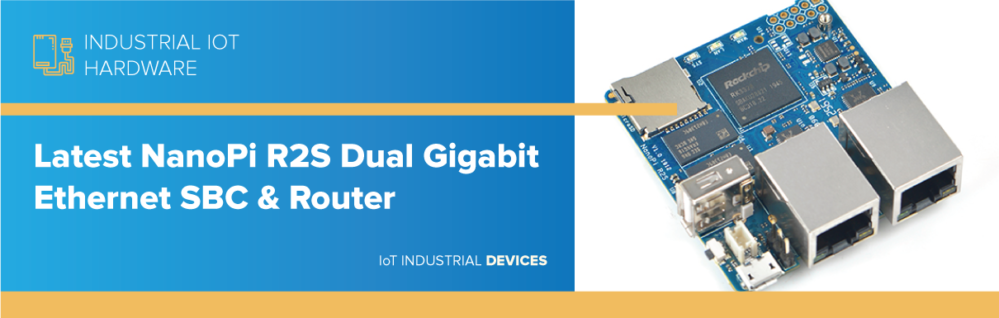
Latest NanoPi R2S Dual Gigabit Ethernet SBC & Router

The new NanoPi R2S is based on the Rockchip RK3328 processor, adding system memory, including 1 GB DDR4 RAM, and is designed to support 4G LTE via the Huawei 8372H-155 USB dongle. R2S is equipped with two Gigabit Ethernet ports (with one deployed for WAN and the other for LAN). This board can surely be used in industrial and Internet of Things (IoT) applications.

Most features resemble an update, but NanoPi R2S does not have built-in Wi-Fi for unknown reasons and certainly seems to be a downgrade. However, instead of built-in WiFi, friendlyELEC recommends using the RTL8821CU USB dongle, which is immediately supported with the default firmware.

NanoPi R2S specifications:

  • SoC – Rockchip RK3328 quad-core Cortex-A53 @ 1.5 GHz with Arm Mali-450MP2
  • System Memory – 1GB DDR4 RAM
  • Storage – MicroSD Slot, SPI flash footprint
  • 1x Gigabit Ethernet (WAN) up to 941 Mbps (measured)
  • 1x Gigabit Ethernet (LAN) up to 941 Mbps (measured) via Realtek RTL8153 USB 3.0 to Ethernet controller
  • USB – 1x USB Type-A host port, 1x micro USB port (power + slave)
  • Debugging – 3-pin 2.54mm pitch header for serial console
  • Expansion – 10-pin GPIO header with GPIOs, I2C, UART, IR_Rx, 5V, 3.3V and GND
  • Misc – 3x LEDs (WAN, LAN, SYS), K1 reset button, fan header
  • Power Supply – 5VDC/3A via micro USB port
  • Dimensions – 55.6 x 52mm
  • Temperature Range – -20℃ to 70℃

Source: https://www.cnx-software.com/2020/01/16/nanopi-r2s-dual-gigabit-ethernet-sbc-router-is-powered-by-rockchip-rk3328-soc/

NanoPi R2S layout
NanoPi R2S layout

Industrial use of previous OrangePi development boards

Introduced in November 2017, the ModBerry M300 series, based on NanoPi NEO revolutionised the economic segment of Industrial IoT devices and proved, that automation and monitoring can be done effectively with low expenditure on industrial installations.

ModBerry M300 O1 based on OrangePi Zero Plus features Allwinner H5 (Quad-core Cortex-A53) SoC, moderate 512MB RAM, storage memory option with microSD slot, USB and Gigabit Ethernet port. The wireless communication is supported with onboard Wi-Fi module.

Offering much higher performance and wider feature range, the ModBerry M300 O2 features same SoC as M300 series, but thanks to OrangePi Zero Plus2 means, the device is equipped with onboard 8GB eMMC, extra microSD expansion slot as alternative and wired/wireless interfaces, e.g. HDMI, Wi-Fi, Bluetooth 4.0.

Latest NanoPi NEO2 Black with IoT accessories & hats

FriendlyElec has launched a new NanoPi microcomputer that can be used in Internet of Things (IoT), automation and storage projects. The NanoPi NEO2 Black measures 40 x 40 mm, weighs 16 grams, and is equipped with an Allwinner H5 four-core processor with ARM Mali-450MP GPU, 1GB DDR3 memory, and has a connector for an eMMC storage module and a slot for a microSD card.

This microcomputer also has two 6-pin and 10-pin connectors, a USB 2.0 socket, a microUSB OTG socket, and a Gigabit Ethernet port (RTL8211E-VB-CG chip). NanoPi NEO2 Black, which can use Armbian, Ubuntu 18.04 (FriendlyCore) and OpenWrt (FriendlyWrt) operating systems, is available to order with a price starting at $ 19.99.

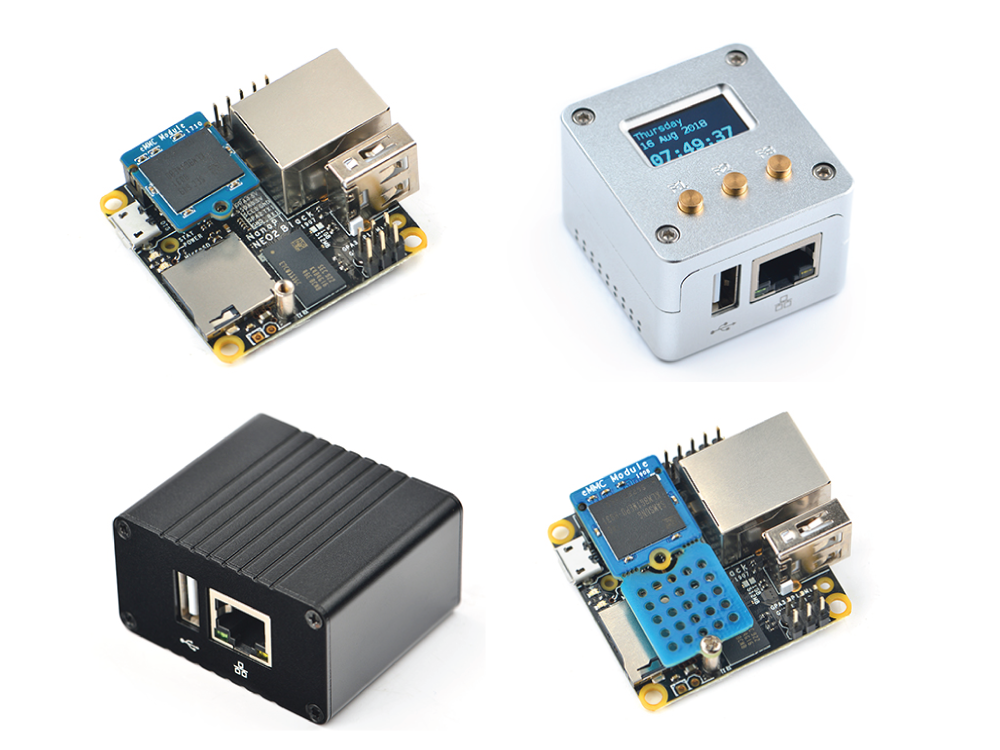
NanoPi NEO2 Black Layout

NanoPi NEO2 Black specifications:

  • SoC – Allwinner H5 quad-core Cortex A53 processor with an ARM Mali-450MP GPU
  • System Memory – 1GB DDR3
  • Storage – MicroSD card slot, eMMC flash module connector
  • Connectivity – Gigabit Ethernet (via RTL8211E-VB-CG chip)
  • USB – 1x USB 2.0 host port, 1x micro USB OTG port, 1x USB via headers
  • Expansion headers10-pin header with I2C, UART, GPIOs, and power signals (5V in/out + GND)
  • 6-pin header with 1x USB, Line Out (stereo), 1x GPIO
  • Debugging – 2-pin unpopulated header for serial console / debugging
  • Misc – Power and system LEDs
  • Power Supply – 5V via micro USB port or VDD pin on headers.
  • Dimensions – 40 x 40 mm
  • Weight – ~16 grams

Source: https://www.cnx-software.com/2019/11/27/buy-nanopi-neo2-black-sbc/

Variety of supported IoT accessories from FriendlyElec

FriendlyElec released plenty of compatible accessories for NanoPi NEO2 Black, including additional eMMC modules, OLED hats and ready-to-use alluminum cases to speed up the implementation.

Latest NanoPi NEO2 Black with IoT accessories & hats
eMMC Modules, compatible alluminum cases and dedicated OLED accessories for NanoPi NEO2 Black

Industrial use of previous OrangePi development boards

Introduced in November 2017, the ModBerry M300 series, based on NanoPi NEO revolutionised the economic segment of Industrial IoT devices and proved, that automation and monitoring can be done effectively with low expenditure on industrial installations.

ModBerry M300 O1 based on OrangePi Zero Plus features Allwinner H5 (Quad-core Cortex-A53) SoC, moderate 512MB RAM, storage memory option with microSD slot, USB and Gigabit Ethernet port. The wireless communication is supported with onboard Wi-Fi module.

Offering much higher performance and wider feature range, the ModBerry M300 O2 features same SoC as M300 series, but thanks to OrangePi Zero Plus2 means, the device is equipped with onboard 8GB eMMC, extra microSD expansion slot as alternative and wired/wireless interfaces, e.g. HDMI, Wi-Fi, Bluetooth 4.0.

Ubuntu Touch for Raspberry Pi 7-inch display

UBPorts community has released an update claiming to support Ubuntu Touch running on a Raspberry Pi 3 with an official 7-inch Raspberry Pi touchscreen. The Raspberry Pi is growing as the Ubuntu Touch programming platform, says UBports founder Marius Gripsgård in the attached video below. However, there was no demo. In this film, UBports creator Florian Leeber added that the Raspberry Pi platform can also serve as the home touch interface for the Internet of Things and other applications.

The key to Pi support is the recent merger of the libhybris project and ARM64 at the “edge” that points to the repository used by the project. This should also facilitate portability to other Arm-based platforms.

A new feature of Ubuntu Touch is the ability to run a Mir display server in Wayland using the Wayland protocol. It is said to enable user session suspension, save battery life, and improve security and privacy. This work has improved the handling of Bluetooth headsets with the upgrade to the BlueZ Bluetooth daemon and PulseAudio patch.

Ubuntu Touch’s way to 64-bit IoT applications

Ubuntu Touch is a special version of Ubuntu, which was designed for mobile devices with touch screens, and more specifically for smartphones and tablets. Unfortunately, Ubuntu was abandoned before conquering the market. However, as is the case in the Open Source world, someone has taken over and developed this project. Ubuntu Touch has just been released in the 64-bit version.

Just two years ago, Canonical was working hard on the Unity8 graphics environment and the Mir display server. Work on these projects was already in a fairly deep stage, and the British giant was tempted to add Unity8 to one of the Ubuntu versions. Unfortunately, at this point the environment was – to put it mildly – infinite and did not work very well (at least in my case). How does it connect with Ubuntu Touch? Well, Ubuntu Touch also used Unity8 and Mir, and both platforms – Desktop PC and mobile – were to be unified. Unfortunately, to the surprise of project enthusiasts, Canonical decided to abandon their work and after a few years of separation return to GNOME and leave the mobile world completely.

It is true that Canonical abandoned their projects, but there was another team that wanted to take them in. We are talking about the UBports group, which is gradually updating Ubuntu Touch and spending them on new models.

Ubuntu Touch. Source: https://twitter.com/UBports

After months of announcements, the Ubuntu Touch project finally got a 64-bit compilation. Earlier, even operating on a suitable processor, this system operated only in 32-bit mode. This is a big step forward, although the compatibility list typically fails.

The change in the UI range will only be introduced by the OTA-12 update, anticipated for an undefined future. But with Ubuntu Touch 64-bit debuts Telegram client – TELEports 0.6.0.

The creators admit that they delayed 64-bit binaries, considering them unnecessary, especially for equipment with less than 4 GB RAM. Now, however, according to new observations, they have changed their minds. Of course, the system itself is not everything. You still need to recompile the apps. But this is to take place successively, based on the base in the form of an already operating system.

Ubuntu Touch for Raspberry Pi Compute Module?

Will Raspberry Pi Compute Module powered solutions get a support for Ubuntu Touch? Maybe the transition to 3rd party devices will be seamless, because of Ubuntu Touch already working on official Raspberry Pi 7-inch display. Similiar soliutions, such as TECHBASE’s TECHPANEL P500 with Compute Module 3/3+ support might be the first device with fully working Ubuntu Touch.

TECHPANEL P500 with CM3/3+ support. Source: https://iiot-shop.com/product/techpanel-p500/