Silicon Labs recently announced two hardware modules based on its BG22 Secure Bluetooth 5.2 SoC: 6x6mm BGM220S system bundled (SiP) and slightly optimized for wireless performance with a better link budget. BGM220P introduced, large PCB variant, wider range.
Both modules can be integrated into products with a battery life of up to 10 years using a single coin cell battery. All variants of BGM220S/P can support Bluetooth directional discovery, and some components can also support Bluetooth mesh low power protocol.
Main features
Silicon Labs EFR32BG22 Arm Cortex-M33 with DSP instructions and floating-point unit, up to 512 kB Flash, 32 kB RAM, 2.4 GHz radio with TX power up to 8 dBm, and Embedded Trace Macrocell (ETM) for advanced debugging
One of industrial IoT devices, supporting Espressif’s ESP32 and Bluetooth technology is eModGATE from TECHBASE. Economical, ESP32-based solution can serve as an end-point in any installation or works well as a gateway, gathering data from scattered sensor mesh across the installation. For more information check Industrial IoT Shop with all the configuration options for eModGATE.
https://iot-industrial-devices.com/wp-content/uploads/2020/09/bluetooth-5-2.png3851210adminhttps://iot-industrial-devices.com/wp-content/uploads/2019/11/iot-industrial-devices-1.pngadmin2020-12-21 08:24:002020-12-22 14:26:38Bluetooth 5.1 / 5.2 and Bluetooth Mesh in new Silicon Labs modules
New features of Edge TPU brought to ModBerry series
In October 2020, with the release of the latest Compute Module 4 from Rasbperry Pi Foundation, TECHBASE announced an upgraded device from ModBerry 500 series, called ModBerry 500 CM4. Thanks to the high-performance PCI-Express bus introduced in Compute Module 4 and Raspberry Pi community, the device itself presents support for a wide range of new applications, such as use of Google’s Artificial Intelligence modules at ease.
Therefore, TECHBASE designed a new device, called ModBerry AI GATEWAY 9500-CM4, utilizing the vertical format of ModBerry 9500, latest Compute Module 4 and Google’s Coral TPU. Installation-ready AI GATEWAY allows direct application in industrial fields.
AI GATEWAY with Coral TPU enhancement
Neuron network capabilities enhance CM4-based devices, not only collecting and sending data, but also allows local data change predictions and allows direct management on-site. This feature gives the possibility for various applications, such as data analysing and establishing trends predictions, smart alarms and smart monitoring, local notification control, etc.
Used Edge TPU coprocessor via PCI-Express bus is capable of performing 4 trillion operations per second (TOPS), using 0.5 watts for each TOPS (2 TOPS per watt). Google Coral easily integrates with Raspberry Pi Compute Module in Linux and optionally in Windows with full support of TensorFlow Lite framework and AutoML Vision Edge solution.
TECHBASE’s AI GATEWAY series, world-first industrial gateway utilizing Raspberry Pi Compute Module 4 and Google Coral TPU
AI GATEWAY with available expansion cards
ModBerry AI GATEWAY 9500-CM4 can be equipped with serial RS-232/485 ports, range of digital and analog I/Os, USB, HDMI and Ethernet. Interfaces can be expanded with additional I/Os and opto-isolation, relays, Ethernet, 1-Wire, CAN, M-Bus Master and Slave, accelerometer, OLED screen and many more features like TPM Security Chip, eSIM and SuperCap backup power support.
ModBerry AI GATEWAY 9500-CM4 series also offers a standard PCI module support for various wireless communication protocols, such as:
GSM modem (4G/LTE and fast 5G modem, interchangeable with Coral TPU)
economic NarrowBand-IoT technology
LoRa, ZigBee, Sigfox, Wireless M-Bus
secondary Wi-Fi/Bluetooth interface or Wi-Fi Hi-Power
custom wireless interfaces
ModBerry AI GATEWAY 9500-CM4 availabilityFirst prototypes are being developed, since Compute Module 4 is already available for the purchase. Delivery time for various configurations of AI GATEWAY will be approximately 2 months, depending on the CM4 supply on the market and chosen expansion cards. For more information contact TECHBASE’s Sales Department via email or Live Chat here.
https://iot-industrial-devices.com/wp-content/uploads/2020/12/ai-gateway.png3851210adminhttps://iot-industrial-devices.com/wp-content/uploads/2019/11/iot-industrial-devices-1.pngadmin2020-12-03 18:06:142021-02-02 11:33:51World-first industrial AI Gateway for Machine Learning
ZigBeemesh’s usefulness for IoT is partly due to the fact that it is an open standard. The same products can be used all over the world, which gives customers a large selection of available option. The high competition between products and producers means that the created solutions are innovative, characterized by high quality and give customers a considerable choice. Many suppliers of cooperating elements of this ecosystem mean that they are not limited to any specific brands or specific semiconductor manufacturers.
ZigBee Mesh. Source: ZigBee Alliance
Compatibility is also promoted, as ZigBee Mesh 3.0 brings all the various ZigBee environments to a single, unified standard. Over the years, ZigBee has covered applications ranging from industrial to business to home, which has led to the development of separate service standards. ZigBee 3.0 collects all these various applications under one umbrella. This eliminates the need for mediation bridges between different sets of ZigBee supporting devices. All of them will be able to communicate directly, regardless of type.
Competitiveness of ZigBee based solutions
With a maximum data bandwidth of 250 kbps at 2.4 GHz, ZigBee is slower than other popular wireless standards such as Wi-Fi or Bluetooth, but it doesn’t matter in typical sensor applications. ZigBee Mesh is designed to send small data packets at relatively long intervals, which is usually sufficient to collect data from temperature sensors, safety sensors, air quality monitoring systems and similar subsystems. In the meantime, the low bandwidth affects the low power needed for the system to work, so that ZigBee nodes can usually work for many years on a single AAA battery.
ZigBee Power Consumption. Source: ZigBee Alliance
With low power consumption, ZigBee supporting products typically have a short transmission range – typically from 10 to 15 meters, and the signal they emit is easily disturbed by obstacles on the route, or changes in the environment. However, the beauty of ZigBee devices lies in their work as part of a lattice topology network, where each of them transmits signals between themselves over a total of longer distances. The grid topology also means that damage to a single device will not stop the entire network, as communication can simply be redirected.
Data security via ZigBee wireless technology
ZigBee 3.0 has introduced an advanced set of tools that allows designers to introduce reliable networks with a balanced security policy and ease of installation. Available features will be constantly updated to respond to emerging threats. The security solution used is based on the ZigBee PRO grating protocol, which was originally created for the ZigBee Smart Energy profile. It is currently used by hundreds of millions of media consumption meters around the world, without detecting any security holes.
New features include device-unique authentication, when connecting to the mesh network, updating of keys used during work, secure software update via wireless network and data encryption at the logical layer of the link.
Industrial use of ZigBee Mesh
One of industrial IoT devices, supporting ZigBee Mesh technology is eModGATE from TECHBASE. Economical, ESP32-based solution can serve as an end-point in any installation or works well as a gateway, gathering data from scattered sensor mesh across the installation. For more information check Industrial IoT Shop with all the configuration options for eModGATE, including ZigBee modem.
https://iot-industrial-devices.com/wp-content/uploads/2019/11/zigbee.png3851210adminhttps://iot-industrial-devices.com/wp-content/uploads/2019/11/iot-industrial-devices-1.pngadmin2020-08-17 11:55:072020-09-09 08:09:43ZigBee Mesh used in end-point IoT devices
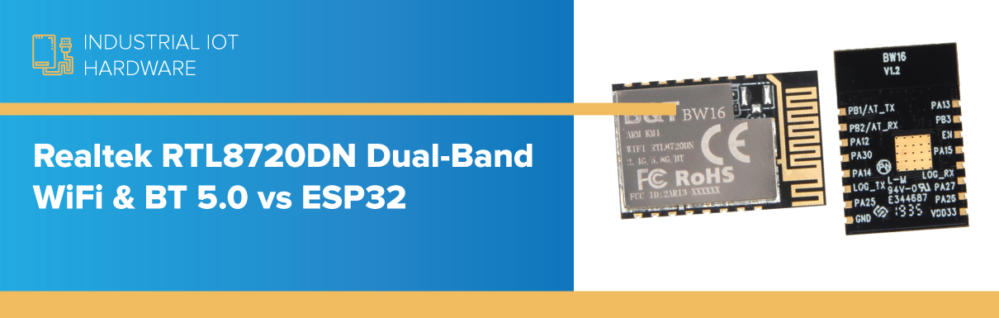
IoT market ofers wide range of small and efficient modules for Home & Industrial Internet of Things applications, equipped with 2.4GHz Wi-Fi, such as Espressif’s ESP32 or older ESP8266 modules. Additional Bluetooth 4.2/5.0 is often found on those. Dual-band Wi-Fi, on the other hand, is hard to find on low-budget IoT modules. Here comes Realtek RTL8720DN.
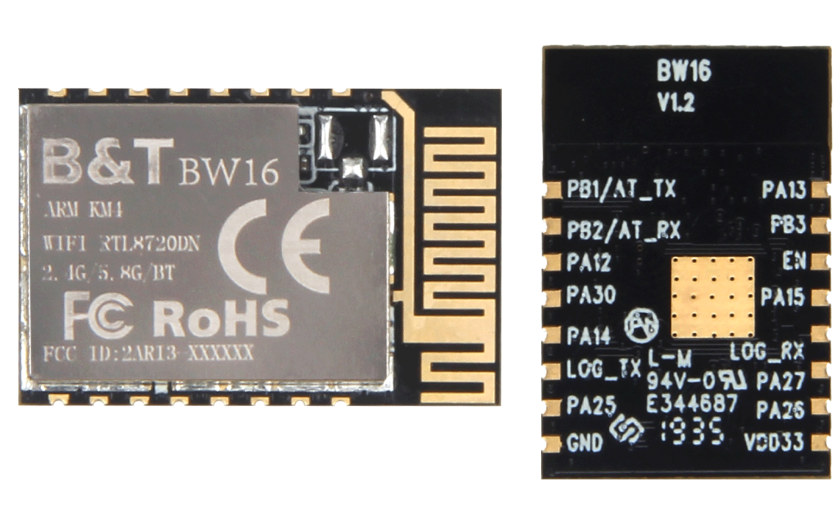
Realtek RTL2720DN module, as a part of AmebaD family, comes with ARM Cortex-M4/M0 wireless MCU with support of 802.11 b/g/n Dual-Band Wi-Fi 2.4GHz / 5GHz and extra Bluetooth 5.0 wireless connectivity.
Realtek RTL8720DN Dual-Band WiFi & Bluetooth 5.0 module
Realtek RTL8720DN specifications:
Wireless SoC – Realtek RTK8720DN MCU with KM4 Arm Cortex-M4 core @ 200 MHz and KM0 Arm Cortex-M0 core @ 20 MHz
Connectivity
WiFi
802.11 a/b/g/n WiFi 4
Frequency Range – 2.412-2.484GHz & 5.180-5.825GHz
Data Rates
802.11a: 6,9,12,18,24,36,48,54Mbps
802.11b: 1,2,5.5,11Mbps
802.11g: 6,9,12,18,24,36,48,54Mbps
802.11n: MCS0–MCS7 @ HT20/HT40 2.4GHz and 5GHz bands
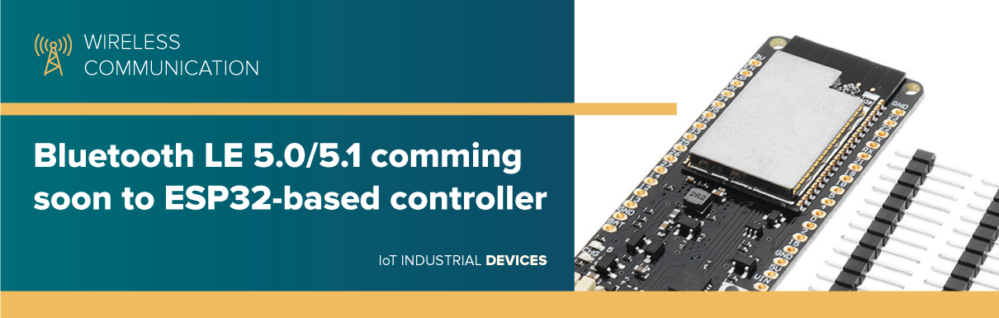
The Espressif’s flagship ESP32 chip recently passed the SIG Bluetooth LE 5.0 certification. This confirms that the version of the protocol supported by the ESP32 microcontroller has been upgraded from Bluetooth LE 4.2 to Bluetooth LE 5.0, which is more stable and compatible.
The implementation and development of the Bluetooth LE (BLE) application requires not only a system that supports this function, but also an attached Bluetooth LE protocol stack consisting of a driver and a host.
Thanks to Bluetooth LE 5.0 certification, ESP32 SoC not only updates the system as a whole, but also adds new features that improve the latest software after passing more stringent tests than previous certification.
Industrial use of ESP32-based solutions
One of industrial IoT devices, supporting Espressif’s ESP32 technology is eModGATE from TECHBASE. Economical, ESP32-based solution can serve as an end-point in any installation or works well as a gateway, gathering data from scattered sensor mesh across the installation. For more information check Industrial IoT Shop with all the configuration options for eModGATE.
The Espressif’s flagship ESP32 chip recently passed the SIG Bluetooth LE 5.0 certification. This confirms that the version of the protocol supported by the ESP32 microcontroller has been upgraded from Bluetooth LE 4.2 to Bluetooth LE 5.0, which is more stable and compatible.
The implementation and development of the Bluetooth LE (BLE) application requires not only a system that supports this function, but also an attached Bluetooth LE protocol stack consisting of a driver and a host.
Bluetooth 5.0 update for ESP32
Thanks to Bluetooth LE 5.0 certification, ESP32 SoC not only updates the system as a whole, but also adds new features that improve the latest software after passing more stringent tests than previous certification.
Due to hardware limitations, ESP32 does not support such functions of Bluetooth LE 5.0 as 2M PHY, LE Long Range, and ADV Extensions.
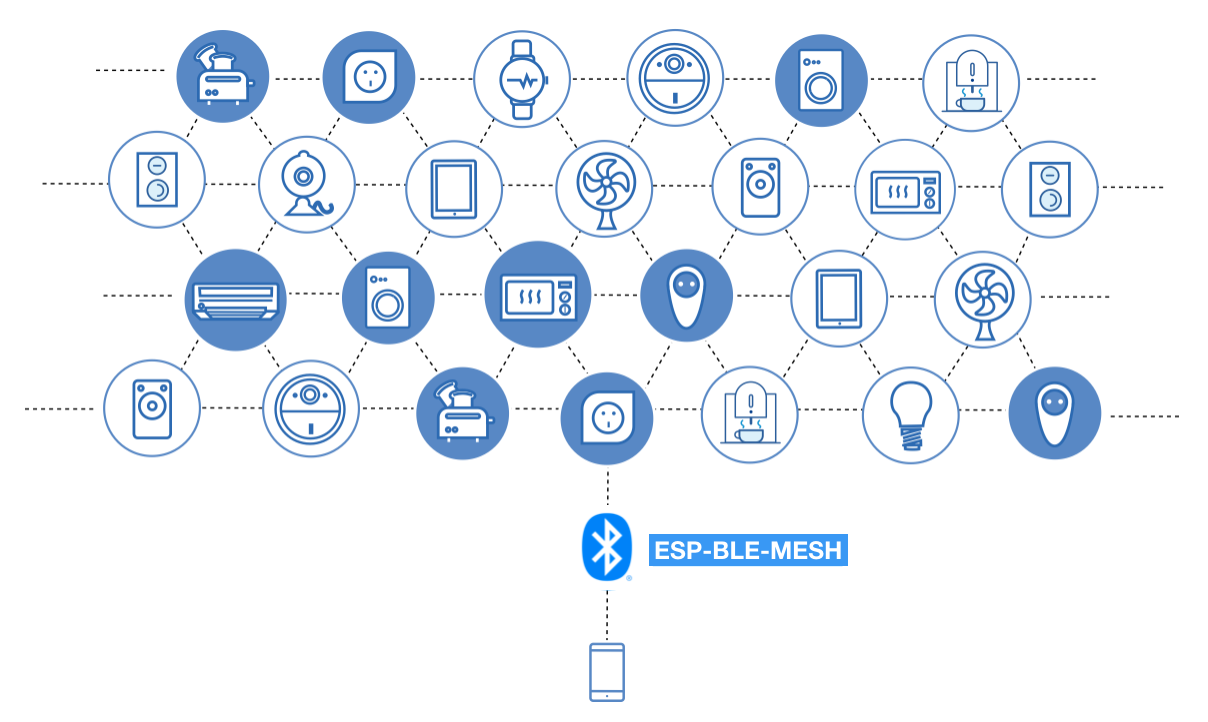
It is also worth mentioning that the combination of Bluetooth and Mesh networking is expected to become a key technology for the Internet of Things. A Bluetooth® Mesh network enables a „many-to-many” relationship among potentially thousands of wireless devices, where data are transmitted not in a direct radio range but in wide physical areas. Espressif’s contribution in this field is the ESP-BLE-MESH, which got fully certified by Bluetooth SIG in September 2019.
Several Bluetooth-operated products on the market, such as wearable devices, smart speakers, cleaning robots, smart lights/sockets, etc., provide evidence that Bluetooth 5.0 and the Bluetooth Mesh networking technology are mature enough to drive the development of interconnected IoT devices. To this end, Espressif’s chips and ESP-BLE-MESH, in particular, are designed to help customers develop easily secure and cost-effective products for smart homes, smart buildings, healthcare, new automobiles and other smart industries.
One of industrial IoT devices, supporting Espressif’s ESP32 technology is eModGATE from TECHBASE. Economical, ESP32-based solution can serve as an end-point in any installation or works well as a gateway, gathering data from scattered sensor mesh across the installation. For more information check Industrial IoT Shop with all the configuration options for eModGATE.
https://iot-industrial-devices.com/wp-content/uploads/2020/01/bluetooth-5-0.png3851210adminhttps://iot-industrial-devices.com/wp-content/uploads/2019/11/iot-industrial-devices-1.pngadmin2020-01-17 12:43:162020-01-17 12:43:18Bluetooth LE 5.0/5.1 comming soon to ESP32-based controller
We may request cookies to be set on your device. We use cookies to let us know when you visit our websites, how you interact with us, to enrich your user experience, and to customize your relationship with our website.
Click on the different category headings to find out more. You can also change some of your preferences. Note that blocking some types of cookies may impact your experience on our websites and the services we are able to offer.
Essential Website Cookies
These cookies are strictly necessary to provide you with services available through our website and to use some of its features.
Because these cookies are strictly necessary to deliver the website, you cannot refuse them without impacting how our site functions. You can block or delete them by changing your browser settings and force blocking all cookies on this website.
Other external services
We also use different external services like Google Webfonts, Google Maps and external Video providers. Since these providers may collect personal data like your IP address we allow you to block them here. Please be aware that this might heavily reduce the functionality and appearance of our site. Changes will take effect once you reload the page.