Wpisy

Introduced with Moduino series, TECHBASE developed further the project of modular aluminum case for their devices. The latest version of housing allows ModBerry to expand in any dimension, supporting additional extension cards (e.g. I/Os, modems, opto-isolation, accelerometer, etc.) and DIN rail mount, that can be retracted into device itself. TECHBASE constantly improves the project to support different platforms (e.g. Raspberry Pi Compute Module 3, NanoPi, ESP32, UpBoard and probably more in the nearest future) and brings them to Industrial IoT world.

Supercapacitor power support for ModBerry

To improve the possibilities of ModBerry devices, TECHBASE added supercapacitor UPS option for ModBerry 500 configurations. Additional power supply available at emergency situations, such as power drop or loss, allows the device to log the recently acquired data and send the notifications to user regarding the occurred event. The supercap support for ModBerry ensures safe system shutdown and protects memory from fragmenting, so there is no need to use diagnostic tools afterwards.

ModBerry enhanced with OLED screen

Just like ESP32-based Moduino series, the ModBerry computers can be now equipped with OLED 0.96″ 128×64 screen via i2c extension protocol. The is small, only about 1″ diameter, but very readable due to the high contrast of an OLED display. Because the display makes its own light, no backlight is required, therefore reduces the power required to run the OLED.


TECHBASE Industrial Computers are designed for easy integration of LoRa / MQTT networks. ModBerry devices base on Raspberry Pi / NanoPi / Intel UpBoard platform communicate with both Cloud and Sensor layer (backed with ESP32 Moduino devices) of your installation via MQTT protocol. Gateway utilizes the features of many protocol libraries, such as original TECHBASE’s iMod protocol controller – installable both on the Gateway device itself or externally with wide range of possibilities (industrial computer, hosted server, etc.). Our devices fully support Node-RED, CODESYS, OpenHAB and many more open protocol libraries.

Wide range of protocol support

All TECHBASE’s solution can be empowered with iMod software incl. protocol support for industrial interfaces, e.g. M-Bus, Modbus, SNMP, MQTT. iMod software works seamlessly with Node-RED using MQTT protocol, allowing use of bacnet and direct control over devices I/Os with Google’s platform-neutral protobuf – extensible mechanism for serializing structured data and zeroMQ controls to connect the code in any modern language, on any platform. The protocol drivers library can be expanded with CODESYS development system to support PROFIBUS, CANopen, EtherCAT, PROFINET and EtherNet/IP.

iMod M-Bus, Wireless M-Bus, Modbus TCP/RTU, SNMP, MQTT, SMS, E-MAIL, SQL/CSV
CODESYS PROFIBUS, CANopen, EtherCAT, PROFINET, EtherNet/IP
Node-RED, etc. MQTT, bacnet, eISCP
OpenHAB Commercial product integration
Other open-source protocols IEC 61850, IEC 60870-5-104, DLMS/COSEM, KNX, eHz meters, IEC 62056-21, REST


In October 2017 TECHBASE introduced newest economical addition to their M-Bus/Modbus Gateway family. Success of ModBerry 500 series based on Compute Module 3 and ModBerry M700 based on NanoPi M2 drove to further development of this efficient platform. TECHBASE proudly presents ModBerry M300 powered by NanoPi NEO.

    • CPU: Allwinner H3, Quad-core Cortex-A7 Up to 1.2GHz
    • DDR3 RAM: 512MB
    • Connectivity: 10/100M Ethernet, RS-232, RS-485
    • USB Host: ext. Type-A x1
    • Wireless communication: Wi-Fi, Bluetooth, LoRa, NB-IoT (LTE cat. NB1) /GPRS/EDGE, 3G/GPRS, ZigBee, Sigfox support
    • Working Temperature: -40℃ to 70℃
    • OS/Software: u-boot, UbuntuCore, Debian and Android

Download PDF datasheet: http://www.a2s.pl/products/ModBerry/ModBerry_M300_EN.pdf

Czytaj dalej

Moduino based on ESP32 can now be equipped with TECHBASE’s original mBus10/60/400 converter module. The converter operates as a M-Bus Master and allows user to connect up to 400 standard M-Bus receivers (Slaves) through M-Bus Master output or fewer devices at a higher M-Bus load over long distances. Moduino, as a fully capable Industrial IoT device, can now be used with every device equipped with M-Bus interface, e.g. heat meters, electricity meters, gas meters, executive modules, recorders, measuring instruments.

Wireless M-Bus support

TECHBASE has added high performance module for wireless M-Bus connectivity and multi-hop networking into Moduino series expansion options. The module is configured as an embedded micro system or simple data modem for low power applications in the metering specifically allocated band of 169 MHz or in the ISM band of 868 MHz. The device is can be configured for interoperability in a WMBus network for Industrial IoT applications.

The RF implementation guarantees best-in-class performance in terms of covered area and power consumption. The output power can be increased up to +30 dBm on the 169 MHz band (+27 dBm on optimized version for highest power efficiency) and up to +15 dBm on the 868 MHz band. The extremely reduced power consumption gives access to long lasting battery life requirement (up to 2 μA in sleep mode for wireless M-Bus module with an RTC clock running).

The Moduino devices  can be provided with a W-MBus stack specifically developed by Embit for the platform that allows to integrate the module in the desired system without effort and simplify the interaction in WMBus networks.


The newest addition to TECHBASE’s Industrial IoT Ecosystem is a lightweight, but powerful energy-efficient and fully capable automation controller series, called Moduino – an industrial computer for remote data control and management, equipped with latest ESP32 compute module, wide range of serial, digital and analog inputs/outputs and wireless communication interfaces. This cost effective solution is perfect for end-point devices.

Moduino is powered by ultra-low power Dual-Core Tensilica LX6 240 MHz processor with 512KB RAM (up to 4MB) and 4MB SPI flash memory on-board. Integrated Wi-Fi/BLE modem and extra wireline/wireless interfaces make the Moduino micro-computer a versatile addition to Industrial IoT solutions offered by TECHBASE company. For more complex installations and for those, who need high integration capabilities, the Moduino devices can easily work remotely with existing ModBerry gateway for data accumulation and monitoring, to perform specific actions before sending the data to cloud services. The Moduino-ModBerry installation can work as standalone Ecosystem (for example via MQTT), providing fog-computing to any installation.

Wireless solution

Both Moduino X1 & X2 offer built-in Wi-Fi & Bluetooth 4.2 and support for LoRa, Sigfox, LTE cat. M1, NarrowBand-IoT (LTE cat. NB1) modems. Currently the support of ZigBee modems is under development. Moduino is equipped with standard U.FL (IPEX) external antenna connectors, allowing the device to reach up to 1km range (for Wi-Fi modem) and expanding the range for other wireless interfaces.

Battery and AC powered

Two multi-sized units X1 and X2 represent diversified approach to IIoT installations for remote data access & management. The main difference between Moduino X1 and it’s larger brother Moduino X2, apart from size, is a battery power support for X1 due to lower energy demand, making it independent from local power grid – perfect for remote installations and scattered objects monitoring. Both solutions can be powered by regular power supply with UPS support (LiPo & Supercapacitor batteries), offer wide range of serial, digital and analog inputs/outputs assisted with support of wireless communication interfaces.

Operating systems & software

Use of ESP32-WROVER compute module adds the support for real-time operating systems (compared to most Raspberry Pi based Linux and Windows OS versions), and openness of the Espressif’s platform to Moduino industrial automation controller. Thanks to enormous community of ESP32 and Arduino users and developers, the Moduino can now adapt existing software solutions, tools and programming environments,  for example:

  • ESP-IDF (Espressif IoT Development Framework)
  • Zephyr Project (scalable RTOS)
  • Arduino (C++)
  • MicroPython
  • Mongoose OS
  • etc.

End-point sensors

The Moduino device is a comprehensive end-point controller for variety of sensors located throughout any installation. It fully supports temperature and humidity sensors and new ones are currently developed, e.g. accelerometer, gyroscope, magnetometer, etc.

 

We proudly announce that ModBerry series devices now supports LoRa and NarrowBand IoT (NB-IoT) modems via extension modules. The new interfaces allows the devices to fully integrate with new networks and systems.

LoRa – Low-Power Wide-Area Network (LPWAN) or Low-Power Network (LPN) is a type of wireless telecommunicationwide area network designed to allow long range communications at a low bit rate among things (connected objects), such as sensors operated on a battery. The low power, low bit rate and intended use distinguish this type of network from a wireless WAN that is designed to connect users or businesses, and carry more data, using more power.

New addition to wide range of communication protocols is NarrowBand IoT:

NarrowBand IoT (NB-IoT) is a Low Power Wide Area Network (LPWAN) radio technology standard developed to enable a wide range of devices and services to be connected using cellular telecommunications bands. NB-IoT is a narrowbandradio technology designed for the Internet of Things (IoT) and is one of a range of Mobile IoT (MIoT) technologies standardized by the 3rd Generation Partnership Project (3GPP). NB-IoT focuses specifically on indoor coverage, low cost, long battery life, and enabling a large number of connected devices.


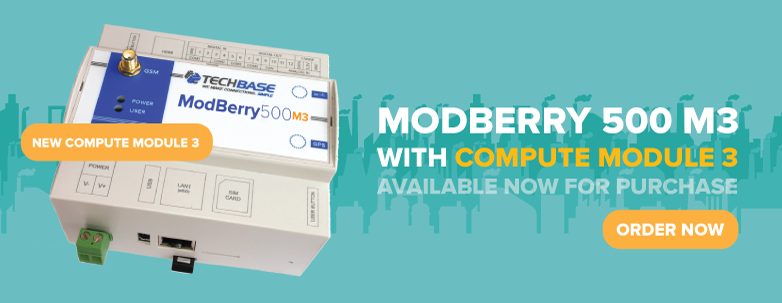
We are proud to announce that our newest device ModBerry 500 M3 is now available to order. ModBerry 500 M3 is an upgraded ModBerry 500 industrial computer series, using latest Compute Module 3 from Raspberry Pi. Used module increase the device’s performance up to ten times, maintaining low power consuption and optimal price of this solution. ModBerry features industrial protocol support, e.g. Modbus, M-Bus, SNMP, MQTT and more. Read full specification in ModBerry 500 M3 datasheet below:

Main features of ModBerry 500 M3:

  • Quad core Cortex A53 processor @ 1.2 GHz with Videocore IV GPU
  • 1GB LPDDR2 RAM
  • 4GB eMMC Flash
  • Full Modbus/M-Bus/SNMP/MQTT protocol support
  • Wide range of wired and wireless communication protocols (Wi-Fi, 3G/LTE, GPS, Bluetooth, ZigBee, etc.)
  • Industrial-grade components and casing with DIN rail mounting

Watch ModBerry website for upcoming news and updates. More industrial solutions coming in 2017!

Compute Module 3 Technical Specification Released

There will be two version of the Compute Module 3:  CM3 with a 4GB eMMC, and CM3 Lite without eMMC, but SD card signal are available to the baseboard.
Apart from this difference, both modules shares the same specs:

SoC
Broadcom BCM2837 quad core Cortex A53 processor @ 1.2 GHz with Videocore IV GPU

System Memory
1GB LPDDR2

Storage

  • CM3 Lite – SD card signals through SO-DIMM connector
  • CM3 – 4GB eMMC flash

200-pin edge connector with:

  • 48x GPIO
  • 2x I2C, 2x SPI, 2x UART
  • 2x SD/SDIO, 1x NAND interface (SMI)
  • 1x HDMI 1.3a
  • 1x USB 2.0 HOST/OTG
  • 1x DPI (Parallel RGB Display)
  • 1x 4-lane CSI Camera Interface (up to 1Gbps per lane), 1x 2-lane CSI Camera Interface (up to 1Gbps per lane)
  • 1x 4-lane DSI Display Interface (up to 1Gbps per lane), 1x 2-lane DSI Display Interface (up to 1Gbps per lane)

Power Supply
VBAT (2.5V to 5.0V) for BCM2837 processor core, 3.3V for PHYs, UI and eMMC flash, 1.8V for PHYs, IO, and SDRAM, VDAC (2.8V typ.) for video composite DAC, GPIO0-27_VREF & GPIO28-45_VREF (1.8 to 3.3V) for the two GPIO banks.

Dimensions
67.6 x 31 mm; compliant with JEDEC MO-224 mechanical specification used in DDR2 SO-DIMM memory module

Temperature Range
-25 to +80 degrees Celsius

Compute Module 3 and 3 Lite are electrically & mechanically compatible with the original Raspberry Pi Compute Module (CM1), so ModBerry 500 / NPE X500 will gain exra performance.

Following differences explained in the datasheet:

„Apart from the CPU upgrade and increase in RAM the other significant hardware differences to be aware of are that CM3 has grown from 30mm to 31mm in height, the VBAT supply can now draw significantly more power under heavy CPU load, and the HDMI HPD N 1V8 (GPIO46 1V8 on CM1) and EMMC EN N 1V8 (GPIO47 1V8 on CM1) are now driven from an IO expander rather than the processor. If a designer of a CM1 product has a suitably specified VBAT, can accommodate the extra 1mm module height increase and has followed the design rules with respect to GPIO46 1V8 and GPIO47 1V8 then a CM3 should work fine in a board designed for a CM1.”

You can download official Data Sheet here:

Compute Module 3

The Raspberry Pi foundation has announced new product –  Raspberry Pi 3 Compute Module.

At the blog post „RASPBERRY PI 3 ON SALE NOW AT $35” from 29th Feb 2016, Eben Upton wrote that Compute Module 3 should be ready soon. We contacted directly with the foundation in this case, also asking whether it will be possible to obtain or purchase samples before the premiere. We received the following information:


Thank you for your interest in Raspberry Pi.

We expect the Compute Module 3 to be available within the next couple of months. Please keep an eye on our blog for announcements.

We do not send samples of our products.

Regards

Nicola Early
Administrator