Wpisy

One of the main problems during the COVID-19 crisis is the lack of adequate ventilator support for patients, a key component of equipment that has a major impact on the breathing of critically ill patients. It’s clear that more ventilators are needed because there aren’t enough devices currently in the hospital for all potential patients who can get infected. Developers use existing creation tools to participate in service calls, for example trying to create a cheap open source Arduino-based ventilators.

Another solution is the AgVa phone ventilator produced by the Indian based company AgVa Healthcare which used one tool we already have: smartphone. The AgVa Phone Ventilator, known officially as the AgVa Advance Pure, is a portable and mobile ventilator system that does the work of a typical ventilator. The vision around the ventilator is that patients should not always have to be stuck to the hospitals all the time.

The primary focus of the ventilator is to provide mechanical ventilation for everyone in need. Its small package ensures easy storage and transportation, whereas its intuitive user interface makes it extremely easy to use even for a non trained person. Finally due to its phenomenally low cost and no need for infrastructure requirement makes it ideal for scaling up the ICU.

Source: https://www.cnx-software.com/2020/04/09/agva-phone-ventilator-connects-to-a-smartphone-to-fight-covid-19/

Industrial Arduino-like devices as a base of medical equipment?

When industrial IoT devices and edge devices, like medical equipment work together, digital information becomes more powerful. Especially in contexts where you need to collect data in a traditional edge context, or control the servo-motors of a ventilatr. You can then remotely monitor the container using the sensor.

By introducing AI (artificial intelligence) into the device itself, edge computing can also make more context-sensitive, quick decisions at the edge. Data gathered from the sensors can be transferred to the cloud at any time after local work has been completed, contributing to a more global AI process, or archived. With the combination of industrial IoT devices and advanced technology, high quality analysis and small footprint will become the AI standard in 2020.

Industrial IoT use of ESP32 chip in eModGATE

Latest innovations used in industrial solutions

One of many uses of IoT can be edge devices, dedicated to data management, process control (e.g. with MQTT protocol) and monitoring. Latest ESP32-based eModGATE controller from TECHBASE company is a series utilizing MicroPython environment to provide data management solutions for end-points applications. The eModGATE has built-in Wi-Fi/BT modem and can be equipped with additional NarrowBand-IoT, LoRa, ZigBee, etc.

For example eModGATE eqipped with wireless NB-IoT modem are perfect for industrial automation solutions, e.g. data logging, metering, telemetrics, remote monitoring, security and data management through all Industrial IoT applications.

Battery powered IoT devices crucial to 2020+ standards

Technology must transfer data to the central system in real time, otherwise it may have negative consequences. If the sensor battery power runs out, a machine failure may stop production for one day or lead to direct danger. If battery life is unbelievable and short, IoT applications will become useless, causing more interference rather than making life easier for its intended purpose. Therefore battery powered IoT devices come as a standard in up-to-date IoT installations

Wireless sensors and sensor networks are one of the elements of the Internet of Things systems and intelligent factories. Replacing the standard sensors and data collection devices with versions that communicate wirelessly gives many benefits, but also enforces a highly thought-out system design that will minimize energy consumption. This is important because these systems must work for many years without servicing. In the article we present the issues regarding the design of systems and forecasting of energy consumption in IoT systems.

Wireless communication vs Battery power

The idea of wireless sensor networks has been around for at least two decades, while the IEEE subgroup working on personal wireless networks defined the 802.15.4 standard in 2003, a year later the first versions of ZigBee appeared. Since then, many varieties of wireless communication have been developed, such as LoRa & NarrowBand-IoT and additional functions introduced, as a result of which designers now have a choice of various open or proprietary protocols. What significantly affects the way the entire project is implemented is energy consumption.

Battery powered IoT installation. Source: https://modberry.techbase.eu/

The basic elements of these systems are sensors that measure physical quantities. Some signal and data processing capabilities are also important. After all, the communication interface is important, which will allow you to pass the measured data on. Such a sensor node should wake up from time to time, make contact with its superordinate controller, transfer data and fall back to sleep again. Battery life depends on the total charge collected. Minimizing this consumption in the long run means that you need to minimize energy consumption during each work cycle. In many cases, the sensor will only work for a small fraction of the time. A measurement that lasts a few milliseconds can be triggered once per second, once per minute, or even less frequently. Therefore, the energy consumed in sleep mode may dominate the total energy consumption.

Battery powered sensors market growth

The lifetime of IoT sensors varies greatly: some last a year years, others 10, the first being the most realistic. When organizations need to deploy engineers to install new batteries in sensors and employ staff to monitor them, the benefits of technology itself are beginning to run out.

Battery powered IoT devices crucial to 2020+ standards

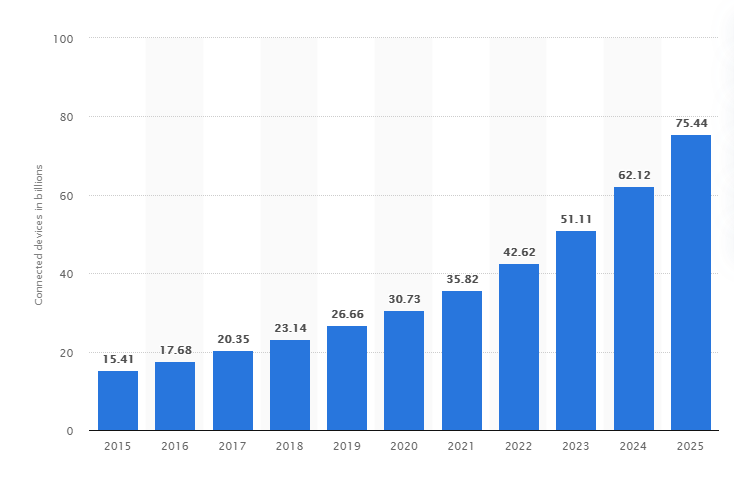
It is estimated that in 2020 nearly 31 billion devices will be connected to the Internet of Things. Such forecasts provide ample opportunities, especially for producers associated with the products that make up it, and they are intensified by the developing IoT technology.

Source: https://globenergia.pl/co-laczy-internet-rzeczy-i-perowskity-fotowoltaika-do-zastosowan-wewnetrznych/

Battery-ready IoT devices based on ESP32

Battery / SuperCap power support allows the processes and data to be securely executed, saved or transferred, and the operating system to be safely shutdown or reboot, if the power source has been restored. The power failure alert can also be sent to cloud service, to perform custom task, specified by user or self-learning AI algorithm.

The Moduino device is a comprehensive end-point controller for variety of sensors located throughout any installation. It fully supports temperature and humidity sensors and new ones are currently developed, e.g. accelerometer, gyroscope, magnetometer, etc.

Battery powered Moduino ESP32
Battery powered IoT installation. Source: https://modberry.techbase.eu/

ModuinoModBerry symbiosis allows wide range of wake-up/sleep schedule customization, in order to perform best and save energy accordingly to power supply state. Arduino and MicroPython environments provide libraries to control different scenarios of data and power management.

With built-in algorithms and the possibility to program on your own, the TECHBASE’s sleep/wake addon module can wake the device using schedule/timer. Another option is wake on external trigger, e.g. change of input, etc. All the options for sleep, shutdown and wake can be configured for various scenarios to ensure constant operation of devices, safety of data and continuity of work in case of power failure in any installation.

In March, sales of Raspberry Pi single-board computers totaled 640,000. The consumer find it the cheapest way to start tinkering and drove to the second-largest sales month since Raspberry Foundation began selling for home use.

Other uses of Raspberry Pi computers are more directly associated with the appearance of COVID-19. For example, in Colombia, efforts are underway to run a ventilator on a Pi computer, and if successful, it will help solve the problem of the lack of traditional ventilation equipment in this country.

I think what this is telling us is that we’re seeing genuine consumer use of the product. It’s not like your desktop PC – you’re not going to be able play Crysis on it – but if you want a machine you can use to edit documents, use the web, use Gmail and Office 365 and all the baseline use cases of a general purpose computer, the Raspberry Pi 4 is a product we’ve made to get over that bar.

Eben Upton, the Raspberry Pi’s co-creator for Techrepublic

When the Raspberry Pi Foundation asked to talk about how to deal with COVID-19 using Raspberry Pi devices, one of the most common uses he saw was 3D printing with use of Raspberry Pi, especially for 3d-printed faceshields.

Raspberry Pi 4
Raspberry Pi 4

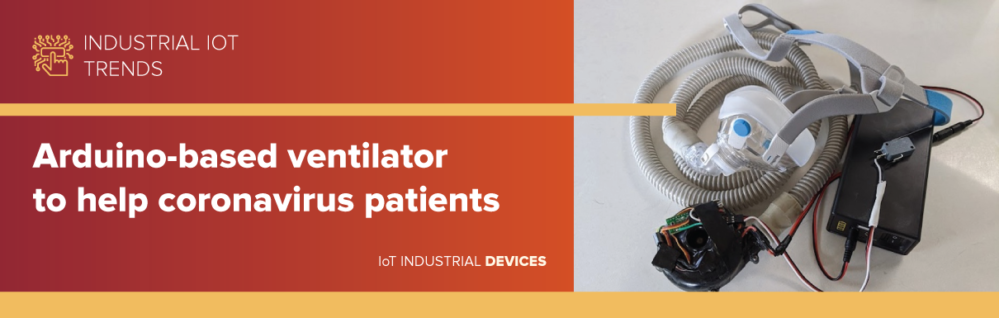
Arduino-based ventilator to help coronavirus patients

A month ago we wrote about Arduino-based solution, similar to the one tested in Columbia. As far as manufacturing and using home-made medical equipment is not advised, the spread of the COVID-19 might push humanity to such solutions. Johnny Lee’s project involves a simple, low-cost ventilator controlled via Arduino.

The idea is that since these machines are basically just blowers controlled by a brushless DC motor, an Arduino Nano equipped with an electonic speed controller could allow it to act as a one. Such a setup has been shown to provide more than enough pressure for a ventilator used on COVID-19 patients. This device has in no way been evaluated or approved for medical use, but it does provide a starting point for experimentation.

Source: https://blog.arduino.cc/2020/03/17/designing-a-low-cost-open-source-ventilator-with-arduino/

New #CoronaIOT initiative from Industrial IoT manufacturer

Trends indicate a weakening of many sectors of the economy, including the IoT sector. However, we can prevent the upcoming crisis with products and technology keeping up with the inevitable changes in our daily lives.

TECHBASE Group took the challenge of gathering potential partners for projects that serve improvement of health safety and worldwide trend of Social Distancing. The program will periodically present new IoT projects, involving manufacturers, software and hardware developers, new technology influencers and media.

Industrial Raspberry Pi powered devices as a base of medical equipment?

When industrial IoT devices and edge devices, like medical equipment work together, digital information becomes more powerful. Especially in contexts where you need to collect data in a traditional edge context, or control the servo-motors of a ventilator. You can then remotely monitor the container using the sensor.

By introducing AI (artificial intelligence) into the device itself, edge computing can also make more context-sensitive, quick decisions at the edge. Data gathered from the sensors can be transferred to the cloud at any time after local work has been completed, contributing to a more global AI process, or archived. With the combination of industrial IoT devices and advanced technology, high quality analysis and small footprint will become the AI standard in 2020.

ModBerry M500 with Raspberry Pi’s 4 on-board

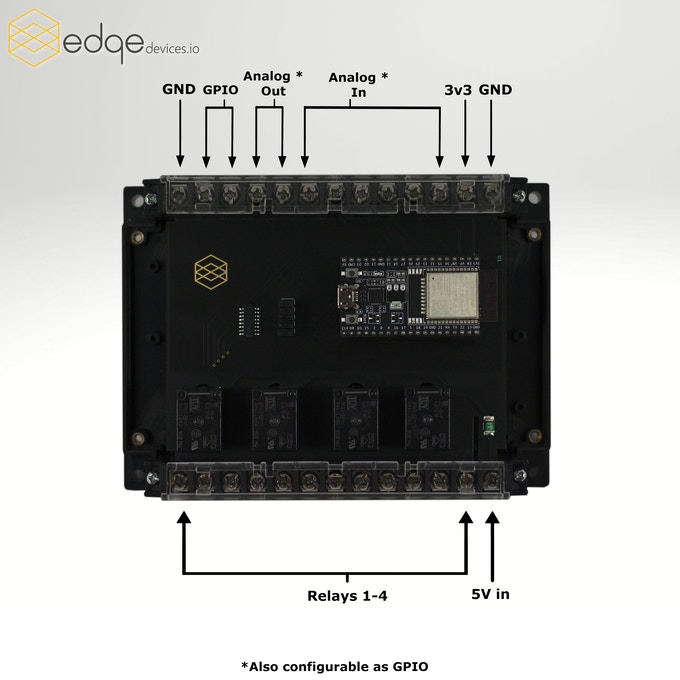
The creators of the Pi-oT module returned to Kickstarter and launched a new module based on ESP32. Thanks to this, users familiar with Arduino programming or preferring lighter architecture can enjoy all the advantages of the IoT module for enterprises.

Pi-oT ESP module key features and specification:

  • Board – ESP32-DevKitC-D32 based on ESP32-WROOM-D32 module with ESP32 dual-core processor, 32Mbit SPI flash
  • Relays – 4x Panasonic SPDT relays controlled via GPIO pins
  • Screws terminals for
    • Relay outputs
    • 6x analog inputs configurable as GPIO if needed
    • 2x analog outputs configurable as GPIO if needed
    • 2x GPIO
    • 5V input, 3.3V, and GND
  • Power Supply – 5V input via terminal or Micro USB port?; 5V circuitry protection
  • Dimensions – DIN rail enclosure

Source: https://www.cnx-software.com/2020/05/04/pi-ot-esp-module-leverages-esp32-screw-terminals-iot-automation/

The ESP Module is a microcontroller based IoT Module which offers the same great features as our Pi-oT Module, but based off on an ESP32 platform. The ESP Module is powered by an ESP32 DEVKITC-32D microcontroller which is included in each reward.

Source: https://www.kickstarter.com/projects/pi-ot/esp-module

Additionally 10 GPIO pins are routed to the housing terminals to utilize the power of ESP32 in a wide range of applications. The flexibility of the ESP32s system allows easy configuration of 6 of these pins as analogue inputs and 2 as analogue outputs.

Industrial use of LoRa & ESP32-based solutions

One of industrial IoT devices, supporting LoRa wireless technology is ESP32 based eModGATE from TECHBASE. Economical, ESP32-based solution can serve as an end-point in any installation or works well as a gateway, gathering data from scattered sensor mesh across the installation. For more information and also Raspberry Pi based solutions check Industrial IoT Shop with all the configuration options for eModGATE.

eModGATE with ESP32

The Colombian medical team tests a fan made with the Raspberry Pi and easily available parts. Robotics engineer Marco Mascolo said he made the project because he knew that machines were in great demand to handle Covid-19. The design and code was published online in March by a Californian, stating that he had ’no previous experience creating medical devices’.

The ventilator control computer is the most important part. Raspberry Pi can set the air pressure, open and close the valves to adjust if the patient needs full or partial breath support, and Mascorro has integrated the code with open software so that anyone can use or change it for free.

Arduino-based ventilator to help coronavirus patients

A month ago we wrote about Arduino-based solution, similar to the one tested in Columbia. As far as manufacturing and using home-made medical equipment is not advised, the spread of the COVID-19 might push humanity to such solutions. Johnny Lee’s project involves a simple, low-cost ventilator controlled via Arduino.

The idea is that since these machines are basically just blowers controlled by a brushless DC motor, an Arduino Nano equipped with an electonic speed controller could allow it to act as a one. Such a setup has been shown to provide more than enough pressure for a ventilator used on COVID-19 patients. This device has in no way been evaluated or approved for medical use, but it does provide a starting point for experimentation.

Source: https://blog.arduino.cc/2020/03/17/designing-a-low-cost-open-source-ventilator-with-arduino/

New #CoronaIOT initiative from Industrial IoT manufacturer

Trends indicate a weakening of many sectors of the economy, including the IoT sector. However, we can prevent the upcoming crisis with products and technology keeping up with the inevitable changes in our daily lives.

TECHBASE Group took the challenge of gathering potential partners for projects that serve improvement of health safety and worldwide trend of Social Distancing. The program will periodically present new IoT projects, involving manufacturers, software and hardware developers, new technology influencers and media.

Industrial Raspberry Pi powered devices as a base of medical equipment?

When industrial IoT devices and edge devices, like medical equipment work together, digital information becomes more powerful. Especially in contexts where you need to collect data in a traditional edge context, or control the servo-motors of a ventilator. You can then remotely monitor the container using the sensor.

By introducing AI (artificial intelligence) into the device itself, edge computing can also make more context-sensitive, quick decisions at the edge. Data gathered from the sensors can be transferred to the cloud at any time after local work has been completed, contributing to a more global AI process, or archived. With the combination of industrial IoT devices and advanced technology, high quality analysis and small footprint will become the AI standard in 2020.

ModBerry M500 with Raspberry Pi’s 4 on-board

The wM-Bus or Wireless Meter Bus is a European standard (EN 13757-4) that defines communication between usability meters and data loggers, hubs or intelligent meter gates. The M-Bus wireless bus has been developed as a standard to meet the needs of the European network of media meters and remote reading systems and forms the basis of a new advanced measurement infrastructure (AMI). The frequency of M-Bus and sub-GHz wireless connections has been used for several years, but is still evolving to adapt to changing environments and take advantage of technological advances, including the emergence of the Internet of Things.

2.4 GHz band vs unlicensed bands

Intelligent network devices require robust long-range wireless communication. The most common frequencies are around 868 MHz, 434 MHz and 169 MHz, which are unlicensed bands in Europe and offer better radio wave propagation compared to 2.4 GHz. By using one of these unlicensed bands, radio waves can reach difficult areas such as underground meters or the location of buildings with many walls or obstacles. Another advantage of operating in the unlicensed band is that utilities have lower solution costs.

COVID-19 and wireless technologies

In times of COVID-19 pandemic hazards, the use of wireless technologies is often a must, to prevent further spread of the coronavirus. One of obvious choices for Internet of Things and home monitorng is Wireless M-Bus implementation.

TECHBASE has added high performance module for Wireless M-Bus connectivity and multi-hop networking into Moduino series expansion options. The module is configured as an embedded micro system or simple data modem for low power applications in the metering specifically allocated band of 169 MHz or in the ISM band of 868 MHz. The device is can be configured for interoperability in a WMBus network for Industrial IoT applications.

The RF implementation guarantees best-in-class performance in terms of covered area and power consumption. The output power can be increased up to +30 dBm on the 169 MHz band (+27 dBm on optimized version for highest power efficiency) and up to +15 dBm on the 868 MHz band. The extremely reduced power consumption gives access to long lasting battery life requirement (up to 2 μA in sleep mode for wireless M-Bus module with an RTC clock running).

The Moduino devices  can be provided with a W-MBus stack specifically developed by Embit for the platform that allows to integrate the module in the desired system without effort and simplify the interaction in WMBus networks.

Some time ago, we wrote about the premiere of Espressif’s ESP32-S2 chip. Check out the summary from Adafruit team on the ESP32-32 features.

Battery-ready IoT devices based on ESP32

Battery / SuperCap power support allows the processes and data to be securely executed, saved or transferred, and the operating system to be safely shutdown or reboot, if the power source has been restored. The power failure alert can also be sent to cloud service, to perform custom task, specified by user or self-learning AI algorithm.

The Moduino device is a comprehensive end-point controller for variety of sensors located throughout any installation. It fully supports temperature and humidity sensors and new ones are currently developed, e.g. accelerometer, gyroscope, magnetometer, etc.

Battery powered Moduino ESP32
Battery powered IoT installation. Source: https://moduino.techbase.eu/

ModuinoModBerry symbiosis allows wide range of wake-up/sleep schedule customization, in order to perform best and save energy accordingly to power supply state. Arduino and MicroPython environments provide libraries to control different scenarios of data and power management.

With built-in algorithms and the possibility to program on your own, the TECHBASE’s sleep/wake addon module can wake the device using schedule/timer. Another option is wake on external trigger, e.g. change of input, etc. All the options for sleep, shutdown and wake can be configured for various scenarios to ensure constant operation of devices, safety of data and continuity of work in case of power failure in any installation.

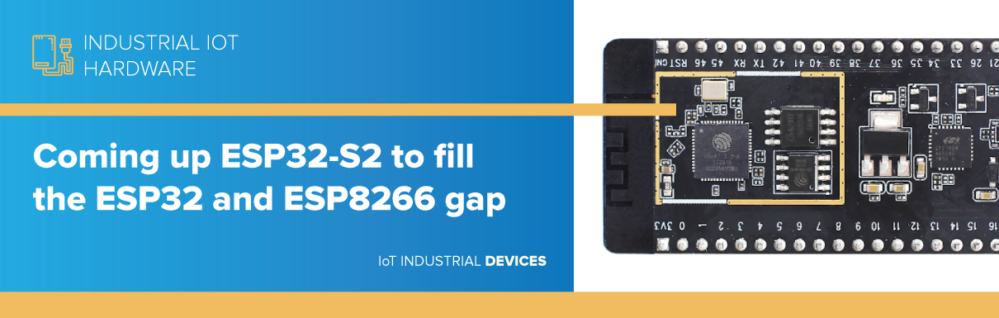
Coming up ESP32-S2 to fill the ESP32 and ESP8266 gap

In March 2019, photos of the new Espressif’s chip „7 2-2-A” leaked. Since then, speculation has come up. It includes BLE5, USB, 5 GHz Wi-Fi and so on. Speculation ended last month when Espressif announced the new ESP32-S2. There is still some confusion about the ESP32-S2, but the specification has become clearer.

With state-of-the-art power management and RF performance, IO capabilities and security features, ESP32-S2 is an ideal choice for a wide variety of IoT or connectivity-based applications, including smart home and wearables.

Source: https://www.espressif.com/en/news/espressif-announces-%E2%80%A8esp32-s2-secure-wi-fi-mcu
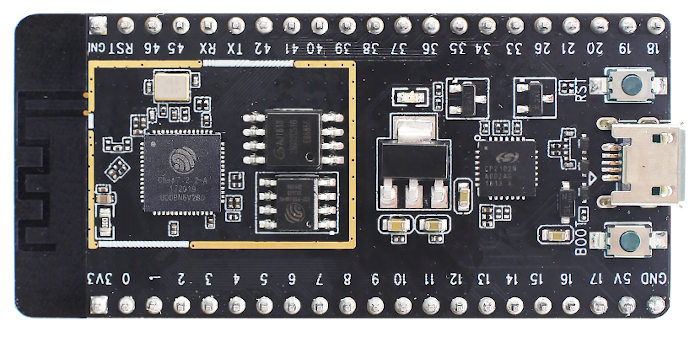
First look of ESP32-S2

CPU and Memory

  • Xtensa® single-core 32-bit LX7 microcontroller
  • 7-stage pipeline
  • Clock frequency of up to 240 MHz
  • Ultra-low-power co-processor
  • 320 kB SRAM, 128 kB ROM, 16 KB RTC memory
  • Up to 1GB of external flash and SRAM support
  • Separate instruction and data cache

Connectivity

  • Wi-Fi 802.11 b/g/n
  • 1×1 transmit and receive
  • HT40 support with data rate up to 150 Mbps
  • Support for TCP/IP networking, ESP-MESH networking, TLS 1.0, 1.1 and 1.2 and other networking protocols over Wi-Fi
  • Support Time-of-Flight (TOF) measurements with normal Wi-Fi packets

IO Peripherals

  • 43 programmable GPIOs
  • 14 capacitive touch sensing IOs
  • Standard peripherals including SPI, I2C, I2S, UART, ADC/DAC and PWM
  • LCD (8-bit parallel RGB/8080/6800) interface and also support for 16/24-bit parallel
  • Camera interface supports 8 or 16-bit DVP image sensor, with clock frequency of up to 40 MHz
  • Full speed USB OTG support

Security

  • RSA-3072-based trusted application boot
  • AES256-XTS-based flash encryption to protect sensitive data at rest
  • 4096-bit eFUSE memory with 2048 bits available for application
  • Digital signature peripheral for secure storage of private keys and generation of RSA signatures

Optimal Power Consumption

ESP32-S2 supports fine-resolution power-control through a selection of clock frequency, duty cycle, Wi-Fi operating modes and individual power control of its internal components. 

  • When Wi-Fi is enabled, the chip automatically powers on or off the RF transceiver only when needed, thereby reducing the overall power consumption of the system. 
  • ULP co-processor with less than 5 uA idle mode and 24 uA at 1% duty-cycle current consumption. Improved Wi-Fi-connected and MCU-idle-mode power consumption.

Battery-ready IoT devices based on ESP32

Battery / SuperCap power support allows the processes and data to be securely executed, saved or transferred, and the operating system to be safely shutdown or reboot, if the power source has been restored. The power failure alert can also be sent to cloud service, to perform custom task, specified by user or self-learning AI algorithm.

The Moduino device is a comprehensive end-point controller for variety of sensors located throughout any installation. It fully supports temperature and humidity sensors and new ones are currently developed, e.g. accelerometer, gyroscope, magnetometer, etc.

Battery powered Moduino ESP32
Battery powered IoT installation. Source: https://moduino.techbase.eu/

ModuinoModBerry symbiosis allows wide range of wake-up/sleep schedule customization, in order to perform best and save energy accordingly to power supply state. Arduino and MicroPython environments provide libraries to control different scenarios of data and power management.

With built-in algorithms and the possibility to program on your own, the TECHBASE’s sleep/wake addon module can wake the device using schedule/timer. Another option is wake on external trigger, e.g. change of input, etc. All the options for sleep, shutdown and wake can be configured for various scenarios to ensure constant operation of devices, safety of data and continuity of work in case of power failure in any installation.

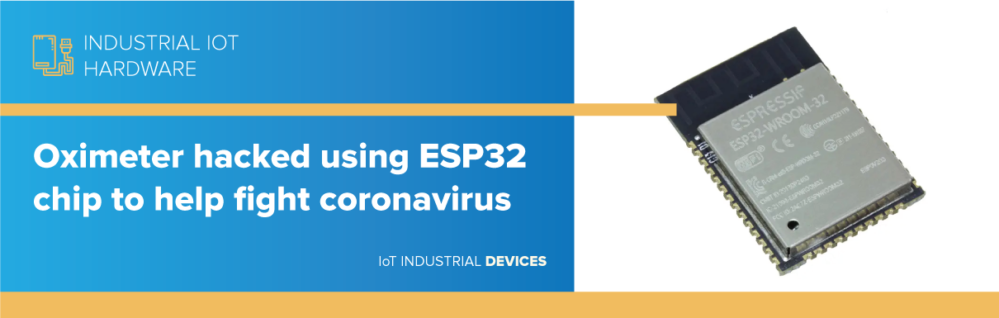
Oximeter hacked using ESP32 chip to help fight coronavirus

Many developement boards can be used in home and industrial applications to control and manage data. A small ESP32 chip was used to hack customer oximeter – a useful tip to help in current COVID-19 related treatments.

Industrial use of ESP32-based solutions

One of industrial IoT devices, supporting Espressif’s ESP32 technology is eModGATE from TECHBASE. Economical, ESP32-based solution can serve as an end-point in any installation or works well as a gateway, gathering data from scattered sensor mesh across the installation. For more information and also Raspberry Pi based solutions check Industrial IoT Shop with all the configuration options for eModGATE.

Obrazek posiada pusty atrybut alt; plik o nazwie emod1.png
eModGATE with ESP32
Arduino-based ventilator to help coronavirus patients

In the times we live in, often a desperate measures must be taken. As far as manufacturing and using home-made medical equipment is not advised, the spread of the COVID-19 might push humanity to such solutions. Johnny Lee’s project involves a simple, low-cost ventilator controlled via Arduino.

The idea is that since these machines are basically just blowers controlled by a brushless DC motor, an Arduino Nano equipped with an electonic speed controller could allow it to act as a one.

Such a setup has been shown to provide more than enough pressure for a ventilator used on COVID-19 patients. This device has in no way been evaluated or approved for medical use, but it does provide a starting point for experimentation.

Source: https://blog.arduino.cc/2020/03/17/designing-a-low-cost-open-source-ventilator-with-arduino/

Industrial Arduino-like devices as a base of medical equipment?

When industrial IoT devices and edge devices, like medical equipment work together, digital information becomes more powerful. Especially in contexts where you need to collect data in a traditional edge context, or control the servo-motors of a ventilatr. You can then remotely monitor the container using the sensor.

By introducing AI (artificial intelligence) into the device itself, edge computing can also make more context-sensitive, quick decisions at the edge. Data gathered from the sensors can be transferred to the cloud at any time after local work has been completed, contributing to a more global AI process, or archived. With the combination of industrial IoT devices and advanced technology, high quality analysis and small footprint will become the AI standard in 2020.

Industrial IoT use of ESP32 chip in eModGATE

Latest innovations used in industrial solutions

One of many uses of IoT can be edge devices, dedicated to data management, process control (e.g. with MQTT protocol) and monitoring. Latest ESP32-based eModGATE controller from TECHBASE company is a series utilizing MicroPython environment to provide data management solutions for end-points applications. The eModGATE has built-in Wi-Fi/BT modem and can be equipped with additional NarrowBand-IoT, LoRa, ZigBee, etc.

For example eModGATE eqipped with wireless NB-IoT modem are perfect for industrial automation solutions, e.g. data logging, metering, telemetrics, remote monitoring, security and data management through all Industrial IoT applications.