Wpisy

New industrial grade touch panel with Raspberry Pi

Latest addition to Industrial IoT Ecosystem from TECHBASE is TECHPANEL P500 is an industrial-grade touch panel automation controller for wide range of industrial installations. Equipped with up to date Raspberry Pi Compute Module 3/3+ or Compute Module 3/3+ Lite, 7” capacitive touch display and IP65 hermetic casing with cast gaskets, can be used in harsh conditions of industrial applications.

Raspberry Pi based touch panel features

New TECHPANEL P500 M3/3+ is powered by quad-core Cortex-A53 1.2GHz processor with 1GB RAM and up to 32GB eMMC or 8GB microSD flash memory. Wide range of modems and extra wireline/wireless interfaces via expansion cards makes the TECHPANEL micro-computer a versatile addition to Industrial IoT solutions offered by TECHBASE company.

TECHPANEL devices can easily work remotely with existing ModBerry Gateways & Moduino ESP32 Edge Controllers for data accumulation and monitoring, to perform specific actions before sending the data to cloud services. TECHPANEL with ModuinoModBerry installation can work as standalone Ecosystem (for example via MQTT), providing complex data management solution to any installation.
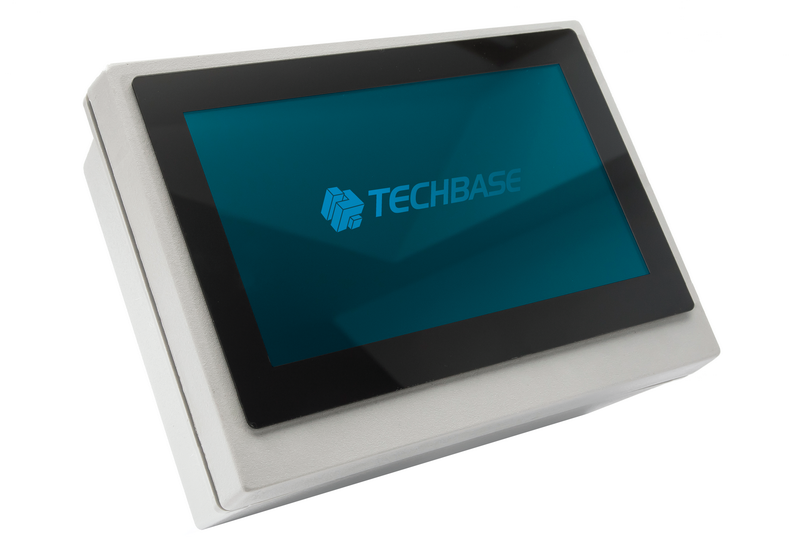
TECHPANEL P500 M3+ with Compute Module 3+ from Raspberry Pi

Visual management and available Raspbian OS

The device is equipped with compact 800 x 480 px 7-inch TFT panel with 10 points capacitive touch to allow the user to perform direct actions on-site. With IP65 casing and extended working temperature range, TECHPANEL can be placed almost everywhere.

Over 23 million Raspberry Pi’s have been sold and the Raspberry Pi is likely to stay as a new standard in the industry. Official Raspbian OS is free operating system based on Linux Debian optimized for the Raspberry Pi comes with over 35,000 packages, pre-compiled software bundled in a nice format for easy installation.
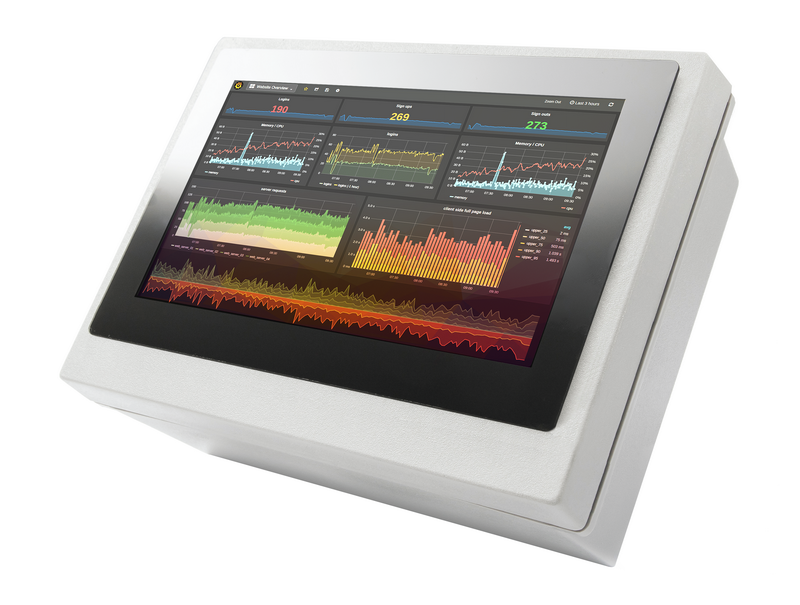
TECHPANEL P500 M3+ with Compute Module 3+ from Raspberry Pi

SPECIFICATION

  • Cortex A53 1.2GHz Processor
  • RAM 1GB, eMMC up to 32GB
  • 7″ TFT screen (800x600px)
  • Capactitive touch screen (10-point)
  • Wide range of expansion modules (Ethernet, RS-232/485/422,  Digital and Analog I/Os, Relay, M-Bus, CAN, optoisolated I/Os, Accelerometer, etc.)
  • Wide range of wireless modules (GPRS/EDGE, 3G/LTE, NarrowBand-IoT, GPS, Wi-Fi, Bluetooth, LoRa, ZigBee, Z-Wave, Sigfox, Wireless M-Bus, etc.)
  • Water-Resistant casing (IP65)
  • Operating temperature: -20°C ~ 70°C
  • Optional SD card support instead of eMMC Flash
ESP32-based LoRa / LoRaWAN wireless network

One way of long-range and low-power data transmission is LoRa wireless technology. Since the Internet of Things market (with ESP32 – based solutions) is mainly covered with short-range Wi-Fi and Bluetooth and long-range with 3G / NarrowBand-IoT technologies, LoRa oftens is omitted or simply unknown by IoT users. Below you will find a short representation of what LoRa is and how can it be used.

What is LoRa / LoRAWAN network?

LoRaWAN® network architecture is deployed in a star-of-stars topology in which gateways relay messages between end-devices and a central network server. The gateways are connected to the network server via standard IP connections and act as a transparent bridge, simply converting RF packets to IP packets and vice versa. The wireless communication takes advantage of the Long Range characteristics of the LoRa physical layer, allowing a single-hop link between the end-device and one or many gateways. All modes are capable of bi-directional communication, and there is support for multicast addressing groups to make efficient use of spectrum during tasks such as Firmware Over-The-Air (FOTA) upgrades or other mass distribution messages.

Source: https://lora-alliance.org/about-lorawan

Industrial use of LoRa & ESP32-based solutions

One of industrial IoT devices, supporting LoRa wireless technology is ESP32 based eModGATE from TECHBASE. Economical, ESP32-based solution can serve as an end-point in any installation or works well as a gateway, gathering data from scattered sensor mesh across the installation. For more information and also Raspberry Pi based solutions check Industrial IoT Shop with all the configuration options for eModGATE.

eModGATE with ESP32
Sigfox announces changes improving IoT applications

First major announcement is that Sigfox will launch a private network (PAN) that will allow IoT customers to choose private and global services according to their needs. The service will be launched for the first time in France in the first quarter of 2020, but Sigfox will be implemented in over 65 countries.

The operator’s wide area network (WAN) will be completed next year in cooperation with Eutelsat. Sigfox provides coverage worldwide using the nano-satellite constellation launched by Eutelsat.

The Sigfox PAN offer will benefit from the existing Sigfox WAN ecosystem. Thanks to the potential to use all components on the market and the use of very low transmit power to support facilities without the need for batteries, the Sigfox PAN offer offers enormous potential,

Ludovic Le Moan, CEO and co-founder of Sigfox.

According to Sigfox, by the end of 2019, there will be more than 15 million registered facilities and over 1,500 customers using this solution in various industries around the world. Sigfox says that PAN customers can expect the same as WAN customers in terms of support and quality. PAN clients can choose to subscribe to additional „WAN Extension” services if needed if the device needs to communicate outside the local network.

Sigfox improving the accuracy of Atlas geolocation services

Internet of Things operators have now launched Atlas Native Complimentary. It is made available free of charge in exchange for the rights to process data regarding GPS data. These data are compared to the fingerprint of the Sigfox network using machine learning, which increases accuracy to 800 meters.

To further increase the accuracy of its geolocation services, Sigfox said it has completed the global implementation of Atlas WiFi in collaboration with HERE Technologies’ mapping experts.

Sigfox uses the global WiFi access point database here. Access points are checked by the Sigfox WiFi tracking module and more closely track the location of external and internal resources with less battery consumption than using GPS.

We are delighted to strengthen our partnership with Amadeus and share our combined expertise to create real digital transformation of the travel sector. Our strategic alliance named PinPoint will not only help to improve the travel experience, but this will also change completely the game for an industry looking for decades for THE technology able to save costs while improving efficiency and quality of services

Raouti Chehih, Chief Adoption Officer at Sigfox

The first services from the strategic alliance are expected to hit the market in 2020.

Industrial use of ESP32-based solutions

One of industrial IoT devices, supporting Sigfox wireless technology is eModGATE from TECHBASE. Economical, ESP32-based solution can serve as an end-point in any installation or works well as a gateway, gathering data from scattered sensor mesh across the installation. For more information check Industrial IoT Shop with all the configuration options for eModGATE.

eModGATE with ESP32
Raspberry Pi & ESP32 use-hack of OpenMQTTGateway

Many developement boards can be used in home and industrial applications to control and manage data. Check out latest video from open-tech infuencer, Andreas Spiess, in which he uses Raspberry Pi and ESP32 boards to build and visualize weight loss system using Xiaomi scale and Node-RED, influxDB and Grafana. Open MQTT Gateway might come in handy too.

Industrial use of Raspberry Pi & ESP32-based solutions

One of industrial IoT devices, supporting Espressif’s ESP32 technology is eModGATE from TECHBASE. Economical, ESP32-based solution can serve as an end-point in any installation or works well as a gateway, gathering data from scattered sensor mesh across the installation. For more information and also Raspberry Pi based solutions check Industrial IoT Shop with all the configuration options for eModGATE.

eModGATE with ESP32
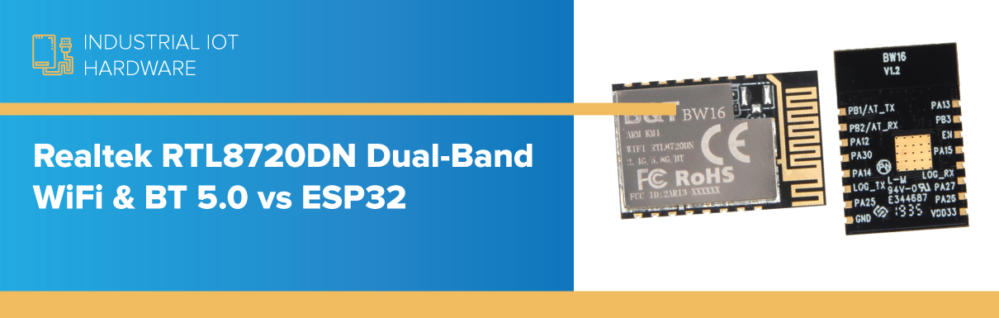
Realtek RTL8720DN Dual-Band WiFi & BT 5.0 vs ESP32

IoT market ofers wide range of small and efficient modules for Home & Industrial Internet of Things applications, equipped with 2.4GHz Wi-Fi, such as Espressif’s ESP32 or older ESP8266 modules. Additional Bluetooth 4.2/5.0 is often found on those. Dual-band Wi-Fi, on the other hand, is hard to find on low-budget IoT modules. Here comes Realtek RTL8720DN.

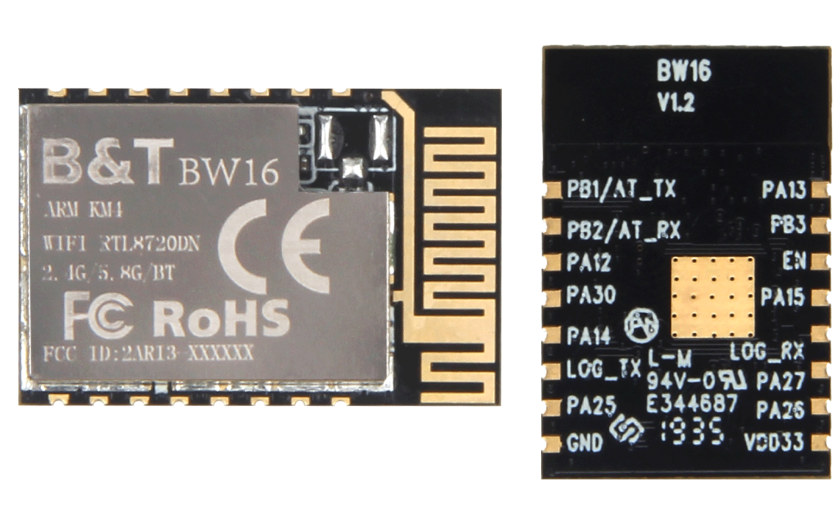
Realtek RTL2720DN module, as a part of AmebaD family, comes with ARM Cortex-M4/M0 wireless MCU with support of 802.11 b/g/n Dual-Band Wi-Fi 2.4GHz / 5GHz and extra Bluetooth 5.0 wireless connectivity.

Realtek RTL8720DN Dual-Band WiFi & Bluetooth 5.0 module

Realtek RTL8720DN specifications:

  • Wireless SoC – Realtek RTK8720DN MCU with KM4 Arm Cortex-M4 core @ 200 MHz and KM0 Arm Cortex-M0 core @ 20 MHz
  • Connectivity
    • WiFi
      • 802.11 a/b/g/n WiFi 4
      • Frequency Range – 2.412-2.484GHz & 5.180-5.825GHz
      • Data Rates
        • 802.11a: 6,9,12,18,24,36,48,54Mbps
        • 802.11b: 1,2,5.5,11Mbps
        • 802.11g: 6,9,12,18,24,36,48,54Mbps
        • 802.11n: MCS0–MCS7 @ HT20/HT40 2.4GHz and 5GHz bands
      • AP, Station, AP/Client supported
    • Bluetooth
      • Bluetooth 5.0 LE
      • Receiver Sensitivity: -92 dBm
      • Transmit Power: 7 dBm
    • Antenna – IPEX connector or PCB Antenna
  • I/O – 16x castellated holes with GPIO, 2x UART (AT commands + serial), ADC, I2C, SPI, 4x PWM, 3.3V, GND
  • Power Supply – 3.3±5% V
  • Dimensions – 24 x 16 x 3 mm
  • Temperature Range – Operating: -20°C to 85°C; storage: -40°C to 125°C
  • Relative Humidity – 10%~90% (non-condensing)
  • Certifications – FCC, CE, SRRC, RoHS

Source: https://www.cnx-software.com/2020/01/17/realtek-rtl8720dn-dual-band-wifi-bluetooth-5-0-iot-module/

Bluetooth 5.0 update for ESP32

The Espressif’s flagship ESP32 chip recently passed the SIG Bluetooth LE 5.0 certification. This confirms that the version of the protocol supported by the ESP32 microcontroller has been upgraded from Bluetooth LE 4.2 to Bluetooth LE 5.0, which is more stable and compatible.

The implementation and development of the Bluetooth LE (BLE) application requires not only a system that supports this function, but also an attached Bluetooth LE protocol stack consisting of a driver and a host.

Thanks to Bluetooth LE 5.0 certification, ESP32 SoC not only updates the system as a whole, but also adds new features that improve the latest software after passing more stringent tests than previous certification.

Industrial use of ESP32-based solutions

One of industrial IoT devices, supporting Espressif’s ESP32 technology is eModGATE from TECHBASE. Economical, ESP32-based solution can serve as an end-point in any installation or works well as a gateway, gathering data from scattered sensor mesh across the installation. For more information check Industrial IoT Shop with all the configuration options for eModGATE.

eModGATE with ESP32
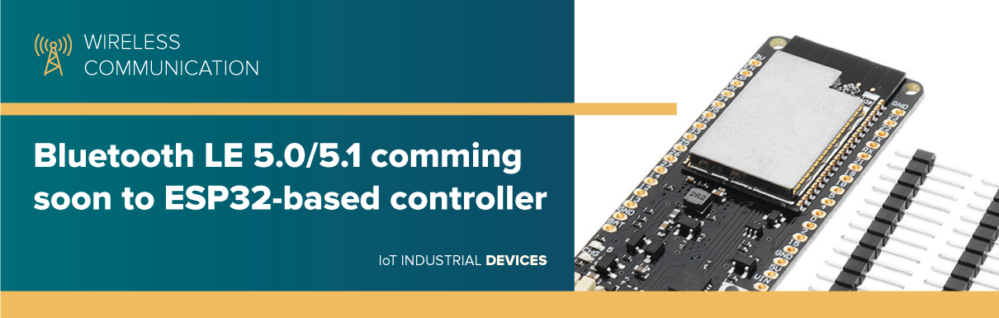
Bluetooth LE 5.0/5.1 comming soon to ESP32-based controller

The Espressif’s flagship ESP32 chip recently passed the SIG Bluetooth LE 5.0 certification. This confirms that the version of the protocol supported by the ESP32 microcontroller has been upgraded from Bluetooth LE 4.2 to Bluetooth LE 5.0, which is more stable and compatible.

The implementation and development of the Bluetooth LE (BLE) application requires not only a system that supports this function, but also an attached Bluetooth LE protocol stack consisting of a driver and a host.

Bluetooth 5.0 update for ESP32

Thanks to Bluetooth LE 5.0 certification, ESP32 SoC not only updates the system as a whole, but also adds new features that improve the latest software after passing more stringent tests than previous certification.

Due to hardware limitations, ESP32 does not support such functions of Bluetooth LE 5.0 as 2M PHY, LE Long Range, and ADV Extensions.

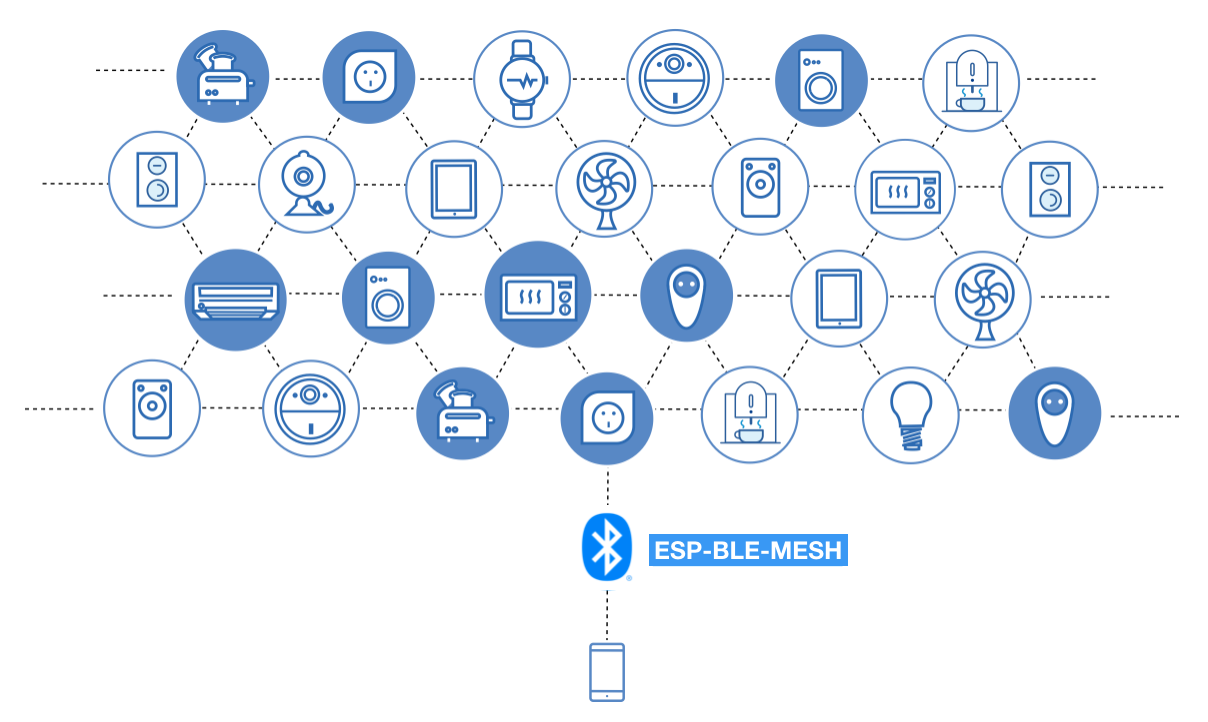
It is also worth mentioning that the combination of Bluetooth and Mesh networking is expected to become a key technology for the Internet of Things. A  Bluetooth® Mesh network enables a „many-to-many” relationship among potentially thousands of wireless devices, where data are transmitted not in a direct radio range but in wide physical areas. Espressif’s contribution in this field is the ESP-BLE-MESH, which got fully certified by Bluetooth SIG in September 2019.

Several Bluetooth-operated products on the market, such as wearable devices, smart speakers, cleaning robots, smart lights/sockets, etc., provide evidence that Bluetooth 5.0 and the Bluetooth Mesh networking technology are mature enough to drive the development of interconnected IoT devices. To this end, Espressif’s chips and ESP-BLE-MESH, in particular, are designed to help customers develop easily secure and cost-effective products for smart homes, smart buildings, healthcare, new automobiles and other smart industries.

Source: https://www.espressif.com/en/news/BLE_5.0_Certification

Industrial use of ESP32-based solutions

One of industrial IoT devices, supporting Espressif’s ESP32 technology is eModGATE from TECHBASE. Economical, ESP32-based solution can serve as an end-point in any installation or works well as a gateway, gathering data from scattered sensor mesh across the installation. For more information check Industrial IoT Shop with all the configuration options for eModGATE.

eModGATE with ESP32
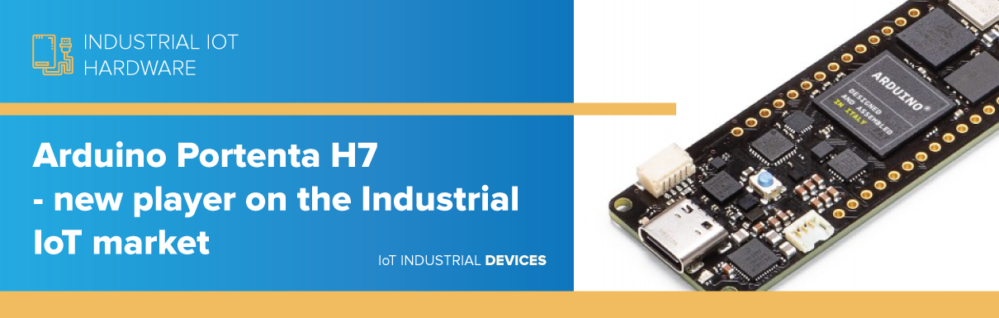
Arduino Portenta H7 - new player on the Industrial IoT market

At the Consumer Electronics Show 2020, Arduino has made a possibly groundbreaking announcement with the Arduino Pro IDE. This could bring the maker scene and classic industrial companies closer together.

Arduino Portenta H7 features

The Portenta H7 is equipped with an STM32H747Xi with a Cortex-M7 and a Cortex-M4. Portenta H7 has 2 megabytes of RAM and a 16 MByte NOR flash. An SD card can be connected via an adapter. The connection to a wireless network is via WiFi 802.11 b/g/n or Bluetooth 5.1. The charging electronics for a 3.7 volt LiPo battery are already integrated.

With the Arduino Portenta H7, the first model of the new Portenta family was announced. This should be tailored specifically to the needs of industrial applications, AI and robotics scenarios.

Arduino Portenta H7
Arduino Portenta H7

The model is equipped with two 80-pin connectors, plus four UART ports. USB Type-C port can output image signals via DisplayPort. The Portenta H7 is also programmable with an interpreter in MicroPython, JavaScript and TensorFlow Light. The single-platinum calculator should be available from February for 90 euros.

Source: https://www.linuxinsider.com/story/86448.html

What the world says about Arduino Portenta?

Fabio Violante, CEO of Arduino, said manufacturers will be able to create modules for robotics, 3D printer and more:

Portenta H7 is directly compatible with other Arduino libraries and offers new features that will benefit hardware manufacturers, such as a DisplayPorl output, much faster ADC multi-channel and high-speed timers.

Arduino Portenta Carrier

Meanwhile, Charlene Marini, vice president of strategy for Arm’s IoT Services Group commented:

SMEs with industrial requirements require simplified development through secure development tools, software and hardware to economically realize their IoT use cases.

ARM Partnership cooperation

ARM works with Arduino to provide secure, easy-to-manage and manageable devices to a wide range of programmers. Two innovations to date show the results of this partnership.

„Mbed OS Portenty is one of the concrete achievements of the partnership,” said Marini. „Another example is the Arduino SIM card, which uses Pelion connection management.”

She said companies have the ability to provide secure Internet of Things on a large scale. This is the foundation of machine learning, automation and the rapid evolution of applications that cross the physical and digital world.

eModGATE with ESP32

Industrial use of Arduino-like solutions

One of industrial IoT devices, supporting Arduino-like technology is eModGATE from TECHBASE. Economical, ESP32-based solution can serve as an end-point in any installation or works well as a gateway, gathering data from scattered sensor mesh across the installation. For more information check Industrial IoT Shop with all the configuration options for eModGATE.

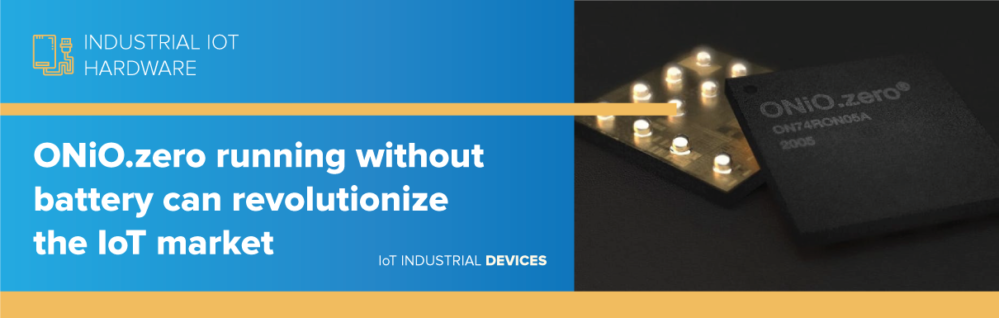
ONiO.zero running without battery can revolutionize the IoT market

ONiO, a Norwegian specialist in the field of the Internet of Things (IoT) for the medical industry, announced ONiO.zero, a RISC-V-based microcontroller with very low power consumption, which can work completely from the energy harvested from the environment. ONiO claims that its design can take energy from the radio spectrum and operate up to 24 MHz.

„ONiO.zero is a wireless MCU with very low power consumption, which uses energy acquisition technology,” wrote the company about its creation. This means that ONiO.zero only works on ambient energy. There are no coin cells, supercaps, lithium and batteries, but still offers a lot of performance.

Battery-based solutions have an unavoidable warning about battery replacement. This leads to increased costs over the entire lifetime. ONiO.zero avoids this problem and reduces operating costs. ONiO.zero is self-powered and supports a wide range of power sources, from multi-frequency RF bands supporting GSM and ISM to optional external sources such as solar, piezoelectric, thermal and voltaic.

Source: https://www.hackster.io/news/onio-zero-offers-up-to-24mhz-of-risc-v-microcontroller-performance-on-nothing-but-harvested-energy-70285321d50d

The microcontroller itself is based on the architecture of the RISC-V instruction set of the open source type (in particular RV32EMC) and operates up to 24 MHz with a supply voltage of 1.8 V. The controller will work if necessary with lower voltages. You can get 6 MHz at 1 V and 1 MHz at 0.8 V, and the system still runs slower, but as fast as 450 mV. Includes 1 KB ROM and 2 KB RAM, as well as 8-32 KB of ultra low power flash memory, capable of 100,000 read and write cycles up to 850 mV.

ONIO.zero running without battery can revolutionize the IoT market

ONiO.zero contains a crystalline Low Energy Bluetooth transmitter (BLE) that can operate at a voltage as low as 850mV, an IEEE 802.15.4 (UWB) broadband transmitter operating in the 3.5-10 GHz band, and optional radio transmitter 433 MHz MICS for the industrial, scientific and medical band (ISM).

ONiO.zero hasn’t been released yet. For more information check the ONiO.zero product page.

Battery-ready IoT devices based on ESP32

Battery / SuperCap power support allows the processes and data to be securely executed, saved or transferred, and the operating system to be safely shutdown or reboot, if the power source has been restored. The power failure alert can also be sent to cloud service, to perform custom task, specified by user or self-learning AI algorithm.

The Moduino device is a comprehensive end-point controller for variety of sensors located throughout any installation. It fully supports temperature and humidity sensors and new ones are currently developed, e.g. accelerometer, gyroscope, magnetometer, etc.

Battery powered Moduino ESP32
Battery powered IoT installation. Source: https://moduino.techbase.eu/

ModuinoModBerry symbiosis allows wide range of wake-up/sleep schedule customization, in order to perform best and save energy accordingly to power supply state. Arduino and MicroPython environments provide libraries to control different scenarios of data and power management.

With built-in algorithms and the possibility to program on your own, the TECHBASE’s sleep/wake addon module can wake the device using schedule/timer. Another option is wake on external trigger, e.g. change of input, etc. All the options for sleep, shutdown and wake can be configured for various scenarios to ensure constant operation of devices, safety of data and continuity of work in case of power failure in any installation.


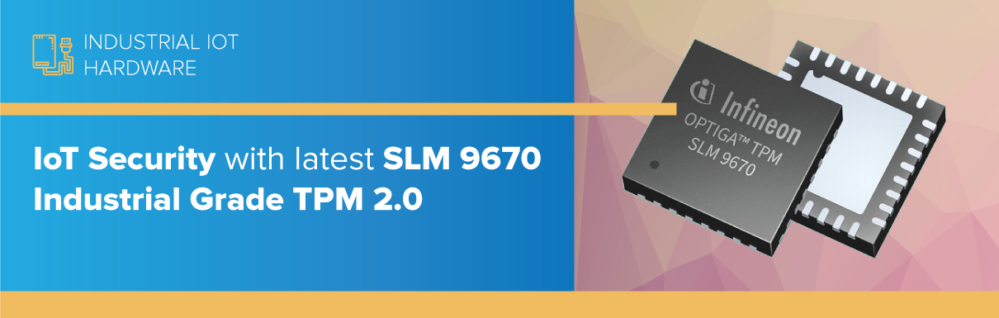
IoT Security with latest SLM 9670 Industrial Grade TPM 2.0

Like other embedded systems, Industrial IoT design faces a constant stream of threats. As hackers adopt new attacks, developers rush to close security holes. Deployed devices need to update IoT firmware, increasing potential security vulnerabilities. For example, using a simple firmware verification check can leave the software published. In this situation, the developer may expect to be able to query external resources for verification and catch attempts to replace the firmware with hacked code. However, even relatively novice hackers can replace the firmware with code that ignores such verification checks. To secure these vurnerabilities comes Industrial Grade TPM 2.0.

Securing devices with Infineon industrial grade TPM

Infineon Technologies AG has unveiled a new security chip that defines the first TPM (Trusted Platform Module), designed specifically for industrial applications such as industrial computers, servers, industrial controllers and edge gates. The module protects confidential data in connected devices and reduces the risk of leakage of this information due to attacks, e.g. hackers.

The OPTIGA TPM SLM 9670 module protects the integrity of industrial systems and the identity of users using them. The system controls access to sensitive data at key locations in industrial environments, such as an automated factory. It also protects the cloud interface if the network uses one. The security system fully meets the TPM 2.0 standard developed by the Trusted Computing Group and is certified by an independent test laboratory in accordance with the criteria contained in this standard. The new module is meticulously controlled and certified by Infineon. Thanks to its use, it is possible to shorten the time of designing and introducing the device to the market, thanks to the ready security solution in the system.

The TPM system has a lifetime declared as 20 years. It allows programmers to perform firmware updates, which in turn enables them to meet the long-term security requirements in rapidly changing industrial environments. In this way, it can also reduce maintenance costs of industrial equipment thanks to secured remote software updates. The TPM chip will be available in serial production in the second half of 2019.

TPM 2.0 Key Features

  • Random Number Generator (RNG) according to NIST SP800-90A
  • TPM FW update functionality installed
  • 6962 Bytes of free NV memory
  • Full personalization with Endorsement Key (EK) and EK certificate
  • Up to 3 keys in the volatile memory
  • Up to 7 keys in the NV memory
  • Up to 8 NV counters
  • Support of various cryptographic algorithms:
    • RSA-1024 and RSA-2048
    • SHA-1 and SHA-256
    • ECC NIST P256
    • ECC BN256

Security chip implementation in Industrial IoT devices

With knowledge of latest Industrial IoT security measures, the choice of proper end-point conroller or gateway is much easier than you think. Some manufacturers can implement TPM 2.0 security chip in production process, to allow users to generate certification keys after purchase, maximizing security of their installations. TECHBASE offers wide range of solutions, optionally aided with TPM system.

For example, ESP-32 based solution, Moduino X series and eModGATE series products offer the support for such security measures. Read more in Industrial IoT Ecosystem brochure, to understand the importance of reliable and secure hardware for Industrial IoT.

NarrowBand-IoT the new black of Industrial IoT

The NB-IoT is becoming a standard in wireless communication of IoT devices, for standalone solutions and complex installations with thousands of units, coordinated with gateways. Will NarrowBand-IoT replace other wireless technologies in industrial automation?

What exactly is NarrowBand?

NarrowBand-IoT (NB-IoT) is a radio technology in the field of LPWAN (Low Power Wide Area Network) dedicated for IoT devices, operating on the licensed frequency band used by telecommunications operators.

The biggest advantages of NB-IoT include:

  • long battery life (up to 10 years),
  • efficiency in the amount of data transferred,
  • intra-building penetration,
  • the ability to connect even tens of thousands of devices in one system,
  • a global standard,
  • a high level of security and low cost

You can build mass solutions and those that until now were considered unprofitable. NB-IoT technology works in the licensed band, so there is no risk of interference and blocking communication by competing networks.

The service life of devices powered by two AA batteries is up to 10 years. However, the devices themselves are constructed in such a way that they can work for many years without the need for technical supervision and recharging the battery.

NB-IoT used in industrial solutions

One of many uses of NarrowBand-IoT wireless modems can be communication of edge devices, dedicated to data management, process control (e.g. with MQTT protocol) and monitoring. Latest ESP32-based eModGATE controller from TECHBASE company is a series utilizing MicroPython environment to provide data management solutions for end-points applications. The eModGATE has built-in Wi-Fi/BT modem and can be equipped with additional NarrowBand-IoT modems

eModGATE eqipped with wireless NB-IoT modem are perfect for industrial automation solutions, e.g. data logging, metering, telemetrics, remote monitoring, security and data management through all Industrial IoT applications.

Supported bandwidths:

  • Global-Band LTE CAT-M1:  B1/B2/B3/B4/B5/B8/B12/B13/B18/B19/B20/B26/B28/B39;
  • Global-Band LTE CAT NB-IoT1:  B1/B2/B3/B5/B8/B12/B13/B17/B18/B19/B20/B26/B28;
  • GPRS/EDGE 850/900/1800/1900Mhz Control Via AT Commands

Supported data transfer:

  • LTE CAT-M1(eMTC) – Uplink up to 375kbps, Downlink up to 300kbps
  • NB-IoT – Uplink up to 66kbps, Downlink up to 34kbps
  • EDGE Class – Uplink up to 236.8Kbps, Downlink up to 236.8Kbps
  • GPRS – Uplink up to 85.6Kbps, Downlink up to 85.6Kbps