Wpisy

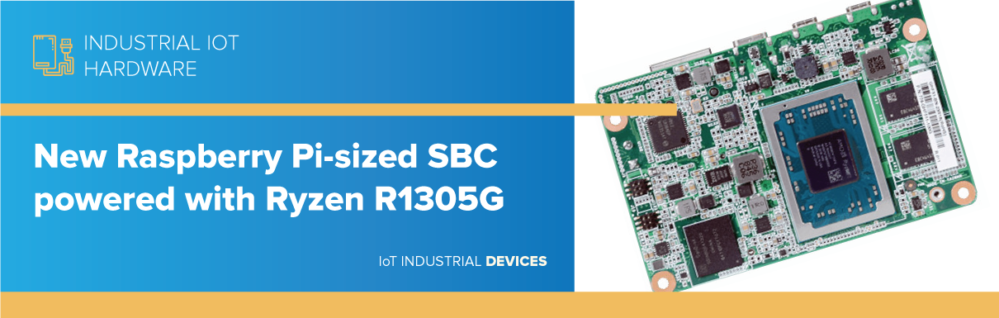
New Raspberry Pi-sized SBC powered with Ryzen R1305G

Single board computers, or SBCs for English in short, are very popular among enthusiasts and DIY enthusiasts. Although they have been available on the market for a long time, the British Raspberry Pi with its low price and great support contributed to the interest of this market by other manufacturers. Today we will focus on the legendary DFI company, which decided to present its vision of this type of device. It is unique because on the laminate the size of a credit card we find the AMD Ryzen Embedded 1000 chip, DDR4 memory chips, built-in eMMC memory and Mini PCI connector. And all this capable of working under classic Windows or Linux.

DFI GHF51 board (top)

DFI GHF51 is a single-board computer with dimensions of 84 x 55 millimeters. The green laminate features a 2-core and 4-thread AMD Ryzen Embedded R1305G chip working with a 1.5 GHz base clock and a maximum clock speed of 2.8 GHz at a TDP from 8 to 10 W. It has an integrated AMD Radeon Vega graphics chip equipped with 3 CU units that supports H.265 video content, VP9 and 4K resolution. The RAM memory is a single-channel DDR4 with a capacity of 2 to 8 GB and working with a clock up to 3200 MHz. The internal memory is an eMMC system with a capacity of 16 to 64 GB, and the whole is completed by the Mini PCIe connector.

DFI GHF51 board (back)

Industrial use of various development boards

Introduced in November 2017, the ModBerry M300 series, based on NanoPi NEO revolutionised the economic segment of Industrial IoT devices and proved, that automation and monitoring can be done effectively with low expenditure on industrial installations.

ModBerry M300 O1 based on OrangePi Zero Plus features Allwinner H5 (Quad-core Cortex-A53) SoC, moderate 512MB RAM, storage memory option with microSD slot, USB and Gigabit Ethernet port. The wireless communication is supported with onboard Wi-Fi module.

Offering much higher performance and wider feature range, the ModBerry M300 O2 features same SoC as M300 series, but thanks to OrangePi Zero Plus2 means, the device is equipped with onboard 8GB eMMC, extra microSD expansion slot as alternative and wired/wireless interfaces, e.g. HDMI, Wi-Fi, Bluetooth 4.0.

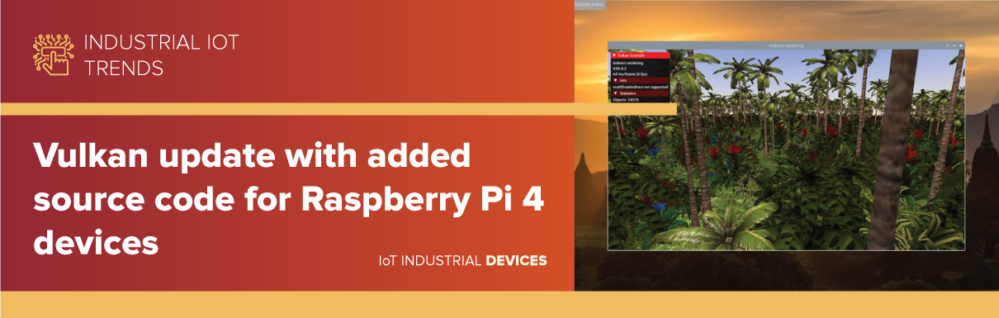
Raspberry Pi 4 is well known for its size and value, but will soon start to be seen for it’s significant performance. A few months ago, the Raspberry Pi Foundation announced the development of Vulkan support on Raspberry Pi 4. Today, the team published demonstration photos showing updates and progress in the current state of the project.

When we announced the effort back in January we were at the point of rendering a coloured triangle, which required only minimal coverage of the Vulkan 1.0 API in the driver. Today, we are passing over 70,000 tests from the Khronos Conformance Test Suite for Vulkan 1.0 and we have an implementation for a significant subset of the Vulkan 1.0 API.

Source: https://www.raspberrypi.org/blog/vulkan-update-now-with-added-source-code/

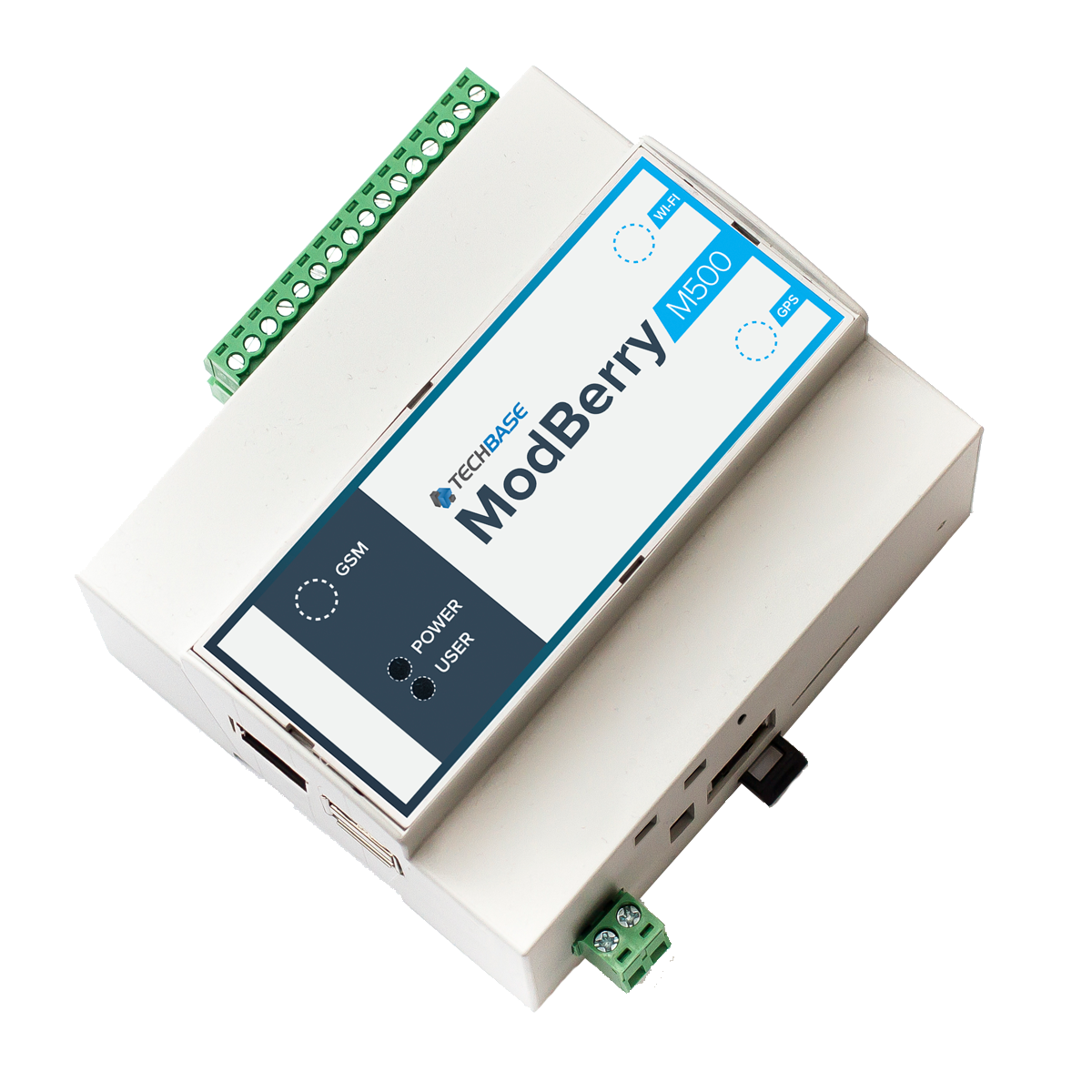
Rasbperry Pi 4 upgrade of ModBerry M500

In 2019, with the premiere of Raspberry Pi 4, TECHBASE upgraded their ModBerry M500 device with the latest revision of this popular SBC, further enhancing the performance of their device. New 1.5GHz quad-core 64-bit ARM Cortex-A72 processor (approximately 3 times better performance than previous Cortex-A53 powering Raspberry Pi 3+ Model B and Compute Module 3 and 3+). ModBerry M500 can now be configured from 2GB / 4GB LPDDR4 SDRAM options.

Revised ModBerry M500 features Gigabit Ethernet, USB3.0, two microHDMI ports supporting OpenGL ES 3.x and 4Kp60 hardware decode of HEVC video. The device is fully compatible with previous versions of Rasbperry Pi based Industrial IoT devices and accessories from TECHBASE.

In 2017, TECHBASE Group introduced an industrial-grade automation controller, based on popular Raspberry Pi 3 board. The device called ModBerry M500 incorporated latest Raspberry Pi SBC and TECHBASE’s standard industrial board to enhance the capabilities of market RPi3.

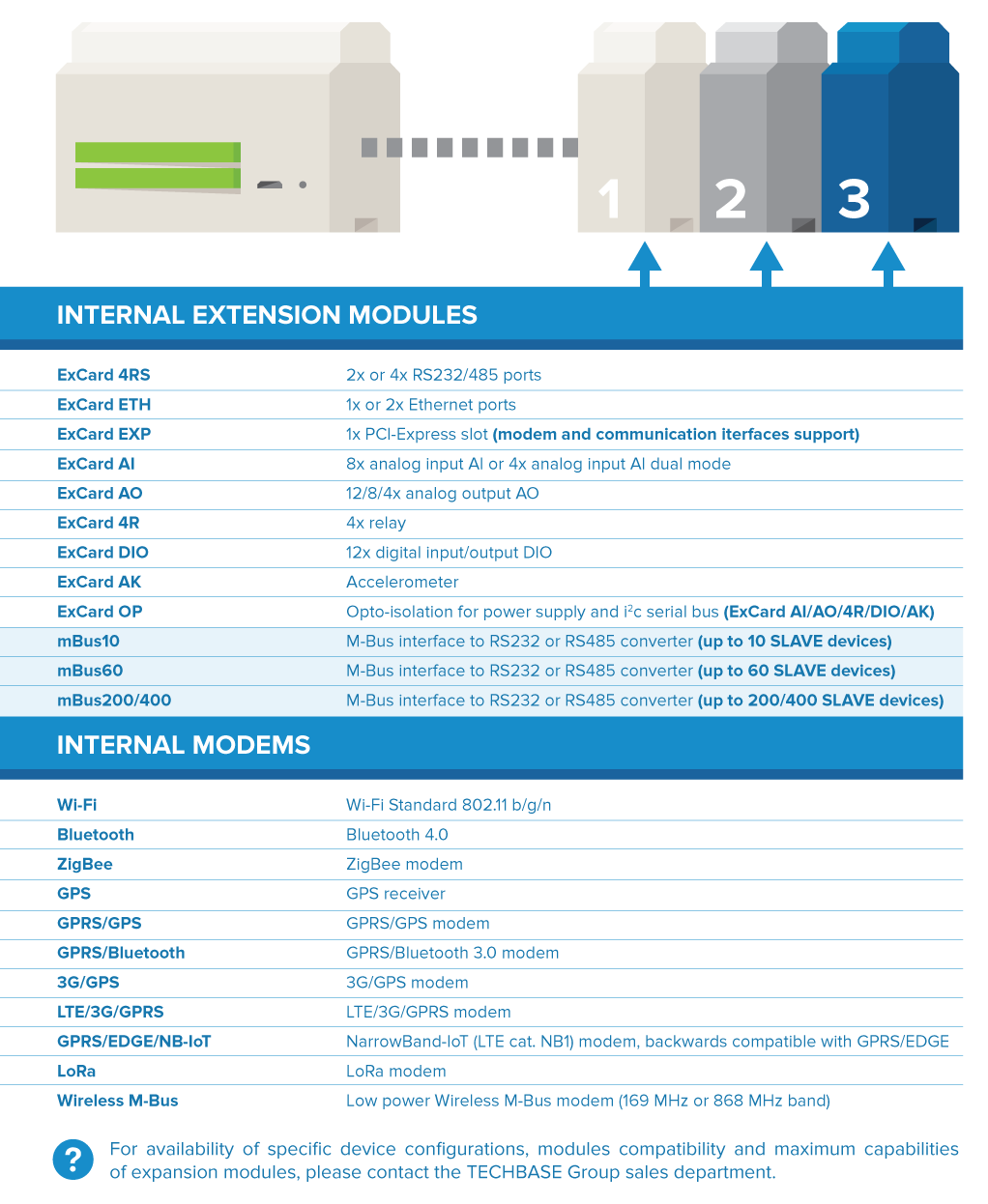
ModBerry M500 added wide range of I/Os to the board, including RS232/485 serial ports, digital and analog I/Os, 10/100Mbps Ethernet port, USB, 1-Wire and optional CAN. ModBerry series also offers additional wired interfaces and wireless communication modules with their proprietary modules called ExCard. The range of wireless modules include 3G/LTE, NarrowBand-IoT (NB-IoT), Wireless M-Bus, ZigBee, LoRa, Sigfox, Wi-Fi, Bluetooth and many more.

Rasbperry Pi 4 upgrade of ModBerry M500

In 2019, with the premiere of Raspberry Pi 4, TECHBASE upgraded their ModBerry M500 device with the latest revision of this popular SBC, further enhancing the performance of their device. New 1.5GHz quad-core 64-bit ARM Cortex-A72 processor (approximately 3 times better performance than previous Cortex-A53 powering Raspberry Pi 3+ Model B and Compute Module 3 and 3+). ModBerry M500 can now be configured from 2GB / 4GB LPDDR4 SDRAM options.

Revised ModBerry M500 features Gigabit Ethernet, USB3.0, two microHDMI ports supporting OpenGL ES 3.x and 4Kp60 hardware decode of HEVC video. The device is fully compatible with previous versions of Rasbperry Pi based Industrial IoT devices and accessories from TECHBASE.

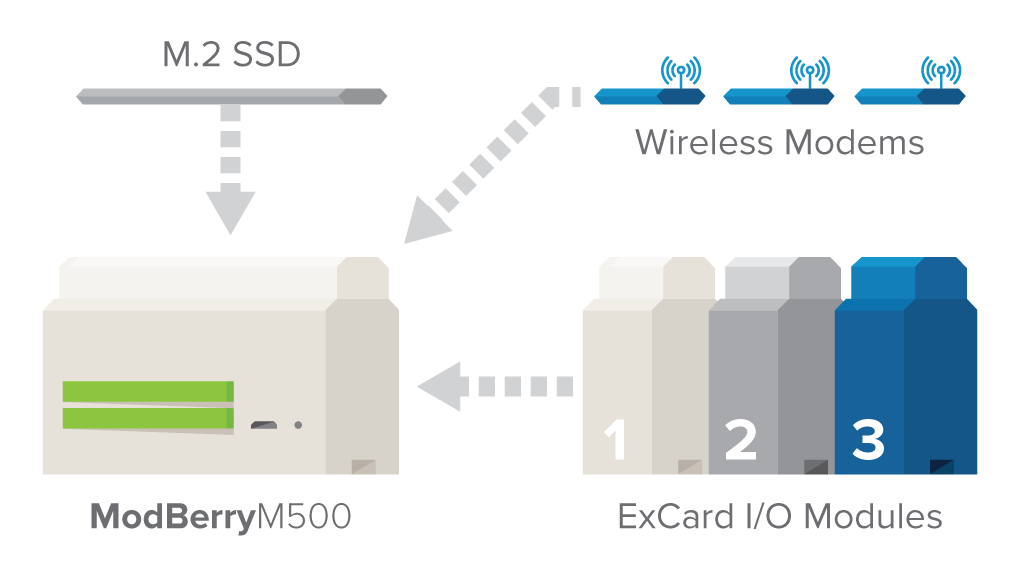
M.2 SSD support for ModBerry M500

Latest software update for Raspberrry Pi 4, now available in beta, makes it possible to boot directly from USB 3.0 connected drive, without the need for an SD card. With a possibility to run the OS directly from SSD is a massive breakthrough, allowing users to improve the performance of the system and data access speed.

ModBerry M500 offers now a feature to include M.2 SSD drive in industrial-grade device. The merge of industrial interfaces and SSD-boosted Raspberry Pi 4 is a perfect solution for on-site data management and gateway application.

ModBerry M500 roadmap for 2020+

Difficult times of coronavirus outbreak in early 2020 changed the expectations for new Industrial IoT devices. Slowed market needed some adjustments to overly expanded devices with reserve of not quite necessary features for different applications – often raising the price of the device.

New addition to ModBerry M series and Industrial IoT Ecosystem offered by TECHBASE Group is the revised ModBerry M500 Lite device, to ensure the full configurability of device’s resources.

ModBerry M500 Lite features:

  • Quad-core ARM Cortex-A72 1.5GHz processor
  • 2/4GB and new 8GB LPDDR4 RAM option
  • SSD M.2 support for mass storage boot
  • Industrial-grade enclosure with DIN-rail mount
  • RTC

ModBerry M500 Lite optional resources:

  • Serial RS232/422/485 ports
  • Digital and Analog I/Os
  • Relays
  • 10/100Mbps Ethernet
  • CAN, 1-Wire
  • M-Bus Master / Slave
  • TPM Security chip
  • OLED 0.96” screen
  • SuperCap UPS

New ModBerry M500 Lite not only is a versatile device with wide array of available optional resources, but also incredible fast with quad 1.5GHz processor, up to 8GB RAM and last but not least, M.2 SSD bootable drive for system, applications and rapid data availability, without the need to bootstrap an SD card. RTC with watchdog option and additional TPM Security chip ensures data safety and breach protection.

Pricing and availability of ModBerry M500 Lite

Price of the device is yet to be specified, but it will be significantly lower than standard ModBerry M500, which can be configured here. Preliminary devices are available to order – please contact our sales department via contact form or Live Chat at https://iiot-shop.com/ to receive a quotation for the configuration needed.

There are many small and compact Arm Linux SBCs, starting from the NanoPi NEO to the Raspberry Pi Zero or Rock Pi S, but lately a smaller board based on the MStar MSC313E Cortex-A7 SoC from BreadBee with a 64MB RAM appeared, enough to run embedded Linux.

Despite MStar MSC313E being a camera processor, the camera interface does not seem exposed in the board, so it looks to be designed to control I/Os over Ethernet. There’s no WiFi for now, but there may eventually be a future model that replaced the Ethernet jack with an Ampak WiFi module.

Source: https://www.cnx-software.com/2020/04/14/breadbee-tiny-embedded-linux-sbc-mstar-msc313e-camera-soc/

BreadBee specifications:

  • SoC – MStar MSC313E Arm Cortex-A7 processor @ ~1.0 GHz with NEON, FPU, 64MB DDR2
  • Storage – 16MB SPI NOR flash
  • Networking – 10/100M Ethernet (RJ45)
  • USB – 1x Micro USB 2.0 port
  • Expansion
    • 24-pin dual-row header (2.54mm pitch) with  SPI, I2C, 4x 10-bit ADC, 3x UART, GPIOs
    • 21-pin header (1.27mm pitch) with SD/SDIO, USB 2.0, GPIOs
  • Misc – RTC, Watchdog timer
  • Power Supply – 5V via micro USB port
  • Dimensions – 32 x 30mm

Source: https://www.cnx-software.com/2020/04/14/breadbee-tiny-embedded-linux-sbc-mstar-msc313e-camera-soc/

Raspberry Pi increase in IoT significance

More and more engineers and technology providers believe that it is suitable for industrial applications in the real world. Over the past few years, there has been a lot of discussion about the use of Raspberry Pi in industry, most of which emphasize that Raspberry Pi is a great tool for engineering experiments, but not so much for industrial applications in the real world. While it is true that the Raspberry Pi is not considered the best choice for mission-critical applications, it is also true that the Raspberry Pi is no longer a platform for experimentation.

Latest Raspberry Pi 4 development board, equipped with a 1.5GHz quad-core 64-bit ARM Cortex-A72 processor (approximately 3 times better performance than previous Cortex-A53 powering Raspberry Pi 3+ Model B and Compute Module 3 and 3+). can be chosen from 1GB / 2GB / 4GB LPDDR4 SDRAM options.

Raspberry Pi 4 continues the tradition of one of the most versatile and cheapest computer devices. It can be used for virtually anything from proprietary IoT solutions to a full-fledged desktop computer. The new Malinka has two micro-HDMI ports, a Gigabit Ethernet port, two USB 3.0 type A ports and two USB 2.0 type A ports.

Industrial use of Raspberry Pi 4

A year ago, TECHBASE released an updated version of the ModBerry M500 industrial IoT computer, replacing the aging Raspberry Pi 3 with a 3B+, giving it better performance. With the recent launch of the Raspberry Pi 4, TECHBASE has yet again, announced another upgrade to the M500, which now packs the latest single-board computer.

Raspberry Pi 4, with 2xHDMI, Gigabit Ethernet and 2xUSB3.0

Over 10 million Raspberry Pi’s have been sold and the Raspberry Pi is likely to stay as a new standard in the industry. Official Raspbian OS is free operating system based on Linux Debian optimized for the Raspberry Pi comes with over 35,000 packages, pre-compiled software bundled in a nice format for easy installation. ModBerry devices are compatible with Raspberry Pi accessories, supported by Raspberry Pi Foundation. ModBerry M500 now with Raspberry Pi 3 Model B+ / Raspberry Pi 4 Model B support.

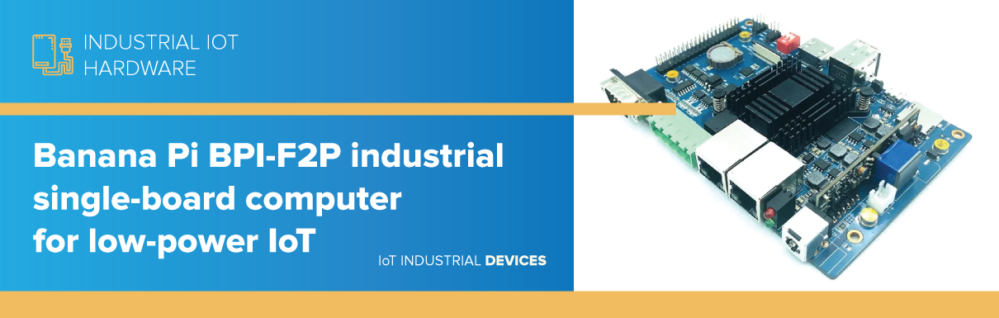
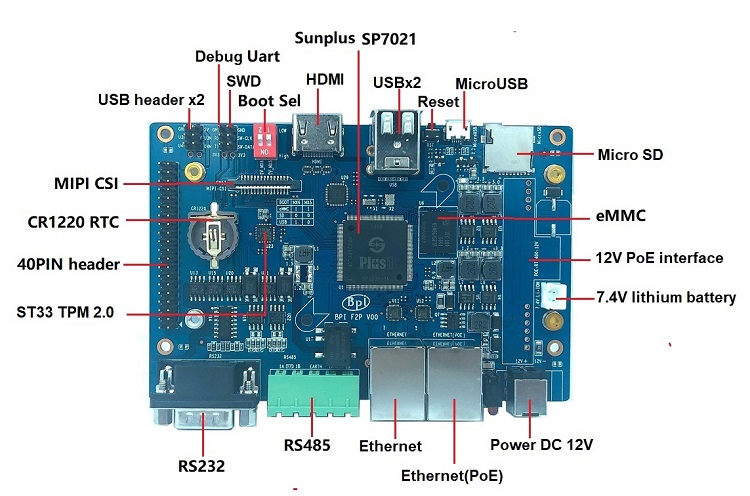
The new Banana Pi BPI-F2P has the same layout and list of functions as the BPI-F2S. The biggest difference is the addition of two serial ports and the addition of a new Power-over-Ethernet function on one of the two 10/100 Ethernet ports. Meanwhile, the FPGA connector on the optional Artix-7 FPGA module has been removed.

The Banana Pi design also revealed Banana Pi BPI-EAI80 AIoT SBC, which does not work under Linux, but to some extent looks like an array. Separate reports state on on BPI-F2P and BPI-EAI80 AIoT. BPI-F2P and BPI-F2S appear to be supported by the Banana Pi community, but there is no indication that they are open source hardware boards like most Banana Pi SBCs. The BPI-F2 diagram has not yet been published.

Banana Pi BPI-F2S

Characteristics Of The SP7021

  • Easy-to-use LQFP package.
  • Quad-core 1GHz Cortex-A7 CPU, plus A926 and 8051 cores.
  • Single 3.3V power*.
  • Integrated 128MB or 512MB DDR3 DRAM.
  • Eight 8-bit 5V-tolerant IO ports, plus one high-current port.
  • Flexible Peripheral Multiplexing (PinMux).
  • Dual PinMuxable Ethernet MACs.
  • Four PinMuxable Enhanced UARTs, plus one console UART.
  • Industrial operating temperature range: -40C ~ +85C.
  • Low EMI simplifies certification.
  • Modern, Yocto-based Linux distribution.
  • 10-year supply guarantee.
  • Robust ready-to-run modern Linux distribution available

Source: https://www.electronics-lab.com/banana-pi-bpi-f2p-low-power-iot/

Industrial use of market Banana Pi-like SBCs

A year ago, TECHBASE released an updated version of the ModBerry M500 industrial IoT computer, replacing the aging Raspberry Pi 3 with a 3B+, giving it better performance. With the recent launch of the Raspberry Pi 4, TECHBASE has yet again, announced another upgrade to the M500, which now packs the latest single-board computer.

ModBerry M500 with Raspberry Pi’s 4

ModBerry M500 also utilizes many more SBC platforms, such as Orange Pi, NanoPi and Intel-based UpBoard. Find more information here: https://iiot-shop.com/product/modberry-m-series/

In 2019, with the premiere of Raspberry Pi 4, TECHBASE upgraded their ModBerry M500 device with the latest revision of this popular SBC, further enhancing the performance of their device. New 1.5GHz quad-core 64-bit ARM Cortex-A72 processor (approximately 3 times better performance than previous Cortex-A53 powering Raspberry Pi 3+ Model B and Compute Module 3 and 3+). ModBerry M500 can now be configured from 2GB / 4GB and new 8GB option of LPDDR4 SDRAM.

Revised ModBerry M500 features Gigabit Ethernet, USB3.0, two microHDMI ports supporting OpenGL ES 3.x and 4Kp60 hardware decode of HEVC video. The device is fully compatible with previous versions of Rasbperry Pi based Industrial IoT devices and accessories from TECHBASE.

Pricing and availability of 8GB RAM and M.2/SSD options

ModBerry M500 8GB option has been added to configurator here. SSD/M.2 option is currently undergoing testing – preliminary devices are available on demand, via Live Chat or contact form at https://iiot-shop.com/

This week, as a result of the incredible efforts of the Arm community, the Rosetta@Home project has been working on a 64-bit Arm such as the Raspberry Pi 4, Nvidia Jetson Nano, Rockchip RK3399 single board computer, and other SBCs with 2GB of memory. Released support for sending work units to devices. More.

Sahaj Sarup from Linaro, the Neocortix team, Arm, and the Baker Lab at the University of Washington all played in role helping us port the Rosetta software to aarch64, get it tested in their Ralph (Rosetta ALPHa) staging environment, validate the scientific results, and eventually push it to Rosetta@Home.

Source: https://www.mininodes.com/how-to-run-rosettahome-on-arm-powered-devices/

Now anyone with free computing power on an arm-powered SBC device with a 64-bit operating system can run BOINC to collect data and have a doctor target the COVID-19 peak protein. You can assist your project by performing protein folding calculations that help you (intermedical and scientific burden).

New #CoronaIOT initiative from Industrial IoT manufacturer

Trends indicate a weakening of many sectors of the economy, including the IoT sector. However, we can prevent the upcoming crisis with products and technology keeping up with the inevitable changes in our daily lives.

TECHBASE Group took the challenge of gathering potential partners for projects that serve improvement of health safety and worldwide trend of Social Distancing. The program will periodically present new IoT projects, involving manufacturers, software and hardware developers, new technology influencers and media.

The ODROID-C4 is a new generation single board computer that is more energy efficient and faster than the ODROID-C2, which was introduced as the world’s first inexpensive 64-bit ARM computer more than four years ago. ODROID concept and format mimic Raspberry Pi 4 but features extended capabilities as a next level competitor to the most popular SBC on the market

The main ODROID-C4 processor is built on a Cortex-A55 quad-core cluster with a new generation Mali-G31 graphics processor. The A55 core uses basic heat sinks and operates at 2.0 GHz without thermal throttling, making it a solid and quiet computer. The performance of multi-core processors is about 40% faster than ODROID-C2, and the system DRAM memory performance is 50% faster.

RPi4 & ODROID-C4 comparison: https://www.cnx-software.com/2020/04/24/raspberry-pi-4-vs-odroid-c4-features-comparison/

Benchmark comparison. Source: https://www.hardkernel.com/shop/odroid-c4/

Raspberry Pi increase in IoT significance

More and more engineers and technology providers believe that it is suitable for industrial applications in the real world. Over the past few years, there has been a lot of discussion about the use of Raspberry Pi in industry, most of which emphasize that Raspberry Pi is a great tool for engineering experiments, but not so much for industrial applications in the real world. While it is true that the Raspberry Pi is not considered the best choice for mission-critical applications, it is also true that the Raspberry Pi is no longer a platform for experimentation.

Latest Raspberry Pi 4 development board, equipped with a 1.5GHz quad-core 64-bit ARM Cortex-A72 processor (approximately 3 times better performance than previous Cortex-A53 powering Raspberry Pi 3+ Model B and Compute Module 3 and 3+). can be chosen from 1GB / 2GB / 4GB LPDDR4 SDRAM options.

Raspberry Pi 4 continues the tradition of one of the most versatile and cheapest computer devices. It can be used for virtually anything from proprietary IoT solutions to a full-fledged desktop computer. The new Malinka has two micro-HDMI ports, a Gigabit Ethernet port, two USB 3.0 type A ports and two USB 2.0 type A ports.

Industrial use of Raspberry Pi 4

A year ago, TECHBASE released an updated version of the ModBerry M500 industrial IoT computer, replacing the aging Raspberry Pi 3 with a 3B+, giving it better performance. With the recent launch of the Raspberry Pi 4, TECHBASE has yet again, announced another upgrade to the M500, which now packs the latest single-board computer.

Raspberry Pi 4, with 2xHDMI, Gigabit Ethernet and 2xUSB3.0

Over 10 million Raspberry Pi’s have been sold and the Raspberry Pi is likely to stay as a new standard in the industry. Official Raspbian OS is free operating system based on Linux Debian optimized for the Raspberry Pi comes with over 35,000 packages, pre-compiled software bundled in a nice format for easy installation. ModBerry devices are compatible with Raspberry Pi accessories, supported by Raspberry Pi Foundation. ModBerry M500 now with Raspberry Pi 3 Model B+ / Raspberry Pi 4 Model B support.

IoT ONE published their insights of COVID-19 impact on Industrial IoT from different perspectives. The so-called tracker helps predict technology adaptation to consequences of coronavirus outbreak, strategy and business transformations to IoT connected branches, and what operational shifts are to be made to help refocus the resources to prevent the negative market-related effects of COVID-19.

New #CoronaIOT initiative from Industrial IoT manufacturer

Trends indicate a weakening of many sectors of the economy, including the IoT sector. However, we can prevent the upcoming crisis with products and technology keeping up with the inevitable changes in our daily lives.

TECHBASE Group took the challenge of gathering potential partners for projects that serve improvement of health safety and worldwide trend of Social Distancing. The program will periodically present new IoT projects, involving manufacturers, software and hardware developers, new technology influencers and media.

On March 21, Taiwan’s Central Command Trend Center updated travel restrictions. This has significantly reduced movement, especially between visitors and non-residents within the country. Many countries around the world continue to struggle to stop the COVID-19 pandemic, but many economic activities, including business trips, were forced to stop.

To stay in business without the possibility of personal meetings, many companies rely on remote business solutions to communicate quickly and efficiently. One such solution is a telepresence robot that allows remote employees to physically exist outside of a regular video conference. OhmniLabs specializes in robotics and telepresence technologies, using UpBoard arrays for their devices.

Source: https://up-board.org/up/specifications/

Telepresence Robots use in coronavirus age

Ohmni Telepresence Robots are also ideal for telemedicine and home care, especially when dealing with patients who may have been exposed to an infectious disease. Healthcare professionals can easily operate their telepresence robots using mobile phones, make regular observations, make initial inquiries and share medical records in real time with relevant staff. Telepresence robots allow medical staff to do their jobs without touching the patient and can be easily cleaned and disinfected later.

The AAEON UP IoT Development Board, with thousands of units sold, is one of the most popular boards used by professional manufacturers. UP boards are implemented in many applications such as robots, drones, machine vision, intelligent home, education, transportation and IoT. OhmniLabs chose UP boards for performance, flexibility, and competitive price. The UP board has Intel Atom x5-Z8350 processor and I / O features such as Gigabit Ethernet port, 4 USB 2.0 ports, 1 USB 3.0 port, HDMI, DSI / eDP. UP boards are popular in the embedded market due to their expandability and small size.

Intel-based industrial computer

The first unit that entered the ModBerry series is a device called ModBerry M1000, utilizing the capabilities of UpBoard platform. New solution uses Quad-core Intel Atom x5-Z8350 processor with 4x 1.44GHz frequency (boost up to 4x 1.92GHz), up to 4GB RAM and 64GB eMMC on board. The new platform also features USB 3.0 and Gigabit Ethernet 10/100/1000Mbps for faster communication and supports new operating systems, e.g.: Windows 10, Yocto, Ubuntu, Ubilinux, Android 6.0.

To read more about ModBerry M1000 solution, download PDF datasheet: https://iiot-shop.com/product/modberry-m-series/

ModBerry M1000