The RAK2287 is a mini-PCIe LPWAN hub module based on the Semtech SX1302 that can be easily integrated with existing routers and other networking equipment with LPWAN gateway capabilities. It can be used on embedded platforms that offer a free mini PCIe slot with SPI connector. In addition to LPWAN functionality, the module is equipped with a ZOE-M8Q GPS chip that provides GNSS functionality.
This module is an exceptional, complete, and cost-efficient gateway solution offering up to 10 programmable parallel demodulation paths, an 8 x 8 channel LoRa® packet detector, 8 x SF5-SF12 LoRa® demodulators and 8 x SF5-SF10 LoRa® demodulators. It is capable of detecting an uninterrupted combination of packets at 8 different spreading factors and 10 channels with continuous demodulation of up to 16 packets. The module is well suited for Internet-of-Things (IoT) applications, that require node density of up to 500 nodes per km² in an environment with moderate interference.
Use of wireless connection makes life and work easier for us every day – from radio stations and GSM to Wi-Fi wireless networks, Zigbee, short-range Bluetooth connectivity and LoRa. With the spread of internet access, the possibility of using wireless connectivity for a new type of service and application has opened. Terminology such as M2M (Machine to Machine) – remote communication between devices and IoT – a network of applications and devices communicating with the Internet have been created.
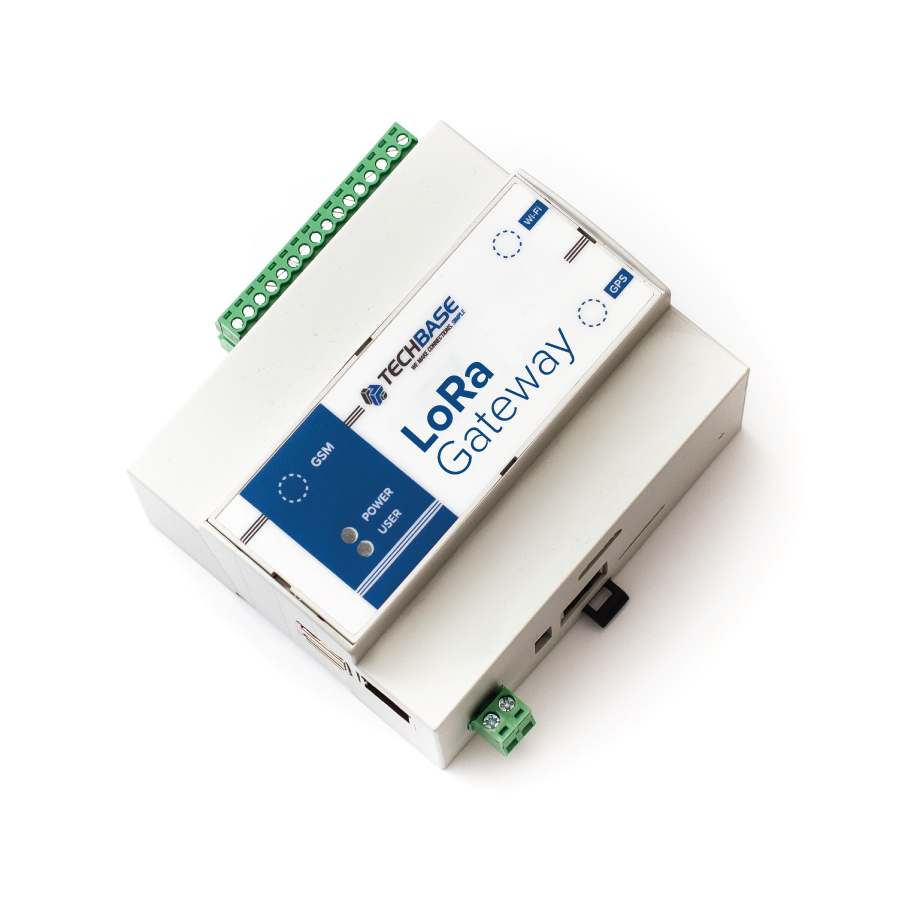
Device equipped with LoRa module is delivered with a LoRaWAN protocol stack, so it can be easily connected to the existing, fast-growing LoRa Alliance infrastructure – both in privately managed local area networks (LAN) and public telecommunications networks to create wide area low power WAN (LPWAN) on a national scale. LoRaWAN stack integration also allows connection to any microcontroller, such as LoRa Gateway industrial device from TECHBASE.
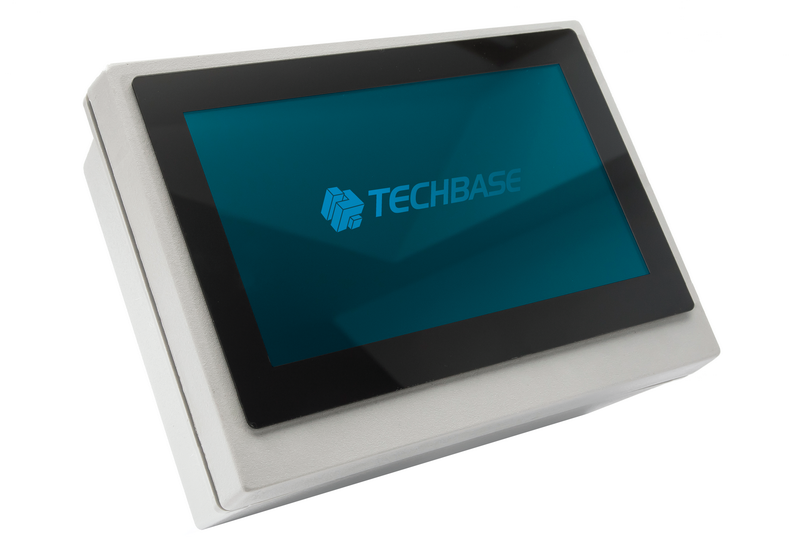
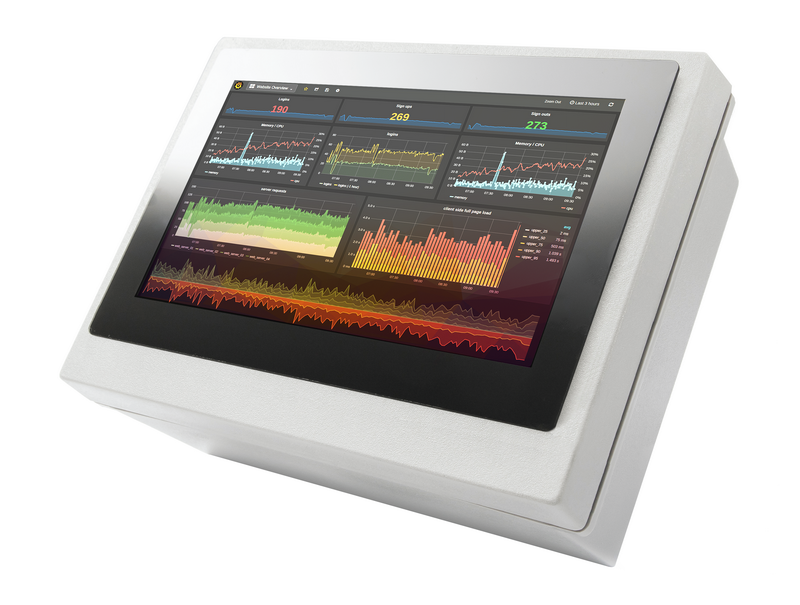
Latest addition to Industrial IoT Ecosystem from TECHBASE is TECHPANELP500 is an industrial-grade touch panel automation controller for wide range of industrial installations. Equipped with up to date Raspberry Pi Compute Module 3/3+ or Compute Module 3/3+ Lite, 7” capacitive touch display and IP65 hermetic casing with cast gaskets, can be used in harsh conditions of industrial applications.
Raspberry Pi based touch panel features
New TECHPANEL P500 M3/3+ is powered by quad-core Cortex-A53 1.2GHz processor with 1GB RAM and up to 32GB eMMC or 8GB microSD flash memory. Wide range of modems and extra wireline/wireless interfaces via expansion cards makes the TECHPANEL micro-computer a versatile addition to Industrial IoT solutions offered by TECHBASE company.
TECHPANEL devices can easily work remotely with existing ModBerry Gateways & Moduino ESP32 Edge Controllers for data accumulation and monitoring, to perform specific actions before sending the data to cloud services. TECHPANEL with Moduino – ModBerry installation can work as standalone Ecosystem (for example via MQTT), providing complex data management solution to any installation.
TECHPANEL P500 M3+ with Compute Module 3+ from Raspberry Pi
Visual management and available Raspbian OS
The device is equipped with compact 800 x 480 px 7-inch TFT panel with 10 points capacitive touch to allow the user to perform direct actions on-site. With IP65 casing and extended working temperature range, TECHPANEL can be placed almost everywhere.
Over 23 million Raspberry Pi’s have been sold and the Raspberry Pi is likely to stay as a new standard in the industry. Official Raspbian OS is free operating system based on Linux Debian optimized for the Raspberry Pi comes with over 35,000 packages, pre-compiled software bundled in a nice format for easy installation.
TECHPANEL P500 M3+ with Compute Module 3+ from Raspberry Pi
SPECIFICATION
Cortex A53 1.2GHz Processor
RAM 1GB, eMMC up to 32GB
7″ TFT screen (800x600px)
Capactitive touch screen (10-point)
Wide range of expansion modules (Ethernet, RS-232/485/422, Digital and Analog I/Os, Relay, M-Bus, CAN, optoisolated I/Os, Accelerometer, etc.)
Wide range of wireless modules (GPRS/EDGE, 3G/LTE, NarrowBand-IoT, GPS, Wi-Fi, Bluetooth, LoRa, ZigBee, Z-Wave, Sigfox, Wireless M-Bus, etc.)
https://iot-industrial-devices.com/wp-content/uploads/2020/02/raspberry-pi-touch-panel.png3851210adminhttps://iot-industrial-devices.com/wp-content/uploads/2019/11/iot-industrial-devices-1.pngadmin2021-05-13 12:29:002021-05-27 12:30:27New industrial grade touch panel with Raspberry Pi
Every fan of new technologies has heard of small single-board computers (SBC) in the form of Raspberry Pi 4. Raspberry debuted on the market in many different versions, and the current model is Model 4B. A lot of people got infected with it for DIY, programming or Linux. But new board comes with variety of pros and cons, as compared to previous RPi3 versions.
Industrial use of market Raspberry Pi 4 SBCs
A year ago, TECHBASE released an updated version of the ModBerry M500 industrial IoT computer, replacing the aging Raspberry Pi 3 with a 3B+, giving it better performance. With the recent launch of the Raspberry Pi 4, TECHBASE has yet again, announced another upgrade to the M500, which now packs the latest single-board computer.
https://iot-industrial-devices.com/wp-content/uploads/2020/02/raspberry-pi-4-pros-cons.png3851210adminhttps://iot-industrial-devices.com/wp-content/uploads/2019/11/iot-industrial-devices-1.pngadmin2021-05-12 12:38:002021-05-27 12:39:32Pros and cons of using Raspberry Pi 4 in IoT
New features of multiple Raspberry Pi Compute Modules 4 brought to new ClusBerry series
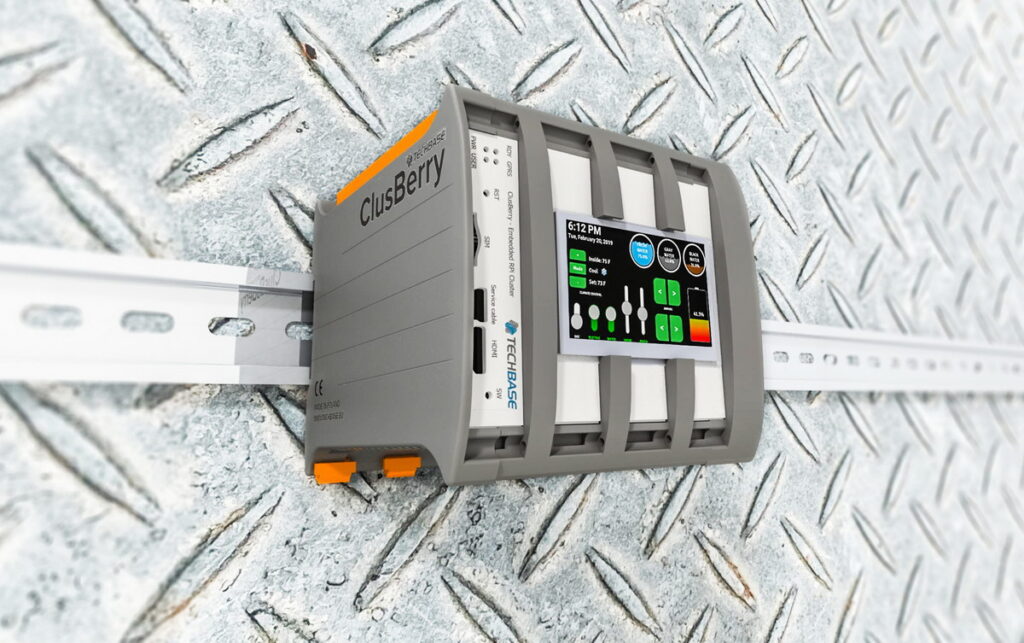
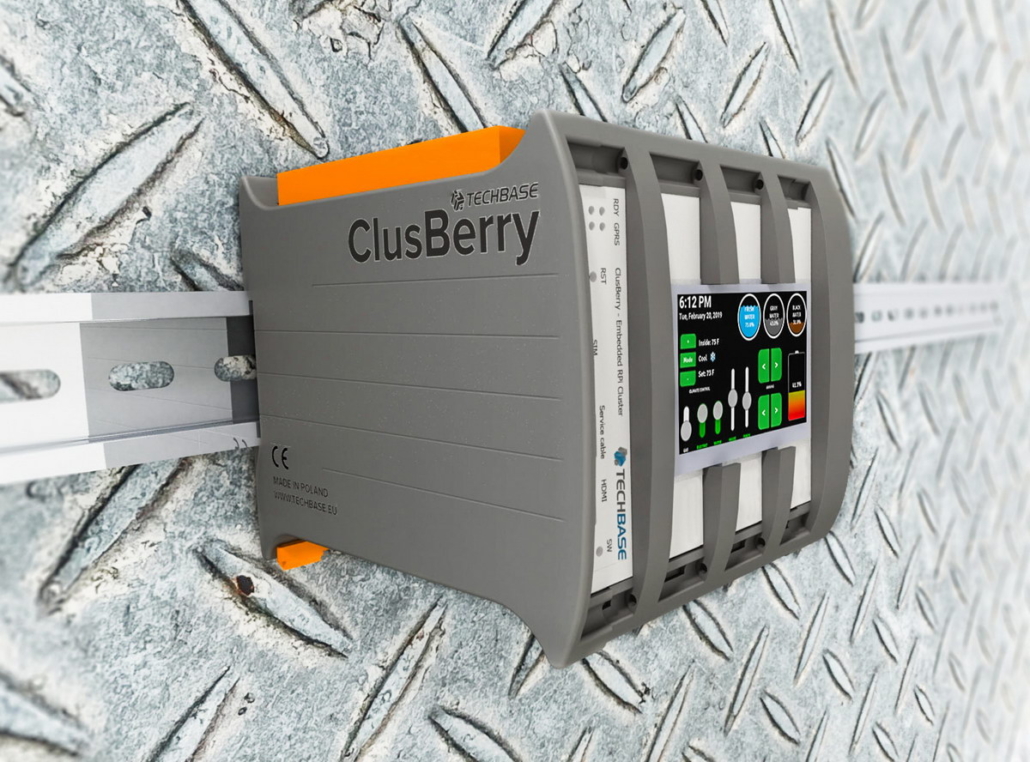
Accompanying the release of ModBerry 500-CM4 and AI GATEWAY 9500-CM4, we present to you a cluster version of the device, called ClusBerry 9500-CM4. Main difference between standard Gateway and ClusBerry is the possibility to include multiple Raspberry Pi Compute Module 4 in one device, as well as the intended suitable amount of wired and wireless interfaces, suited for the project.
Fully configurable devices are something desirable in the IoT market, where high performance and low cost is a key factor to success of implementation. TECHBASE’s Industrial IoT Ecosystem gives the opportunity to adjust ordered devices with certain resources and cut unnecessary I/Os, lowering the total cost of the device.
Wide range of ClusBerry modules
ClusBerry 9500-CM4 supports up to 8 cluster modules andcomes with a variety of interchangeable modules to choose from, including:
Standard 9500-CM4 cluster module with Compute Module 4 and chosen configuration:
I/O Controller with range of DI, DO, AI, 1-Wire, RS-232/485 and CAN interfaces
Communication Gateway with wired (1/2x Ethernet, Serial Ports) and wireless interfaces (LTE-cat.M1, 4G, 5G, LoRa, ZigBee, Z-Wave, Wireless M-Bus)
NAS File Server with 2x SSD SATA III and RAID support, managed with Nextcloud or ownCloud software
USB3.0 Hub for 5G communication, Modems, AI Cluster and peripherals
Gigabit LAN/WAN Router with additional 2.5GbE network card as an independent switch/router shielded from the mainboard cluster network
SuperCap / Power management module for backup power supply (supercapacitors / Li-Ion battery) and sleep mode management aided with ESP32-module
Additional expansion cards, with resources suited for the installation (DIO, AIO, Serial Ports and dedicated sensor cards, detailed below)
This is where Raspberry Pi Compute Module can shine, but due to the hardware speed limitations of the buses in this module, it was not completely effective and was rather a development platform. Altho the introduction of new Compute Module 4 has opened the possibility to construct and maintain effective hardware matrix solutions with the use of both PCI-Express buses and 1GBps Ethernet. Therefore, the ClusBerry 9500-CM4 opens up completely new capabilities of utilizing cluster solutions for Industrial Automation and server applications.
Reason for use of Raspberry Pi CM4 cluster in ClusBerry 9500-CM4
Various implementations must have guaranteed high hardware performance to react fast enough in real time. For this purpose, the arrays of processor blocks are constructed to be assigned to individual tasks. For several years now, attempts have been made to use various types of SBC for this purpose, including, of course, Raspberry Pi. However, the practical effectiveness of such solutions so far has not been of interest for several reasons. First of all, these solutions were most often associated with many mechanical limitations and the structure of the matrix itself required excessive wiring, preventing failure-free operation and the cost of the entire maintenance of the structure.
ClusBerry 9500-CM4 with available expansion cards
ClusBerry 9500-CM4 can be equipped with multiple expansion cards, e.g. serial RS-232/485 ports, range of digital and analog I/Os, USB, HDMI and Ethernet. Interfaces can be expanded with additional I/Os and opto-isolation, relays, Ethernet, 1-Wire, CAN, M-Bus Master and Slave, accelerometer and many more features like TPM Security Chip & eSIM. The device can also be equipped with additional SuperCap backup power source for continuous work and safe boot/shutdown in case of emergency.
ClusBerry 9500-CM4 series also offers a standard PCI module support for various wireless communication protocols, such as:
GSM modem (4G/LTE and fast 5G modem)
economic NarrowBand-IoT technology
LoRa, ZigBee, Z-Wave, Sigfox, Wireless M-Bus
secondary Wi-Fi/Bluetooth interface or Wi-Fi Hi-Power
custom wireless interfaces
Software cluster management with Docker and K3s Lightweight Kubernetes
With use of Docker-based and Kubernetes solutions, installation and management of ClusBerry 9500-CM4 is easy and backed with a large community for further support and development. Kubernetes is a portable, extensible open-source software platform for managing containerized tasks and sites that enables declarative configuration and automation. The Kubernetes ecosystem is large and dynamically developing. Kubernetes services, support and tools are widely available.
Kubernetes provides:
Detection of new services and traffic. Kubernetes can balance the load and redirect the network traffic to ensure the stability of the entire installation.
Kubernetes data storage management enables you to automatically mount any type of storage system – on-premises, from cloud providers and others.
Automatic deployment and rollback. You can describe the expected state of your installation with Kubernetes, which will take care of bringing the actual state to the expected state in a controlled manner. For example, with Kubernetes, you can manage your cluster modules at ease, boot modules from one to another, upgrade firmware crosswise and provide safe operation of each module
Automatic management of available resources. ClusBerry 9500-CM4provides a cluster of modules that Kubernetes can use to run tasks in containers. You determine the CPU power and RAM requirements for each container. Kubernetes arranges containers on machines in such a way as to make the best use of provided resources.
Self-healing Kubernetes reboots containers that have stopped working, replaces them with new ones, forces disabling containers that are not responding to certain status queries, and does not announce their availability until they are ready to run.
Managing confidential information and Kubernetes configuration with TPM Security Chip allows you to store and manage confidential information such as passwords, OAuth tokens and SSH keys. Secured data and configuration information can be provided and changed without having to rebuild the container image and without exposing sensitive data in the overall software configuration.
ClusBerry 9500-CM4 availability
First prototypes are being developed, since Compute Module 4 is already available for the purchase. Delivery time for various configurations of ClusBerry will be approximately 2 months, depending on the CM4 supply on the market and chosen expansion cards. For more information contact TECHBASE’s Sales Department via email or Live Chat here or visit product website: https://clusberry.techbase.eu.
https://iot-industrial-devices.com/wp-content/uploads/2021/04/clusberry-iot.png3851210adminhttps://iot-industrial-devices.com/wp-content/uploads/2019/11/iot-industrial-devices-1.pngadmin2021-05-05 12:45:002021-05-27 12:46:35Raspberry Pi based ClusBerry possitively affecting IoT market
Sequent Microsystems has introduced the Raspberry Pi „4-relay” add-on to the Industrial IoT market. Four relays switch lines for loads up to 10 A and 250 V, can be stacked up to 8 times with max. 32 switched relays.
It can be used to control loads of up to 10A and 250V. You can control directly all your lights and appliances. Pluggable connectors accept 18 to 22 AWG wires and simplify the installation, specially if you are planning to use more than one card. The cards are stacked with 18mm male-female standoffs. All the hardware required for the installation is provided. Relays are controlled through I2C IO Expanders, using only 2 pins on the GPIO interface and leaving all the other pins available for the user.
Some industrial IoT devices, based on Raspberry Pi platform already offer Relay expansion modules. One of them is ModBerry 500 CM4 series, introduced in 2014 – later upgraded with latest Raspberry Pi’s Compute Module 4+. ModBerry standard configurator offers up to 12x Relay expansion, with additional customizable options available for larger orders.
ExCard modules to peak the performance
Every TECHBASE’s industrial computer is supported by ExCard add-on modules for extra RS-232/485 serial ports, Ethernet ports, PCIe slots, analog input and output, digital I/Os, relays, M-Bus interface, opto-isolation, accelerometer, etc. To provide specific communication paths, ModBerry can be rigged with additional Wi-Fi/Bluetooth module, 3G/LTE, NarrowBand-IoT, LoRa, ZigBee, GPS and Wireless M-Bus.
The latest options for ModBerry series are:
SuperCap expansion, to provide constant power supply as a UPS option
OLED 0.96” & new OLED 1,3″ screen, allowing the control without the need of connecting into the device
ESP32 module as a security chip, to add a firewall into control installation and ensure constant operation of the device, even with power drops and random events
Aluminum case, to grant much higher durability for extra harsh industrial conditions
https://iot-industrial-devices.com/wp-content/uploads/2021/04/relay-raspberry-pi.png3851210adminhttps://iot-industrial-devices.com/wp-content/uploads/2019/11/iot-industrial-devices-1.pngadmin2021-04-15 10:59:002021-04-19 11:07:13Relay expansion modules for Raspberry Pi based devices
New features of multiple Raspberry Pi Compute Modules 4 brought to new ClusBerry series
Accompanying the release of ModBerry 500-CM4 and AI GATEWAY 9500-CM4, we present to you a cluster version of the device, called ClusBerry 9500-CM4. Main difference between standard Gateway and ClusBerry is the possibility to include multiple Raspberry Pi Compute Module 4 in one device, as well as the intended suitable amount of wired and wireless interfaces, suited for the project.
Fully configurable devices are something desirable in the IoT market, where high performance and low cost is a key factor to success of implementation. TECHBASE’s Industrial IoT Ecosystem gives the opportunity to adjust ordered devices with certain resources and cut unnecessary I/Os, lowering the total cost of the device.
Wide range of ClusBerry modules
ClusBerry 9500-CM4 supports up to 8 cluster modules andcomes with a variety of interchangeable modules to choose from, including:
Standard 9500-CM4 cluster module with Compute Module 4 and chosen configuration:
I/O Controller with range of DI, DO, AI, 1-Wire, RS-232/485 and CAN interfaces
Communication Gateway with wired (1/2x Ethernet, Serial Ports) and wireless interfaces (LTE-cat.M1, 4G, 5G, LoRa, ZigBee, Z-Wave, Wireless M-Bus)
NAS File Server with 2x SSD SATA III and RAID support, managed with Nextcloud or ownCloud software
USB3.0 Hub for 5G communication, Modems, AI Cluster and peripherals
Gigabit LAN/WAN Router with additional 2.5GbE network card as an independent switch/router shielded from the mainboard cluster network
SuperCap / Power management module for backup power supply (supercapacitors / Li-Ion battery) and sleep mode management aided with ESP32-module
Additional expansion cards, with resources suited for the installation (DIO, AIO, Serial Ports and dedicated sensor cards, detailed below)
This is where Raspberry Pi Compute Module can shine, but due to the hardware speed limitations of the buses in this module, it was not completely effective and was rather a development platform. Altho the introduction of new Compute Module 4 has opened the possibility to construct and maintain effective hardware matrix solutions with the use of both PCI-Express buses and 1GBps Ethernet. Therefore, the ClusBerry 9500-CM4 opens up completely new capabilities of utilizing cluster solutions for Industrial Automation and server applications.
Reason for use of Raspberry Pi CM4 cluster in ClusBerry 9500-CM4
Various implementations must have guaranteed high hardware performance to react fast enough in real time. For this purpose, the arrays of processor blocks are constructed to be assigned to individual tasks. For several years now, attempts have been made to use various types of SBC for this purpose, including, of course, Raspberry Pi. However, the practical effectiveness of such solutions so far has not been of interest for several reasons. First of all, these solutions were most often associated with many mechanical limitations and the structure of the matrix itself required excessive wiring, preventing failure-free operation and the cost of the entire maintenance of the structure.
ClusBerry 9500-CM4 with available expansion cards
ClusBerry 9500-CM4 can be equipped with multiple expansion cards, e.g. serial RS-232/485 ports, range of digital and analog I/Os, USB, HDMI and Ethernet. Interfaces can be expanded with additional I/Os and opto-isolation, relays, Ethernet, 1-Wire, CAN, M-Bus Master and Slave, accelerometer and many more features like TPM Security Chip & eSIM. The device can also be equipped with additional SuperCap backup power source for continuous work and safe boot/shutdown in case of emergency.
ClusBerry 9500-CM4 series also offers a standard PCI module support for various wireless communication protocols, such as:
GSM modem (4G/LTE and fast 5G modem)
economic NarrowBand-IoT technology
LoRa, ZigBee, Z-Wave, Sigfox, Wireless M-Bus
secondary Wi-Fi/Bluetooth interface or Wi-Fi Hi-Power
custom wireless interfaces
Software cluster management with Docker and K3s Lightweight Kubernetes
With use of Docker-based and Kubernetes solutions, installation and management of ClusBerry 9500-CM4 is easy and backed with a large community for further support and development. Kubernetes is a portable, extensible open-source software platform for managing containerized tasks and sites that enables declarative configuration and automation. The Kubernetes ecosystem is large and dynamically developing. Kubernetes services, support and tools are widely available.
Kubernetes provides:
Detection of new services and traffic. Kubernetes can balance the load and redirect the network traffic to ensure the stability of the entire installation.
Kubernetes data storage management enables you to automatically mount any type of storage system – on-premises, from cloud providers and others.
Automatic deployment and rollback. You can describe the expected state of your installation with Kubernetes, which will take care of bringing the actual state to the expected state in a controlled manner. For example, with Kubernetes, you can manage your cluster modules at ease, boot modules from one to another, upgrade firmware crosswise and provide safe operation of each module
Automatic management of available resources. ClusBerry 9500-CM4provides a cluster of modules that Kubernetes can use to run tasks in containers. You determine the CPU power and RAM requirements for each container. Kubernetes arranges containers on machines in such a way as to make the best use of provided resources.
Self-healing Kubernetes reboots containers that have stopped working, replaces them with new ones, forces disabling containers that are not responding to certain status queries, and does not announce their availability until they are ready to run.
Managing confidential information and Kubernetes configuration with TPM Security Chip allows you to store and manage confidential information such as passwords, OAuth tokens and SSH keys. Secured data and configuration information can be provided and changed without having to rebuild the container image and without exposing sensitive data in the overall software configuration.
ClusBerry 9500-CM4 availability
First prototypes are being developed, since Compute Module 4 is already available for the purchase. Delivery time for various configurations of ClusBerry will be approximately 2 months, depending on the CM4 supply on the market and chosen expansion cards. For more information contact TECHBASE’s Sales Department via email or Live Chat here or visit product website: https://clusberry.techbase.eu.
https://iot-industrial-devices.com/wp-content/uploads/2021/04/clusberry-iot.png3851210adminhttps://iot-industrial-devices.com/wp-content/uploads/2019/11/iot-industrial-devices-1.pngadmin2021-04-13 09:35:002021-04-19 09:41:08Raspberry Pi based ClusBerry possitively affecting IoT market
The NB-IoT is becoming a standard in wireless communication of IoT devices, for standalone solutions and complex installations with thousands of units, coordinated with gateways. Will NarrowBand-IoT replace other wireless technologies in industrial automation?
What exactly is NarrowBand?
NarrowBand-IoT (NB-IoT) is a radio technology in the field of LPWAN (Low Power Wide Area Network) dedicated for IoT devices, operating on the licensed frequency band used by telecommunications operators.
You can build mass solutions and those that until now were considered unprofitable. NB-IoT technology works in the licensed band, so there is no risk of interference and blocking communication by competing networks.
The service life of devices powered by two AA batteries is up to 10 years. However, the devices themselves are constructed in such a way that they can work for many years without the need for technical supervision and recharging the battery.
NB-IoT used in industrial solutions
One of many uses of NarrowBand-IoT wireless modems can be communication of edge devices, dedicated to data management, process control (e.g. with MQTT protocol) and monitoring. Latest ESP32-based eModGATE controller from TECHBASE company is a series utilizing MicroPython environment to provide data management solutions for end-points applications. TheeModGATE has built-in Wi-Fi/BT modem and can be equipped with additional NarrowBand-IoT modems
eModGATE with ESP32
eModGATE eqipped with wireless NB-IoT modem are perfect for industrial automation solutions, e.g. data logging, metering, telemetrics, remote monitoring, security and data management through all Industrial IoT applications.
https://iot-industrial-devices.com/wp-content/uploads/2020/07/narrowband.png3851210adminhttps://iot-industrial-devices.com/wp-content/uploads/2019/11/iot-industrial-devices-1.pngadmin2021-04-12 09:15:002021-04-19 09:23:13NarrowBand-IoT a way to go with industrial ESP32
With latest Raspberry Pi Compute Module 4, the Raspberry Foundation added NVMe SSD support via M.2 (PCIe 2.0) interface. Jeff Geerling tested 3 piece M.2 SSD RAID array which is another example how Compute Module 4 is a milestone in IoT applications.
SSD/eMMC benchmark scores for Compute Module 4
With the debut of Raspberry Pi Compute Module 4 and ModBerry 500 CM4 from TECHBASE, another addition came to Industrial Controllers and Edge Automation. New module carried the likelihood to associate NVMe SSD module by means of M.2 slot utilizing PCIe 2.0 interface.
Order next batch of Raspberry Pi Compute Module 4 devices
TECHBASE’s ModBerry 500 series has gotten an update to Compute Module 4 and is accessible for pre-orders. TECHBASE is leading producer of Industrial Raspberry Pi and Industrial Compute Module applications. ModBerry 500 series is completely viable with all arrivals of Compute Module from Rasbperry Pi Foundation.
Primary highlights of refreshed device are:
up to 4x quicker eMMC Flash with up to 32GB capacity
up to 2x quicker execution than recent CM3 rendition with quad-center Cortex-A72 4×1.5GHz
up to 8x more RAM (8GB LPDDR4)
1Gbit Ethernet interface
discretionary PCIe card support for NVMe SSD by M.2
discretionary second PCIe support for remote modem arrangements, for example 5G modems
First group of ModBerry 500 CM4 devices has just been dispatched, we are gathering orders for next batch. Hustle just a bit to get your devices rapidly!
As the remote application market is growing rapidly, technology also needs to progress, ensuring greater range and transmission speed while reducing energy consumption. Technological progress makes it possible to create innovative standards for new, sophisticated applications that facilitate our life and work. One of wireless connection choices can be LoRa technogoly.
LoRa (Long Range Radio) technology with low data throughput allows IoT and M2M applications to communicate wirelessly over 15 kilometers, with a battery life of more than 10 years. LoRa allows you to connect millions of wireless nodes with compatible gateways and has several key advantages over other wireless solutions. For example, it uses spectrum spreading modulation with the ability to demodulate a signal 20 dB below the noise level.
LoRa uses license-free sub-gigahertz radio frequency bands like 433 MHz, 868 MHz (Europe) and 915 MHz (Australia and North America). LoRa enables long-range transmissions (more than 10 km in rural areas) with low power consumption.[4] The technology is presented in two parts: LoRa, the physical layer and LoRaWAN (Long Range Wide Area Network), the upper layers.
Compared to 3G and 4G cellular networks, LoRa technology is also better scalable and more cost-effective for embedded applications. It has a much greater range than other popular wireless protocols, which allows devices to operate without amplifiers, reducing the total cost of the application.
Thanks to scalability, reliable communication, mobility and ability to work in difficult external conditions, the LoRa module is perfectly suited for use in a wide range of wireless monitoring and control applications that do not require high transmission speeds. Examples of applications may include smart city (street lighting sensors, motion sensors), energy (intelligent measurement of electricity / water / gas consumption) and industrial / commercial / home applications, among others HVAC, intelligent devices, security systems and lighting.
Use of wireless connection makes life and work easier for us every day – from radio stations and GSM to Wi-Fi wireless networks, Zigbee, short-range Bluetooth connectivity and LoRa. With the spread of internet access, the possibility of using wireless connectivity for a new type of service and application has opened. Terminology such as M2M (Machine to Machine) – remote communication between devices and IoT – a network of applications and devices communicating with the Internet have been created.
Device equipped with LoRa module is delivered with a LoRaWAN protocol stack, so it can be easily connected to the existing, fast-growing LoRa Alliance infrastructure – both in privately managed local area networks (LAN) and public telecommunications networks to create wide area low power WAN (LPWAN) on a national scale. LoRaWAN stack integration also allows connection to any microcontroller, such as LoRa Gateway from TECHBASE.
https://iot-industrial-devices.com/wp-content/uploads/2019/11/lora.png3851210adminhttps://iot-industrial-devices.com/wp-content/uploads/2019/11/iot-industrial-devices-1.pngadmin2021-03-22 11:19:002021-03-24 11:49:02Is LoRa a 'must be' for Industrial IoT?
Updated ClusBerry device for Smart Home and developers
A new addition to TECHBASE’s Industrial IoT Ecosystem is a variation of recent cluster device, ClusBerry based on multiple Raspberry Pi Compute Module 4 and custom cluster board allowing free configuration from two up to eight modules. Each module can perform various tasks, from standard I/O gateway, wireless modem, Gigabit LAN router to NAS file server and AI Gateway with up to 4 Google Coral Edge TPU modules.
You can manage your cluster modules at ease, boot modules from one to another, upgrade firmware crosswise and provide safe operation of each module. The modules are connected to internal Ethernet Switch and USB OTG to provide such feature and allow quick heal of the cluster.
For home applications and with the nod to software developers, we released ClusBerry device in less industrial casing, to be used in the comfort of own house – on your desk next to PC or wall-mounted in any convenient place. ClusBerry for Home is fully modular as it’s industrial version and offers the same performance and options.
New features of multiple Compute Modules 4 brought to new ClusBerry series
Accompanying the release of ModBerry 500-CM4 and AI GATEWAY 9500-CM4, we present to you a cluster version of the device, called ClusBerry 9500-CM4. Main difference between standard Gateway and ClusBerry is the possibility to include multiple Compute Module 4 in one device, as well as the intended suitable amount of wired and wireless interfaces, suited for the project.
Fully configurable devices are something desirable in the IoT market, where high performance and low cost is a key factor to success of implementation. TECHBASE’s Industrial IoT Ecosystem gives the opportunity to adjust ordered devices with certain resources and cut unnecessary I/Os, lowering the total cost of the device.
Reason for use of Raspberry Pi CM4 cluster in ClusBerry 9500-CM4
Various implementations must have guaranteed high hardware performance to react fast enough in real time. For this purpose, the arrays of processor blocks are constructed to be assigned to individual tasks. For several years now, attempts have been made to use various types of SBC for this purpose, including, of course, Raspberry Pi. However, the practical effectiveness of such solutions so far has not been of interest for several reasons. First of all, these solutions were most often associated with many mechanical limitations and the structure of the matrix itself required excessive wiring, preventing failure-free operation and the cost of the entire maintenance of the structure.
This is where Raspberry Pi Compute Module can shine, but due to the hardware speed limitations of the buses in this module, it was not completely effective and was rather a development platform. Altho the introduction of new Compute Module 4 has opened the possibility to construct and maintain effective hardware matrix solutions with the use of both PCI-Express buses and 1GBps Ethernet. Therefore, the ClusBerry 9500-CM4 opens up completely new capabilities of utilizing cluster solutions for Industrial Automation and server applications.
Wide range of ClusBerry modules
ClusBerry 9500-CM4 supports up to 8 cluster modules andcomes with a variety of interchangeable modules to choose from, including:
Standard 9500-CM4 cluster module with Compute Module 4 and chosen configuration:
I/O Controller with range of DI, DO, AI, 1-Wire, RS-232/485 and CAN interfaces
Communication Gateway with wired (1/2x Ethernet, Serial Ports) and wireless interfaces (LTE-cat.M1, 4G, 5G, LoRa, ZigBee, Z-Wave, Wireless M-Bus)
NAS File Server with 2x SSD SATA III and RAID support, managed with Nextcloud or ownCloud software
USB3.0 Hub for 5G communication, Modems, AI Cluster and peripherals
Gigabit LAN/WAN Router with additional 2.5GbE network card as an independent switch/router shielded from the mainboard cluster network
SuperCap / Power management module for backup power supply (supercapacitors / Li-Ion battery) and sleep mode management aided with ESP32-module
Additional expansion cards, with resources suited for the installation (DIO, AIO, Serial Ports and dedicated sensor cards, detailed below)
ClusBerry 9500-CM4 with available expansion cards
ClusBerry 9500-CM4 can be equipped with multiple expansion cards, e.g. serial RS-232/485 ports, range of digital and analog I/Os, USB, HDMI and Ethernet. Interfaces can be expanded with additional I/Os and opto-isolation, relays, Ethernet, 1-Wire, CAN, M-Bus Master and Slave, accelerometer and many more features like TPM Security Chip & eSIM. The device can also be equipped with additional SuperCap backup power source for continuous work and safe boot/shutdown in case of emergency.
ClusBerry 9500-CM4 series also offers a standard PCI module support for various wireless communication protocols, such as:
GSM modem (4G/LTE and fast 5G modem)
economic NarrowBand-IoT technology
LoRa, ZigBee, Z-Wave, Sigfox, Wireless M-Bus
secondary Wi-Fi/Bluetooth interface or Wi-Fi Hi-Power
custom wireless interfaces
Software cluster management with Docker and K3s Lightweight Kubernetes
With use of Docker-based and Kubernetes solutions, installation and management of ClusBerry 9500-CM4 is easy and backed with a large community for further support and development. Kubernetes is a portable, extensible open-source software platform for managing containerized tasks and sites that enables declarative configuration and automation. The Kubernetes ecosystem is large and dynamically developing. Kubernetes services, support and tools are widely available.
Kubernetes provides:
Detection of new services and traffic. Kubernetes can balance the load and redirect the network traffic to ensure the stability of the entire installation.
Kubernetes data storage management enables you to automatically mount any type of storage system – on-premises, from cloud providers and others.
Automatic deployment and rollback. You can describe the expected state of your installation with Kubernetes, which will take care of bringing the actual state to the expected state in a controlled manner. For example, with Kubernetes, you can manage your cluster modules at ease, boot modules from one to another, upgrade firmware crosswise and provide safe operation of each module
Automatic management of available resources. ClusBerry 9500-CM4provides a cluster of modules that Kubernetes can use to run tasks in containers. You determine the CPU power and RAM requirements for each container. Kubernetes arranges containers on machines in such a way as to make the best use of provided resources.
Self-healing Kubernetes reboots containers that have stopped working, replaces them with new ones, forces disabling containers that are not responding to certain status queries, and does not announce their availability until they are ready to run.
Managing confidential information and Kubernetes configuration with TPM Security Chip allows you to store and manage confidential information such as passwords, OAuth tokens and SSH keys. Secured data and configuration information can be provided and changed without having to rebuild the container image and without exposing sensitive data in the overall software configuration.
ClusBerry 9500-CM4 availability
First prototypes are being developed, since Compute Module 4 is already available for the purchase. Delivery time for various configurations of ClusBerry will be approximately 2 months, depending on the CM4 supply on the market and chosen expansion cards. For more information contact TECHBASE’s Sales Department via email or Live Chat here or visit product website: https://clusberry.techbase.eu.
https://iot-industrial-devices.com/wp-content/uploads/2021/03/clusberry-for-home.png3851210adminhttps://iot-industrial-devices.com/wp-content/uploads/2019/11/iot-industrial-devices-1.pngadmin2021-03-15 13:38:002021-03-16 10:55:24Raspberry Pi Compute Module 4 Cluster for Smart Home
We may request cookies to be set on your device. We use cookies to let us know when you visit our websites, how you interact with us, to enrich your user experience, and to customize your relationship with our website.
Click on the different category headings to find out more. You can also change some of your preferences. Note that blocking some types of cookies may impact your experience on our websites and the services we are able to offer.
Essential Website Cookies
These cookies are strictly necessary to provide you with services available through our website and to use some of its features.
Because these cookies are strictly necessary to deliver the website, you cannot refuse them without impacting how our site functions. You can block or delete them by changing your browser settings and force blocking all cookies on this website.
Other external services
We also use different external services like Google Webfonts, Google Maps and external Video providers. Since these providers may collect personal data like your IP address we allow you to block them here. Please be aware that this might heavily reduce the functionality and appearance of our site. Changes will take effect once you reload the page.