Many developement boards can be used in home and industrial applications to control and manage data. Check out latest video from open-tech infuencer, Andreas Spiess, in which he uses Raspberry Pi and ESP32 boards to build and visualize weight loss system using Xiaomi scale and Node-RED, influxDB and Grafana. Open MQTT Gateway might come in handy too.
Industrial use of Raspberry Pi & ESP32-based solutions
One of industrial IoT devices, supporting Espressif’s ESP32 technology is eModGATE from TECHBASE. Economical, ESP32-based solution can serve as an end-point in any installation or works well as a gateway, gathering data from scattered sensor mesh across the installation. For more information and also Raspberry Pi based solutions check Industrial IoT Shop with all the configuration options for eModGATE.
https://iot-industrial-devices.com/wp-content/uploads/2020/01/raspberry-pi-esp32-mqtt.png3851210adminhttps://iot-industrial-devices.com/wp-content/uploads/2019/11/iot-industrial-devices-1.pngadmin2020-01-22 12:58:302020-01-22 12:58:33Raspberry Pi & ESP32 use-hack of OpenMQTTGateway
A new industrial-class single-board computer, called Banana Pi BPI-F2S, was released with Linux 4.19. Banana Pi BPI-F2S is a new SBC from BPI Tech – a daughter company of SinoVoIP. The heart of Banana Pi BPI-F2S is the SP7021 chip from SunPlus containing a 1GHz Cortex-A7 quad-core ARM processor, A962 type ARM coprocessor and 8051 controller. More information about the SP7021 chip is available in the Wiki.
Banana Pi BPI-F2S
For storage, the Banana Pi BPI-F2S has an 8 GB eMMC flash and a microSD card slot. Here is the rest of the list of specifications:
Video output: HDMI 1.4
I / F camera: MIPI CSI connector
Connectivity: two 10/100 Ethernet
USB: two USB 2.0 ports, one micro USB port
Power supply: 12 VDC
Expansion: 40-pin GPIO compatible with Raspberry Pi
Two 50-pin FPGA interfaces for Trenz Electronic Trix Electronic TE0725LP-01-100-2D Artix 7 board
Banana Pi BPI-F2S a new industrial SoC on the market
SunPlus SP7021 is a revolutionary SoC that has the power of a Linux-grade chip and the integration simplicity of a microcontroller. With ARM Cortex-A7 Quad core, ARM926 real-time core. Designed by Sunplus Technology in collaboration with Tibbo Technology, PLUS1 takes all the sophisticated elements typically found in modern industrial-grade embedded Linux chips, adds a plethora of features targeting IoT and industrial control applications, and delivers the resulting design in a simple microcontroller-like package that needs few external components, simplifies the schematic diagram, and reduces the PCB complexity.”
Banana Pi BPI-F2S (SP7021)
SP7021 is a SoC solution of industrial control. It meets customers’ full demand on function but with low cost so that will improve customers’ competitiveness in the market. SP7021 provides rich GPIOs, storage and USB interface. And it provides MIPI CSI interface for video input and HDMI interface for video output. It also provides FPGA interface for function extension. SP7021 also has 4 Ethernet ports providing customers a high competitive solution.
Industrial use of previous BananaPi-like development boards
Introduced in November 2017, the ModBerry M300 series, based on NanoPi NEO revolutionised the economic segment of Industrial IoT devices and proved, that automation and monitoring can be done effectively with low expenditure on industrial installations.
ModBerry M300 O1 based on OrangePi Zero Plus features Allwinner H5 (Quad-core Cortex-A53) SoC, moderate 512MB RAM, storage memory option with microSD slot, USB and Gigabit Ethernet port. The wireless communication is supported with onboard Wi-Fi module.
Offering much higher performance and wider feature range, the ModBerry M300 O2 features same SoC as M300 series, but thanks to OrangePi Zero Plus2 means, the device is equipped with onboard 8GB eMMC, extra microSD expansion slot as alternative and wired/wireless interfaces, e.g. HDMI, Wi-Fi, Bluetooth 4.0.
https://iot-industrial-devices.com/wp-content/uploads/2020/01/banana-pi-bpi-f2s.png3851210adminhttps://iot-industrial-devices.com/wp-content/uploads/2019/11/iot-industrial-devices-1.pngadmin2020-01-16 14:57:002020-01-17 15:01:11New industrial single-board computer from Banana Pi
UBPorts community has released an update claiming to support Ubuntu Touch running on a Raspberry Pi 3 with an official 7-inch Raspberry Pi touchscreen. The Raspberry Pi is growing as the Ubuntu Touch programming platform, says UBports founder Marius Gripsgård in the attached video below. However, there was no demo. In this film, UBports creator Florian Leeber added that the Raspberry Pi platform can also serve as the home touch interface for the Internet of Things and other applications.
The key to Pi support is the recent merger of the libhybris project and ARM64 at the “edge” that points to the repository used by the project. This should also facilitate portability to other Arm-based platforms.
A new feature of Ubuntu Touch is the ability to run a Mir display server in Wayland using the Wayland protocol. It is said to enable user session suspension, save battery life, and improve security and privacy. This work has improved the handling of Bluetooth headsets with the upgrade to the BlueZ Bluetooth daemon and PulseAudio patch.
Ubuntu Touch’s way to 64-bit IoT applications
Ubuntu Touch is a special version of Ubuntu, which was designed for mobile devices with touch screens, and more specifically for smartphones and tablets. Unfortunately, Ubuntu was abandoned before conquering the market. However, as is the case in the Open Source world, someone has taken over and developed this project. Ubuntu Touch has just been released in the 64-bit version.
Just two years ago, Canonical was working hard on the Unity8 graphics environment and the Mir display server. Work on these projects was already in a fairly deep stage, and the British giant was tempted to add Unity8 to one of the Ubuntu versions. Unfortunately, at this point the environment was – to put it mildly – infinite and did not work very well (at least in my case). How does it connect with Ubuntu Touch? Well, Ubuntu Touch also used Unity8 and Mir, and both platforms – Desktop PC and mobile – were to be unified. Unfortunately, to the surprise of project enthusiasts, Canonical decided to abandon their work and after a few years of separation return to GNOME and leave the mobile world completely.
It is true that Canonical abandoned their projects, but there was another team that wanted to take them in. We are talking about the UBports group, which is gradually updating Ubuntu Touch and spending them on new models.
After months of announcements, the Ubuntu Touch project finally got a 64-bit compilation. Earlier, even operating on a suitable processor, this system operated only in 32-bit mode. This is a big step forward, although the compatibility list typically fails.
The change in the UI range will only be introduced by the OTA-12 update, anticipated for an undefined future. But with Ubuntu Touch 64-bit debuts Telegram client – TELEports 0.6.0.
The creators admit that they delayed 64-bit binaries, considering them unnecessary, especially for equipment with less than 4 GB RAM. Now, however, according to new observations, they have changed their minds. Of course, the system itself is not everything. You still need to recompile the apps. But this is to take place successively, based on the base in the form of an already operating system.
Ubuntu Touch for Raspberry Pi Compute Module?
Will Raspberry Pi Compute Module powered solutions get a support for Ubuntu Touch? Maybe the transition to 3rd party devices will be seamless, because of Ubuntu Touch already working on official Raspberry Pi 7-inch display. Similiar soliutions, such as TECHBASE’s TECHPANEL P500 with Compute Module 3/3+ support might be the first device with fully working Ubuntu Touch.
https://iot-industrial-devices.com/wp-content/uploads/2019/12/ubuntu.png3851210adminhttps://iot-industrial-devices.com/wp-content/uploads/2019/11/iot-industrial-devices-1.pngadmin2019-11-28 15:12:002019-12-05 15:39:43Ubuntu Touch for Raspberry Pi 7-inch display
Node-RED is an interesting environment for modeling processes, by visually defining information flows. It is a module working in the node.js environment. It is a flow-based programming tool, originally developed by the IBM Emerging Technology Services team and now part of the JS Foundation.
History of Node-RED environment
Node-RED provides users with a ready-made set of easy-to-connect nodes and supports code creation by configuring data transmission and sensor communication to their applications. It is up to you whether you create a new flow of equipment to increase and control the economics of the IoT system. Hardware platform for this system can easily be Raspberry Pi based industrial device, like ModBerry computer.
Node-RED started life in early 2013 as a side-project by Nick O’Leary and Dave Conway-Jones of IBM’s Emerging Technology Services group. What began as a proof-of-concept for visualising and manipulating mappings between MQTT topics, quickly became a much more general tool that could be easily extended in any direction.
It was open-sourced in September 2013 and has been developed in the open ever since, culminating in it being one of the founding projects of the JS Foundation in October 2016.
Node.js is a runtime environment for programs written in JavaScript, currently based on the Chrome V8 engine. While I used to associate JavaScript only with scripts for animated galleries on websites, after a really short period of learning I notice the great advantages of using JS as a language for creating programs launched outside of the browser. Programs run in node.js work in the background, in the console, or even have their own UI with normal windows in Windows, macOS or Linux.
Node-RED example
The principle of operation is relatively simple. Visually, we combine different blocksthat perform specific functions. Through connections, Node-RED sends messages, which are basically a JavaScript object, consisting of various data.
Node-RED consists of a Node.js based runtime that you point a web browser at to access the flow editor. Within the browser you create your application by dragging nodes from your palette into a workspace and start to wire them together. With a single click, the application is deployed back to the runtime where it is run. The palette of nodes can be easily extended by installing new nodes created by the community and the flows you create can be easily shared as JSON files.
Flow-based programming is ideal for the creators of IoT solutions for visualizing and controlling data flow, maintaining and managing a series of cause-related events. Apart from the fact that Node-RED can be run basically anywhere you can install NodeJS, this program is a card for IoT solution developers for mapping and maintaining solutions.
With the development and implementation of Internet of Things solutions around the world, Node-RED has become an invaluable tool for solution architects and programmers, due to its ease of use in flow programming and solution mapping. IoT solutions, also known as applications, are the convergence of the physical world with the digital world to extract valuable data for insight that increases process or system performance. This convergence results in countless triggers and events that must be performed to control systems or notify those responsible when the system is above its expectations.
https://iot-industrial-devices.com/wp-content/uploads/2019/11/node-red.png3851210adminhttps://iot-industrial-devices.com/wp-content/uploads/2019/11/iot-industrial-devices-1.pngadmin2019-11-26 13:16:002019-11-27 13:35:03Node-RED & Raspberry Pi in service of Industry 4.0
Like other embedded systems, Industrial IoT design faces a constant stream of threats. As hackers adopt new attacks, developers rush to close security holes. Deployed devices need to update IoT firmware, increasing potential security vulnerabilities. For example, using a simple firmware verification check can leave the software published. In this situation, the developer may expect to be able to query external resources for verification and catch attempts to replace the firmware with hacked code. However, even relatively novice hackers can replace the firmware with code that ignores such verification checks. To secure these vurnerabilities comes Industrial Grade TPM 2.0.
Securing devices with Infineon industrial grade TPM
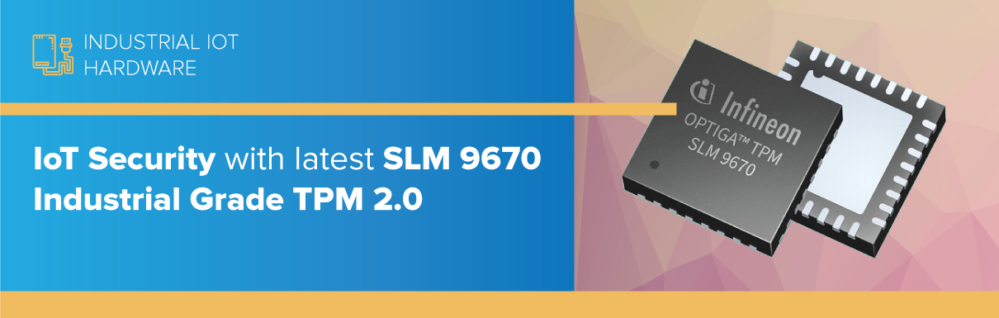
Infineon Technologies AG has unveiled a new security chip that defines the first TPM (Trusted Platform Module), designed specifically for industrial applications such as industrial computers, servers, industrial controllers and edge gates. The module protects confidential data in connected devices and reduces the risk of leakage of this information due to attacks, e.g. hackers.
The OPTIGA TPM SLM 9670 module protects the integrity of industrial systems and the identity of users using them. The system controls access to sensitive data at key locations in industrial environments, such as an automated factory. It also protects the cloud interface if the network uses one. The security system fully meets the TPM 2.0 standard developed by the Trusted Computing Group and is certified by an independent test laboratory in accordance with the criteria contained in this standard. The new module is meticulously controlled and certified by Infineon. Thanks to its use, it is possible to shorten the time of designing and introducing the device to the market, thanks to the ready security solution in the system.
The TPM system has a lifetime declared as 20 years. It allows programmers to perform firmware updates, which in turn enables them to meet the long-term security requirements in rapidly changing industrial environments. In this way, it can also reduce maintenance costs of industrial equipment thanks to secured remote software updates. The TPM chip will be available in serial production in the second half of 2019.
TPM 2.0 Key Features
Random Number Generator (RNG) according to NIST SP800-90A
TPM FW update functionality installed
6962 Bytes of free NV memory
Full personalization with Endorsement Key (EK) and EK certificate
Up to 3 keys in the volatile memory
Up to 7 keys in the NV memory
Up to 8 NV counters
Support of various cryptographic algorithms:
RSA-1024 and RSA-2048
SHA-1 and SHA-256
ECC NIST P256
ECC BN256
Security chip implementation in Industrial IoT devices
With knowledge of latest Industrial IoT security measures, the choice of proper end-point conroller or gateway is much easier than you think. Some manufacturers can implement TPM 2.0 security chip in production process, to allow users to generate certification keys after purchase, maximizing security of their installations. TECHBASE offers wide range of solutions, optionally aided with TPM system.
eModGATE with ESP32
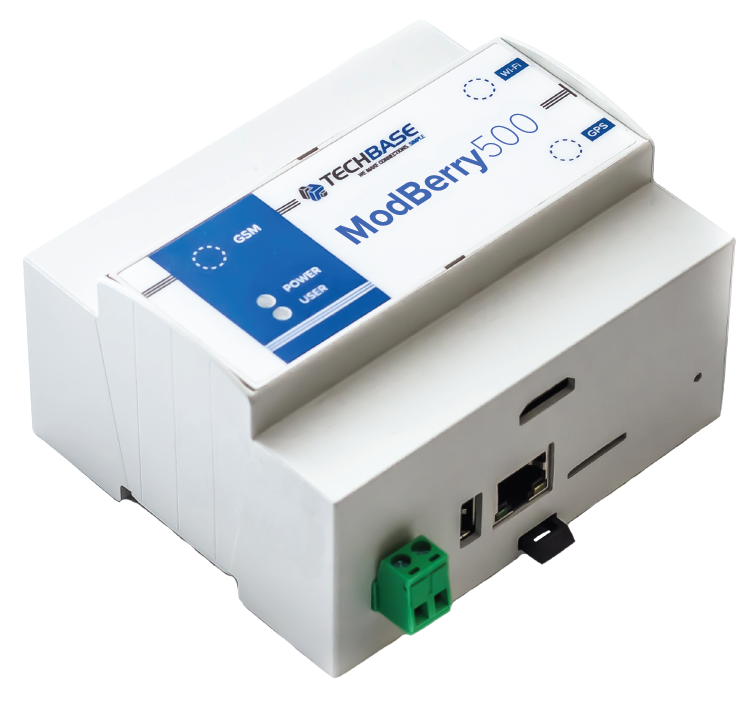
ModBerry 500 with Raspberry Pi’s Compute Module 3+
Industrial devices with TPM 2.0 support
For example, ESP-32 based solution, Moduino X series and eModGATE series products offer the support for such security measures. Read more in Industrial IoT Ecosystem brochure, to understand the importance of reliable and secure hardware for Industrial IoT.
UPDATE 22.10.20: ModBerry 500 with Compute Module 4 available for pre-order
TECHBASE’s ModBerry industrial computer series has received an update to Compute Module 4 and is available for pre-orders. TECHBASE is leading manufacturer of Industrial Raspberry Pi and Industrial Compute Module solutions. ModBerry 500 series is fully compatible with all releases of Compute Module from Rasbperry Pi foundation.
Main features of updated device are:
up to 4x faster eMMC Flash with up to 32GB storage
up to 2x faster performance of CPU apllications than previous CM3 version
up to 8x more RAM (8GB LPDDR4)
optional 1Gbit Ethernet interface
optional PCIe card support for NVMe SSD drive (via M.2)
optional second PCIe support for wireless modem solutions
First orders will be ready with subject to the availability of the CM4 module itself.
Update on Raspberry Pi’s Compute Module 4 features [15.10.2020]
According to latest leaks about Compute Module 4 specifiaction and features we can be more than sure that:
New Compute Module will feature Wi-Fi and Bluetooth on-board! Raspberry Pi Compute Module series will probably include versions with and without these modems to provide modules for variety of industrial applications.
PCI-Express line will be available externally to enable extension support via PCIe
Ethernet support will be enabled, most probably 1Gbps, since it is a standard in latest Raspberry Pi 4B.
It a matter of time before we will see Raspberry Pi Compute Module 3+ successor, probably called Compute Module 4, a new milestone of professional embedded IoT module. What might be the specification of this highly expected development board? What changes will it bring to Industrial use of IoT?
We are witnessing the fourth industrial revolution. Its key element is to create systems of interconnected sensors and actuators that operate within one global network. The so-called Internet of Things, unlike the consumer market, meet much more difficult requirements. To be able to meet harsh industrial expectations, many automation companies have already begun to offer solutions especially tailored to the application of the Internet of Things in Industry 4.0.
Although it may seem quite obvious nowadays, it is worth to be aware that just a few years ago such algorithms were practically not implemented at all in small consumer devices. It was only when people got used to smartphones that the idea of ubiquitous communication and adaptation of the way the system or device works to the environment became understandable. In fact, this confirms the validity of the idea of the Internet of Things as an important direction in the development of electronics – and in practice also automation.
Raspberry Pi is gaining recognition in Industry
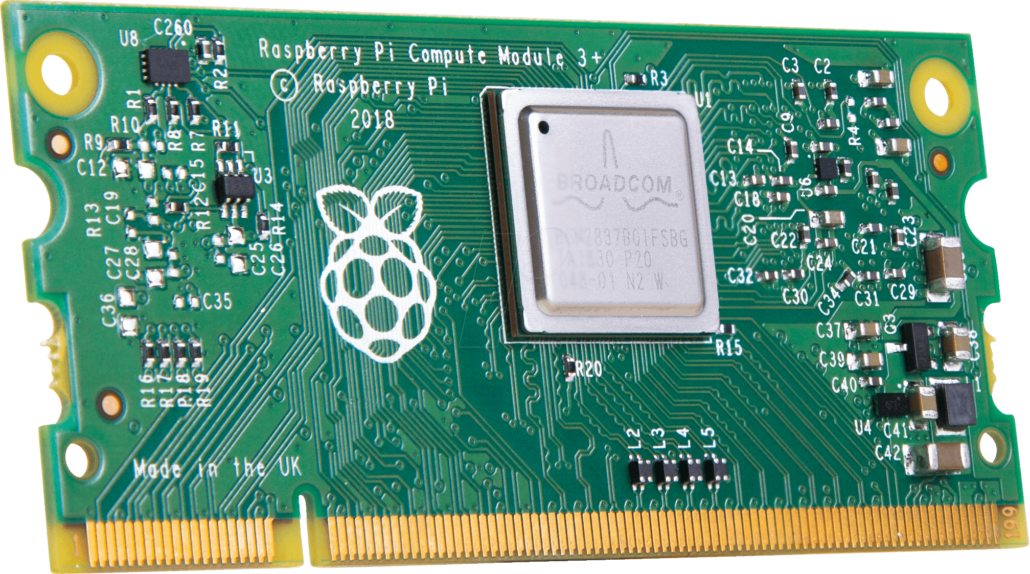
Almost a year ago, in the beginning of 2019, Raspberry Pi Foundation presented Raspberry Pi Compute Module 3+, a successor to previous CM3 version of development board, aimed at businesses and industrial users. The Compute Module uses a standard DDR2 SODIMM (small outline dual in-line memory module) form factor. GPIO and other I/O functions are routed through the 200 pins on the board.
Raspberry Pi Compute Module 3+
Only a few months later, in June 2019, came big premiere of Raspberry Pi 4 Model B, the long-awaited successor of customer RPi3+. With new processor, larger RAM options and many input/output changes, became new standard in small, embedded PC world.
It seems a matter of time before the Raspberry Pi Compute Module 3+ will get its own successor, probably called Compute Module 4, a new milestone of professional embedded IoT module. What might be the specification of this highly expected development board?
Raspberry Pi Compute Module 4 specification forecast
Compute Module 4 specifications probably will look like these:
and OpenGL ES 3.0 graphics will replace 1.1, 2.0 versions,
weight and factor will stay the same, to provide a possibility to upgrade current IoT applications of CM3 and CM3+
A Lite 4 version of Compute Module is to be expected too, without eMMC and probably limited SDRAM options.
With much higher performance, the new Raspberry Pi Compute Module 4 will, for sure, support Gigabit Ethernet, USB 3.0 expansions. We might even see wider working temperature range, if Raspberry Pi Foundation decides to make some hardware changes, to follow, for example, ESP32 – used in end-point IoT automation.
Industrial use of Compute Module
With Compute Module 3+ options from Raspberry Pi, TECHBASE upgraded their ModBerry 500/9500 industrial computers. From now on the ModBerry 500/9500 can be supported with extended eMMC, up to 32GB. Higher memory volume brings new features available for ModBerry series.
ModBerry 500 with Compute Module 3+
Higher performance of ModBerry 500/9500with extended eMMC flash memory, up to 32GB , powered by quad-core Cortex A53 processor allows the device to smoothly run Windows 10 IoT Core system, opening up many possibilities for data management, remote control and visualisation.
Many users’ favorite Linux distribution has a new version. Ubuntu 19.10 has been officially released, whose name is „Eoan Ermine”. Ubuntu 19.10 „Eoan Emine” is the latest version of the popular Linux distribution, valued for its intuitive operation, fast operation, pleasant interface and wide compatibility. Anyone interested can already update or download and install this edition manually.
This new version replaces Ubuntu 19.04 „Disco Dingo”. It will be updated for 9 months, followed by 20.04 „Focal Fossa” with extended support period (LTS).
The most important news in Ubuntu 19.10 is the Linux 5.3 kernel and the GNOME 3.34 graphical environment, which is supposed to provide faster performance, better responsiveness and the option of grouping applications in the menu along with many other functions and changes. The authors also tout „dramatically improved” performance and accelerated startup (although this has never been a major problem).
The installer of the new Ubuntu may also contain Nvidia graphics card drivers, which may not be a revolutionary change, but it is certainly something that users will welcome with open arms. The same as the appearance of USB icons in the system dock, clearer graphic themes, support for the ZFS file system or the software package in the latest versions: LibreOffice 6.3, Firefox 69, Thunderbird 68, Transmission 2.9.4 or Remmina 1.3.4.
Ubuntu 19.10 for latest Raspberry Pi applications
With 19.10 release of Ubuntu Server, Canonical announced official support for the Raspberry Pi 4. The latest board from the Raspberry Pi Foundation sports a faster system-on-a-chip with a processor that uses the Cortex-A72 architecture (quad-core 64-bit ARMv8 at 1.5GHz). Additionally, it offers up to 4GB of RAM. We are supporting the Raspberry Pi 4 to give developers access to a low-cost board, powerful enough to consolidate compute workloads at the edge.
TheRaspberry Pi has established itself as a most accessible platform for innovators in the embedded space. Canonical is dedicated to empowering innovators with open-source software. Consequently, Canonical endeavors to offer full official support for all the boards in the Raspberry Pi family. Canonical will therefore enable both Ubuntu Server and Ubuntu Core for existing and upcoming Pi boards.
A year ago, TECHBASE released an updated version of the ModBerry M500 industrial IoT computer, replacing the aging Raspberry Pi 3 with a 3B+, giving it better performance. With the recent launch of the Raspberry Pi 4, TECHBASE has yet again, announced another upgrade to the M500, which now packs the latest single-board computer.
Raspberry Pi 4
Over 10 million Raspberry Pi’s have been sold and the Raspberry Pi is likely to stay as a new standard in the industry. Official Raspbian OS is free operating system based on Linux Debian optimized for the Raspberry Pi comes with over 35,000 packages, pre-compiled software bundled in a nice format for easy installation. ModBerry devices are compatible with Raspberry Pi accessories, supported by Raspberry Pi Foundation. ModBerry M500 now with Raspberry Pi 3 Model B+ / Raspberry Pi 4 Model B support.
https://iot-industrial-devices.com/wp-content/uploads/2019/12/ubuntu-19-10.png3851210adminhttps://iot-industrial-devices.com/wp-content/uploads/2019/11/iot-industrial-devices-1.pngadmin2019-11-19 16:18:002019-12-05 16:33:53Ubuntu 19.10 „Eoan Ermine” for Raspberry Pi 4
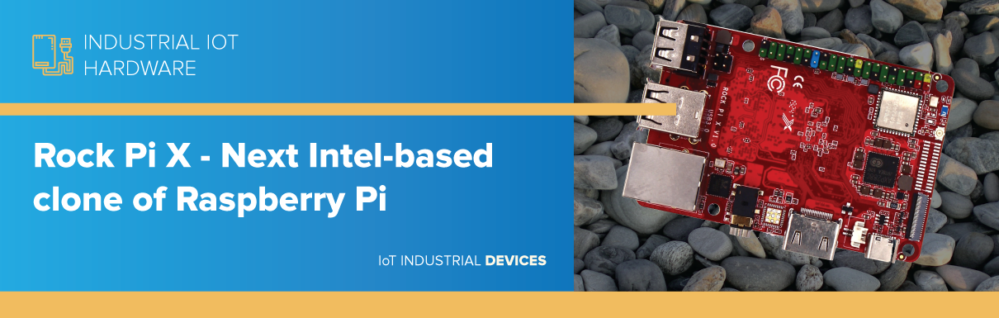
Every fan of new technologies has heard of small single-board computers (SBC) in the form of Raspberry Pi. Raspberry debuted on the market in many different versions, and the current model is Model 4B. A lot of people got infected with it for DIY, programming or Linux. No wonder that many other companies are trying to replicate British success. One of them is Rock Pi, which has just presented Rock Pi X. Compared to many other SBCs available on the market, it does not use a processor based on ARM architecture, but a chip from Intel. However, it is already quite old and cheap CPU, but it translates into a low price of the device.
Rock Pi X is a single-board computer with dimensions of 52 x 85 x 18 millimeters. The heart of the device is the Intel Atom x5-Z8300 processor from 2015, which has 4-cores and 4-threads clocked from 1.44 to 1.88 GHz, 2 MB Cache memory and integrated graphics Intel HD Graphics (Cherry Trail). RAM memory depends on the chosen variant and it can be 1, 2 or 4 GB DDR3L 1866 MHz. There is no built-in memory here, but there is a slot for MicroSD cards and eMMC modules. Model Rock Pi X A has no wireless connection (only RJ-45 socket), while Model B has a module 802.11ac WiFi + Bluetooth 4.2 LE.
Among the available connectors we will find one HDMI 1.4, headphone port, one USB 3.1 Gen 1, two USB 2.0, one USB type C with OTG support and a 40-pin GPIO identical to that of the Raspberry Pi. Most importantly, however, that the use of the x86 processor allows the normal installation and support of Windows 10, and not its prosthesis with the annotation ARM. However, it should be remembered that the discussed Atom was not a performance demon even at the time of its release. Rock Pi X will be available soon, suggested prices are as follows:
Model A 1GB RAM – $39
Model A 2GB RAM – $49
Model A 4GB RAM – $65
Model B 1GB RAM – $49
Model B 2GB RAM – $59
Model B 4GB RAM – $75
ModBerry M500 with Raspberry Pi’s 4
Industrial use of market SBCs
A year ago, TECHBASE released an updated version of the ModBerry M500 industrial IoT computer, replacing the aging Raspberry Pi 3 with a 3B+, giving it better performance. With the recent launch of the Raspberry Pi 4, TECHBASE has yet again, announced another upgrade to the M500, which now packs the latest single-board computer.
https://iot-industrial-devices.com/wp-content/uploads/2019/12/rock-pi.png3851210adminhttps://iot-industrial-devices.com/wp-content/uploads/2019/11/iot-industrial-devices-1.pngadmin2019-11-13 11:58:002019-12-06 12:09:34Rock Pi X - Next Intel-based clone of Raspberry Pi
The Raspberry Pi platform, which is no longer intended solely for educational and experimental purposes, is increasingly being promoted for Industrial IoT use. Despite few minor drawbacks of standard Raspberry Pi 4Model B format, such as reduced working temperature range, as compared to industrial standards, RPi4 can serve as a platform for high performance computing on gateway level of installation, processing data gathered from lighter end-point units, such as ESP32-based solutions.
ModBerry M500 Gateway with Raspberry Pi 4
Raspberry Pi increase in IoT significance
More and more engineers and technology providers believe that it is suitable for industrial applications in the real world. Over the past few years, there has been a lot of discussion about the use of Raspberry Pi in industry, most of which emphasize that Raspberry Pi is a great tool for engineering experiments, but not so much for industrial applications in the real world. While it is true that the Raspberry Pi is not considered the best choice for mission-critical applications, it is also true that the Raspberry Pi is no longer a platform for experimentation.
Latest Raspberry Pi 4 development board, equipped with a 1.5GHz quad-core 64-bit ARM Cortex-A72 processor (approximately 3 times better performance than previous Cortex-A53 powering Raspberry Pi 3+ Model B and Compute Module 3 and 3+). can be chosen from 1GB / 2GB / 4GB LPDDR4 SDRAM options.
Raspberry Pi 4 continues the tradition of one of the most versatile and cheapest computer devices. It can be used for virtually anything from proprietary IoT solutions to a full-fledged desktop computer. The new Malinka has two micro-HDMI ports, a Gigabit Ethernet port, two USB 3.0 type A ports and two USB 2.0 type A ports.
Raspberry Pi 4, with 2xHDMI, Gigabit Ethernet and 2xUSB3.0
Industrial use of Raspberry Pi 4
A year ago, TECHBASE released an updated version of the ModBerry M500 industrial IoT computer, replacing the aging Raspberry Pi 3 with a 3B+, giving it better performance. With the recent launch of the Raspberry Pi 4, TECHBASE has yet again, announced another upgrade to the M500, which now packs the latest single-board computer.
Over 10 million Raspberry Pi’s have been sold and the Raspberry Pi is likely to stay as a new standard in the industry. Official Raspbian OS is free operating system based on Linux Debian optimized for the Raspberry Pi comes with over 35,000 packages, pre-compiled software bundled in a nice format for easy installation. ModBerry devices are compatible with Raspberry Pi accessories, supported by Raspberry Pi Foundation. ModBerry M500 now with Raspberry Pi 3 Model B+ / Raspberry Pi 4 Model B support.
https://iot-industrial-devices.com/wp-content/uploads/2019/11/rpi4_2.png3851210adminhttps://iot-industrial-devices.com/wp-content/uploads/2019/11/iot-industrial-devices-1.pngadmin2019-11-08 13:23:402020-12-09 18:29:45Raspberry Pi 4 as an alternative for gateway platform
The NB-IoT is becoming a standard in wireless communication of IoT devices, for standalone solutions and complex installations with thousands of units, coordinated with gateways. Will NarrowBand-IoT replace other wireless technologies in industrial automation?
What exactly is NarrowBand?
NarrowBand-IoT (NB-IoT) is a radio technology in the field of LPWAN (Low Power Wide Area Network) dedicated for IoT devices, operating on the licensed frequency band used by telecommunications operators.
You can build mass solutions and those that until now were considered unprofitable. NB-IoT technology works in the licensed band, so there is no risk of interference and blocking communication by competing networks.
The service life of devices powered by two AA batteries is up to 10 years. However, the devices themselves are constructed in such a way that they can work for many years without the need for technical supervision and recharging the battery.
NB-IoT used in industrial solutions
One of many uses of NarrowBand-IoT wireless modems can be communication of edge devices, dedicated to data management, process control (e.g. with MQTT protocol) and monitoring. Latest ESP32-based eModGATE controller from TECHBASE company is a series utilizing MicroPython environment to provide data management solutions for end-points applications. TheeModGATE has built-in Wi-Fi/BT modem and can be equipped with additional NarrowBand-IoT modems
eModGATE eqipped with wireless NB-IoT modem are perfect for industrial automation solutions, e.g. data logging, metering, telemetrics, remote monitoring, security and data management through all Industrial IoT applications.
https://iot-industrial-devices.com/wp-content/uploads/2019/11/nbiot.png3851210adminhttps://iot-industrial-devices.com/wp-content/uploads/2019/11/iot-industrial-devices-1.pngadmin2019-11-07 12:40:422019-11-08 09:10:12NarrowBand-IoT the new black of Industrial IoT
We may request cookies to be set on your device. We use cookies to let us know when you visit our websites, how you interact with us, to enrich your user experience, and to customize your relationship with our website.
Click on the different category headings to find out more. You can also change some of your preferences. Note that blocking some types of cookies may impact your experience on our websites and the services we are able to offer.
Essential Website Cookies
These cookies are strictly necessary to provide you with services available through our website and to use some of its features.
Because these cookies are strictly necessary to deliver the website, you cannot refuse them without impacting how our site functions. You can block or delete them by changing your browser settings and force blocking all cookies on this website.
Other external services
We also use different external services like Google Webfonts, Google Maps and external Video providers. Since these providers may collect personal data like your IP address we allow you to block them here. Please be aware that this might heavily reduce the functionality and appearance of our site. Changes will take effect once you reload the page.