The leader of LoRa and RF technology, Semtech will continue to support the LoRa ecosystem by introducing a new portfolio of solutions called LoRa Edge to simplify and accelerate IoT applications for edges. LoRa Edge is a new, versatile, new low-power LoRa platform that enables a wide range of indoor and outdoor asset management applications in the industrial, construction, housing, agricultural, transport and logistics markets.
Semtech continually delivers Internet of Things (IoT) solutions that simplify and accelerate the development of LPWAN applications,” said Pedro Pachuca, Director of IoT Wireless in Semtech’s Wireless and Sensing Products Group. “LoRa Edge and LoRa Cloud geolocation services enable customers to develop ultra-low-power applications for a variety of industries and will expand the mass adoption of LoRa in the IoT ecosystem.
150 – 2700 MHz continuous frequency synthesizer range
GPS/BeiDou scanning
Wi-Fi passive scanning
Low-Power LoRa/(G)FSK RF Transceiver
Worldwide frequency bands support in the range 150 – 960 MHz
High power PA path +22 dBm
High efficiency PA path +15 dBm
Fully compatible with the LoRaWAN® standard
Cryptographic Engine
Hardware support for AES-128 encryption/decryption based algorithms
Handling device parameters such as DevEUI and JoinEUI
Protects confidential information such as encryption keys
Stores NwkKey, AppKey, as defined in the LoRaWAN standard
Use of LoRa in industrial automation
Use of wireless connection makes life and work easier for us every day – from radio stations and GSM to Wi-Fi wireless networks, Zigbee, short-range Bluetooth connectivity and LoRa. With the spread of internet access, the possibility of using wireless connectivity for a new type of service and application has opened. Terminology such as M2M (Machine to Machine) – remote communication between devices and IoT – a network of applications and devices communicating with the Internet have been created.
Device equipped with LoRa module is delivered with a LoRaWAN protocol stack, so it can be easily connected to the existing, fast-growing LoRa Alliance infrastructure – both in privately managed local area networks (LAN) and public telecommunications networks to create wide area low power WAN (LPWAN) on a national scale. LoRaWAN stack integration also allows connection to any microcontroller, such as ModBerry industrial device from TECHBASE.
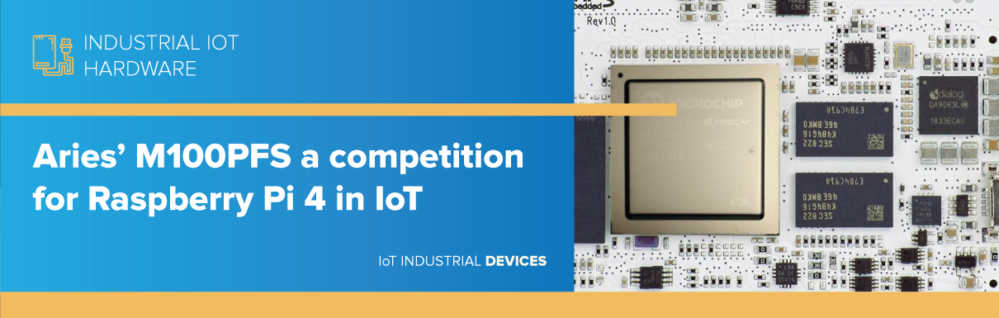
Aries Embedded announced one of the first computing modules with the SoF PolarFire function. It is equipped with a Linux RISC-V SoC chip with a Microchip Microsemi FPGA processor. The M100PFS has the same dimensions of 74 x 42 mm as the similar M100PF module from Aries and is equipped with PolarFire FPGAs without RISC-V core for Linux.
The two major M100PFS SKUs are:
M100PFS-025ADA0 — MPFS025T FPGA with 23K LE, 68 math blocks, 4x SERDES; 1GB LPDDR4 RAM for HMS (RISC-V/Linux); 4GB eMMC
M100PFS-250AECC — MPFS250T FPGA with 254K LE, 784 blocks, 16x SERDES; 4GB LPDDR4 each for HMS and FPGA; 8GB eMMC
PolarFire SoC from Microchip combines the previously introduced PolarFire FPGA card with 4x RISC-V U54-MC SiFive core. Microchip claims that PolarFire SoCs are superior to hybrid SoCs with an arm / FPGA, such as Xilinx Zynq, with more configurable and open RISC-V designs, lower power consumption and much better real-time deterministic functions. I am In December, the company called it „the first FPGA SoC chip with deterministic and consistent RISC-V processor clusters and the deterministic L2 memory subsystem enabling the use of Linux and real-time applications.”
Industrial use of market Raspberry Pi 4 SBCs
A year ago, TECHBASE released an updated version of the ModBerry M500 industrial IoT computer, replacing the aging Raspberry Pi 3 with a 3B+, giving it better performance. With the recent launch of the Raspberry Pi 4, TECHBASE has yet again, announced another upgrade to the M500, which now packs the latest single-board computer.
https://iot-industrial-devices.com/wp-content/uploads/2020/04/aries-m100pfs-rpi4.png3851210adminhttps://iot-industrial-devices.com/wp-content/uploads/2019/11/iot-industrial-devices-1.pngadmin2020-04-14 11:59:002020-04-26 12:09:57Aries’ M100PFS a competition for Raspberry Pi 4 in IoT
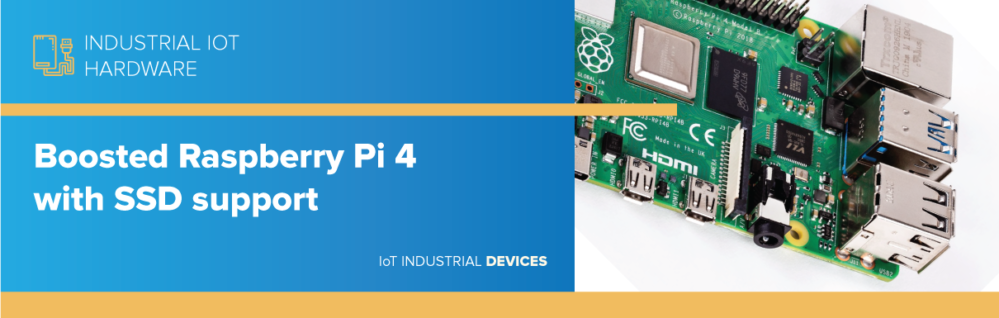
Many developement boards can be used in home and industrial applications to control and manage data. Check out latest video from open-tech infuencer, Andreas Spiess, in which he uses Raspberry Pi and SSD drive with Berryboot to enhance Raspberry Pi data storage capacity.
Industrial use of Raspberry Pi 4
A year ago, TECHBASE released an updated version of the ModBerry M500 industrial IoT computer, replacing the aging Raspberry Pi 3 with a 3B+, giving it better performance. With the recent launch of the Raspberry Pi 4, TECHBASE has yet again, announced another upgrade to the M500, which now packs the latest single-board computer.
Raspberry Pi 4
Over 10 million Raspberry Pi’s have been sold and the Raspberry Pi is likely to stay as a new standard in the industry. Official Raspbian OS is free operating system based on Linux Debian optimized for the Raspberry Pi comes with over 35,000 packages, pre-compiled software bundled in a nice format for easy installation. ModBerry devices are compatible with Raspberry Pi accessories, supported by Raspberry Pi Foundation. ModBerry M500 now with Raspberry Pi 3 Model B+ / Raspberry Pi 4 Model B support.
https://iot-industrial-devices.com/wp-content/uploads/2020/04/raspberry-pi-4-ssd.png3851210adminhttps://iot-industrial-devices.com/wp-content/uploads/2019/11/iot-industrial-devices-1.pngadmin2020-04-08 14:31:002020-04-24 11:55:48Boosted Raspberry Pi 4 with SSD support
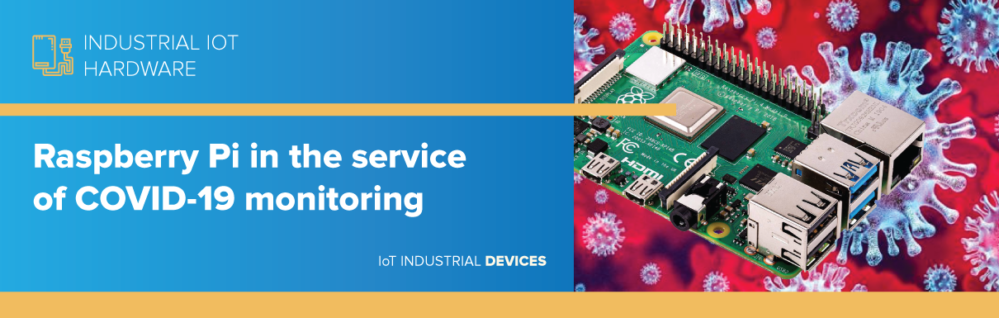
Raspberry Pi devices are often used by scientists, especially for capturing and analyzing biological data. A particularly noteworthy sober project has published news this week.
According to the researchers at UMass Amherst, FluSense is about the size of a dictionary. Includes an inexpensive microphone set, heat sensor, Raspberry Pi and Intel Movidius 2 neural engine. The idea is to use AI on the edge to classify audio samples and determine the number of people in a room at any given time.
Image courtesy of the University of Massachusetts Amherst
We believe that FluSense has the potential to expand the arsenal of health surveillance tools used to forecast seasonal flu and other viral respiratory outbreaks, such as the COVID-19 pandemic or SARS,” Rahman told TechCrunch. “By understanding the ebb and flow of the symptoms dynamics across different locations, we can have a better understanding of the severity of a novel infectious disease and that way we can enforce targeted public health intervention such as social distancing or vaccination.
The device distinguishes cough from other sounds. By combining cough data with information about the size of the crowd at your location, you can get an index that predicts the number of people who may be experiencing flu symptoms.
Currently we are planning to deploy the FluSense system in several large public spaces (e.g., large cafeteria, classroom, dormitories, gymnasium, auditorium) to capture syndromic signals from a broad range of people who live in a certain town or city,” they said. “We are also looking for funding to run a large-scale multi-city trial. In the meantime, we are also diversifying our sensing capability by extending FluSense’s capability to capture more syndromic signals (e.g., recently we added sneeze sensing capability to FluSense). We definitely see a significant level of commercialization potential in this line of research.
https://iot-industrial-devices.com/wp-content/uploads/2020/04/rpi-covid-19.png3851210adminhttps://iot-industrial-devices.com/wp-content/uploads/2019/11/iot-industrial-devices-1.pngadmin2020-04-06 11:16:172020-04-06 11:17:53Raspberry Pi in the service of COVID-19 monitoring
The Raspberry Pi platform, with introduced in 2019 Raspberry Pi 4 is no longer available with lowest, 1GB RAM configuration. Since the price of 2GB version dropped by $10 to the $35 — the same as the 1GB version. Therefore the 1GB is no longer available for puchase. Also the USB type C problems were fixed with the latest revision.
In latest announcement, Eben Upton, co-founder and CEO of Raspberry Pi Trading, admitted that most people already know that Raspberry Pi 4 requires at least 2 GB of RAM to be the first Pi to replace desktop computers. Upton also says, that comared to original original Raspberry Pi, the new RPI 4 has 40x processor performance, 10x bandwidth and 4x screen pixels. The SBC also has 4 to 8 times more RAM than the previous 512 MB model.
Raspberry Pi increase in IoT significance
More and more engineers and technology providers believe that it is suitable for industrial applications in the real world. Over the past few years, there has been a lot of discussion about the use of Raspberry Pi in industry, most of which emphasize that Raspberry Pi is a great tool for engineering experiments, but not so much for industrial applications in the real world. While it is true that the Raspberry Pi is not considered the best choice for mission-critical applications, it is also true that the Raspberry Pi is no longer a platform for experimentation.
Latest Raspberry Pi 4 development board, equipped with a 1.5GHz quad-core 64-bit ARM Cortex-A72 processor (approximately 3 times better performance than previous Cortex-A53 powering Raspberry Pi 3+ Model B and Compute Module 3 and 3+). can be chosen from 1GB / 2GB / 4GB LPDDR4 SDRAM options.
Raspberry Pi 4, with 2xHDMI, Gigabit Ethernet and 2xUSB3.0
Raspberry Pi 4 continues the tradition of one of the most versatile and cheapest computer devices. It can be used for virtually anything from proprietary IoT solutions to a full-fledged desktop computer. The new Malinka has two micro-HDMI ports, a Gigabit Ethernet port, two USB 3.0 type A ports and two USB 2.0 type A ports.
Industrial use of Raspberry Pi 4
A year ago, TECHBASE released an updated version of the ModBerry M500 industrial IoT computer, replacing the aging Raspberry Pi 3 with a 3B+, giving it better performance. With the recent launch of the Raspberry Pi 4, TECHBASE has yet again, announced another upgrade to the M500, which now packs the latest single-board computer.
Over 10 million Raspberry Pi’s have been sold and the Raspberry Pi is likely to stay as a new standard in the industry. Official Raspbian OS is free operating system based on Linux Debian optimized for the Raspberry Pi comes with over 35,000 packages, pre-compiled software bundled in a nice format for easy installation. ModBerry devices are compatible with Raspberry Pi accessories, supported by Raspberry Pi Foundation. ModBerry M500 now with Raspberry Pi 3 Model B+ / Raspberry Pi 4 Model B support.
https://iot-industrial-devices.com/wp-content/uploads/2020/03/rpi4-1gb-2gb.png3851210adminhttps://iot-industrial-devices.com/wp-content/uploads/2019/11/iot-industrial-devices-1.pngadmin2020-03-31 13:17:082020-04-01 14:55:42Raspberry Pi 4 no longer available with 1GB RAM
UPDATE 22.10.20: ModBerry 500, first industrial computer based on Compute Module 4, available for pre-order
TECHBASE’s ModBerry industrial computer series has received an update to Compute Module 4 and is available for pre-orders. TECHBASE is leading manufacturer of Industrial Raspberry Pi and Industrial Compute Module solutions. ModBerry 500 series is fully compatible with all releases of Compute Module from Rasbperry Pi foundation.
Main features of updated device are:
up to 4x faster eMMC Flash with up to 32GB storage
up to 2x faster performance of CPU apllications than previous CM3 version
up to 8x more RAM (8GB LPDDR4)
optional 1Gbit Ethernet interface
optional PCIe card support for NVMe SSD drive (via M.2)
optional second PCIe support for wireless modem solutions
First orders will be ready with subject to the availability of the CM4 module itself.
Update on Raspberry Pi’s Compute Module 4 features [15.10.2020]
According to latest leaks about Compute Module 4 specifiaction and features we can be more than sure that:
New Compute Module will feature Wi-Fi and Bluetooth on-board! Raspberry Pi Compute Module series will probably include versions with and without these modems to provide modules for variety of industrial applications.
PCI-Express line will be available externally to enable extension support via PCIe
Ethernet support will be enabled, most probably 1Gbps, since it is a standard in latest Raspberry Pi 4B.
Compute Module 4 a new milestione in Industrial IoT
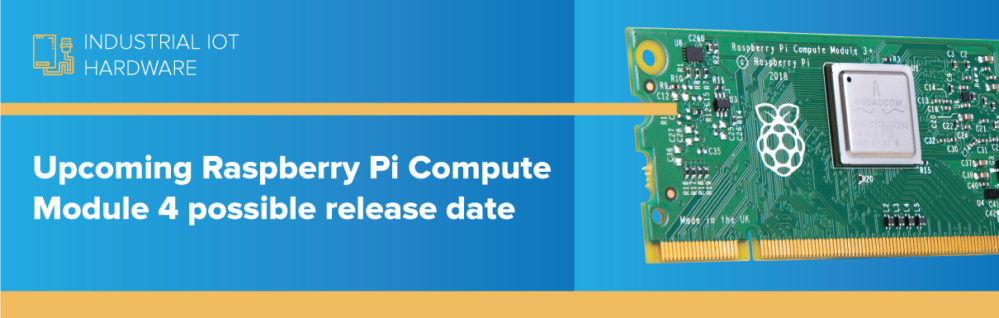
A new milestone of Industrial IoT might come to life in this year. The successor of Raspberry Pi Compute Module 3+, working named Compute Module 4, will certainly draw from Raspberry Pi 4 B features, such as new Cortex-A72 processor (Broadcom BCM2711) and multiple RAM/eMMC options. Rumours say, that we may also see Gigabit Ethernet and USB3.0/3.1 support, since it was a main drawback in previous models.
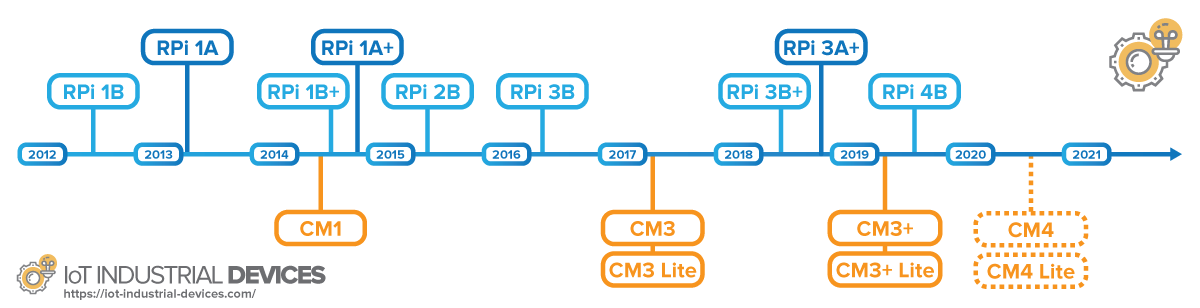
Raspberry Pi release timeline with probable Compute Module 4 release date
First Rasbperry Pi 1B model had it’s analogy in industrial Compute Module 1 after almost 2 years from it’s premiere. Compute Module 2 was probably omitted because the change from RPi1 to RPI2 mainly involved a minor change of the processor (Cortex-A7 900MHz), which was almost immediately replaced with Cortex-A53 1.2GHz in Raspberry Pi 3.
The premiere of Compute Module 3 occured a year after RPI 3 announcement, providing a significant boost of industrial market solutions. Since Raspberry Pi 4 was a great success in 2019, we might see it’s equivalent in industrial series of Raspberry Pi – Compute Module 4. A possible release date of Raspberry Pi’s Compute Module 4 is mid-2020.
Raspberry Pi is gaining recognition in Industry
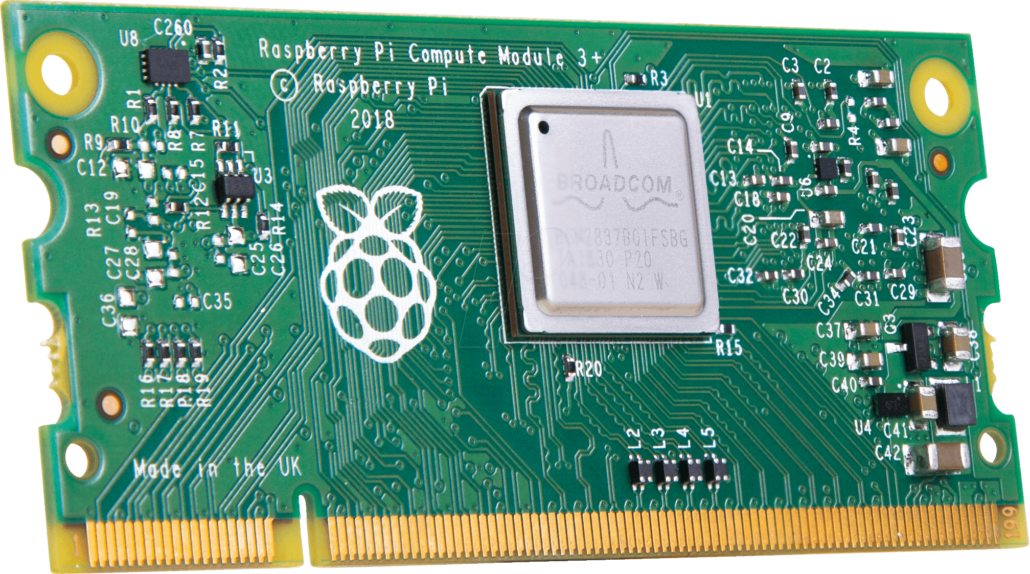
Almost a year ago, in the beginning of 2019, Raspberry Pi Foundation presented Raspberry Pi Compute Module 3+, a successor to previous CM3 version of development board, aimed at businesses and industrial users. The Compute Module uses a standard DDR2 SODIMM (small outline dual in-line memory module) form factor. GPIO and other I/O functions are routed through the 200 pins on the board.
Raspberry Pi Compute Module 3+
Only a few months later, in June 2019, came big premiere of Raspberry Pi 4 Model B, the long-awaited successor of customer RPi3+. With new processor, larger RAM options and many input/output changes, became new standard in small, embedded PC world.
It seems a matter of time before the Raspberry Pi Compute Module 3+ will get its own successor, probably called Compute Module 4, a new milestone of professional embedded IoT module. What might be the specification of this highly expected development board?
Raspberry Pi Compute Module 4 specification forecast
Compute Module 4 specifications probably will look like these:
and OpenGL ES 3.0 graphics will replace 1.1, 2.0 versions,
weight and factor will stay the same, to provide a possibility to upgrade current IoT applications of CM3 and CM3+
A Lite 4 version of Compute Module is to be expected too, without eMMC and probably limited SDRAM options.
With much higher performance, the new Raspberry Pi Compute Module 4 will, for sure, support Gigabit Ethernet, USB 3.0 expansions. We might even see wider working temperature range, if Raspberry Pi Foundation decides to make some hardware changes, to follow, for example, ESP32 – used in end-point IoT automation.
Industrial use of Compute Module
With Compute Module 3+ options from Raspberry Pi, TECHBASE upgraded their ModBerry 500/9500 industrial computers. From now on the ModBerry 500/9500 can be supported with extended eMMC, up to 32GB. Higher memory volume brings new features available for ModBerry series.
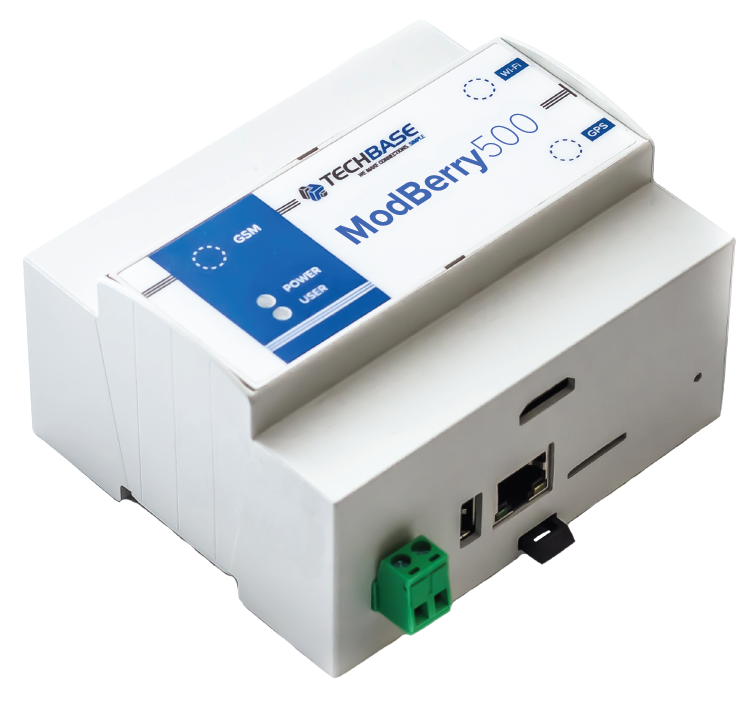
ModBerry 500 with Compute Module 3+
Higher performance of ModBerry 500/9500with extended eMMC flash memory, up to 32GB , powered by quad-core Cortex A53 processor allows the device to smoothly run Windows 10 IoT Core system, opening up many possibilities for data management, remote control and visualisation.
https://iot-industrial-devices.com/wp-content/uploads/2020/02/raspberry-pi-compute-module-4.png3851210adminhttps://iot-industrial-devices.com/wp-content/uploads/2019/11/iot-industrial-devices-1.pngadmin2020-03-27 16:19:002020-10-24 17:17:15Raspberry Pi Compute Module 4 possible release date
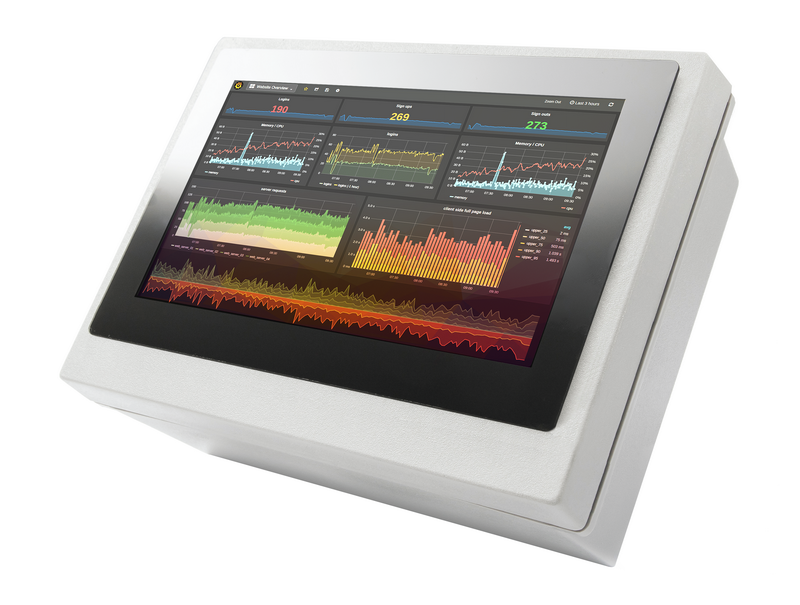
Latest addition to Industrial IoT Ecosystem from TECHBASE is TECHPANELP500 is an industrial-grade touch panel automation controller for wide range of industrial installations. Equipped with up to date Raspberry Pi Compute Module 3/3+ or Compute Module 3/3+ Lite, 7” capacitive touch display and IP65 hermetic casing with cast gaskets, can be used in harsh conditions of industrial applications.
Raspberry Pi based touch panel features
New TECHPANEL P500 M3/3+ is powered by quad-core Cortex-A53 1.2GHz processor with 1GB RAM and up to 32GB eMMC or 8GB microSD flash memory. Wide range of modems and extra wireline/wireless interfaces via expansion cards makes the TECHPANEL micro-computer a versatile addition to Industrial IoT solutions offered by TECHBASE company.
TECHPANEL devices can easily work remotely with existing ModBerry Gateways & Moduino ESP32 Edge Controllers for data accumulation and monitoring, to perform specific actions before sending the data to cloud services. TECHPANEL with Moduino – ModBerry installation can work as standalone Ecosystem (for example via MQTT), providing complex data management solution to any installation.
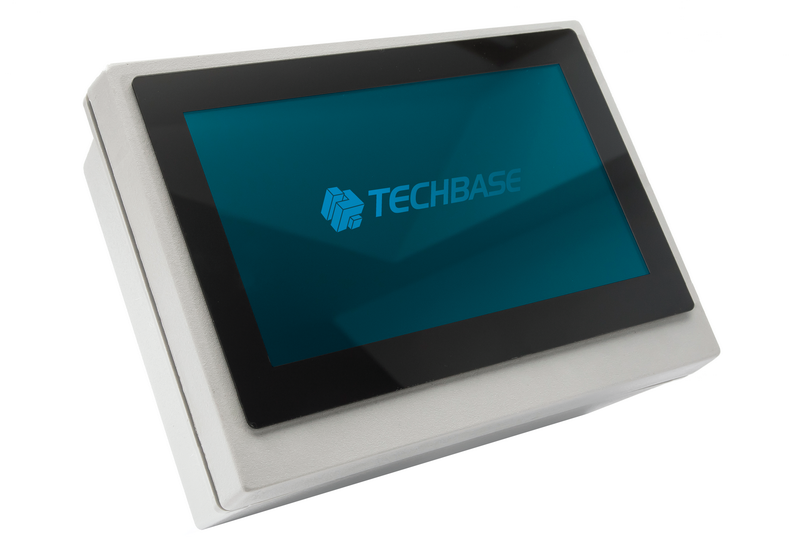
TECHPANEL P500 M3+ with Compute Module 3+ from Raspberry Pi
Visual management and available Raspbian OS
The device is equipped with compact 800 x 480 px 7-inch TFT panel with 10 points capacitive touch to allow the user to perform direct actions on-site. With IP65 casing and extended working temperature range, TECHPANEL can be placed almost everywhere.
Over 23 million Raspberry Pi’s have been sold and the Raspberry Pi is likely to stay as a new standard in the industry. Official Raspbian OS is free operating system based on Linux Debian optimized for the Raspberry Pi comes with over 35,000 packages, pre-compiled software bundled in a nice format for easy installation.
TECHPANEL P500 M3+ with Compute Module 3+ from Raspberry Pi
SPECIFICATION
Cortex A53 1.2GHz Processor
RAM 1GB, eMMC up to 32GB
7″ TFT screen (800x600px)
Capactitive touch screen (10-point)
Wide range of expansion modules (Ethernet, RS-232/485/422, Digital and Analog I/Os, Relay, M-Bus, CAN, optoisolated I/Os, Accelerometer, etc.)
Wide range of wireless modules (GPRS/EDGE, 3G/LTE, NarrowBand-IoT, GPS, Wi-Fi, Bluetooth, LoRa, ZigBee, Z-Wave, Sigfox, Wireless M-Bus, etc.)
https://iot-industrial-devices.com/wp-content/uploads/2020/02/raspberry-pi-touch-panel.png3851210adminhttps://iot-industrial-devices.com/wp-content/uploads/2019/11/iot-industrial-devices-1.pngadmin2020-03-25 11:44:002020-03-31 16:18:41New industrial grade touch panel with Raspberry Pi
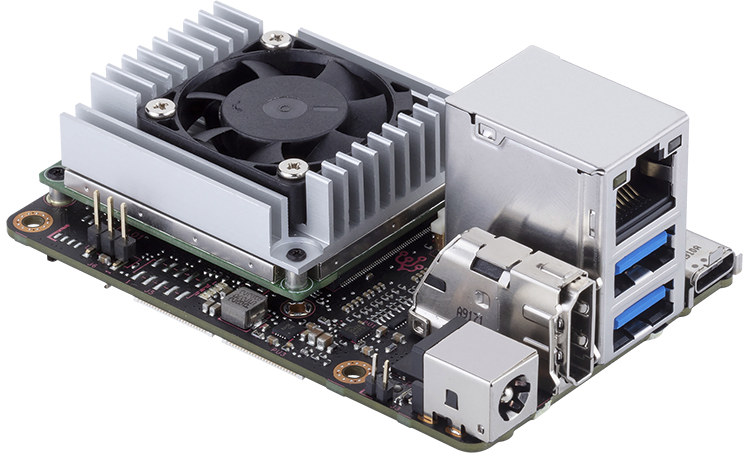
ASUS announced Tinker Edge T in mid-2019, but now officially announces their latest SBC. Edge T expands Tinker Board series, which was already a strong rival of Raspberry Pi and latest Google Coral Dev Board.
The ASUS company has designed Tinker Edge T for AI applications powered with has Google Edge TPU. Google has optimized Edge TPU for machine learning and must be able to run Tinker Edge T up to 4 ter per second operations (TOPS) at just 0.5 W. Therefore, this board is a good candidate for automatic image recognition and other automation projects
ASUS Tinker Edge T with active cooler
ASUS Tinker Edge T specification
Below you will find complete specification of announced ASUS Tinker Edge T single-board computer:
Edge TPU module:
SoC – NXP i.MX 8M quad-core Arm Cortex-A53 processor with Arm Cortex-M4F real-time core, GC7000 Lite 3D GPU
ML accelerator – Google Edge TPU coprocessor delivering up to 4 TOPS
System Memory – 1 GB LPDDR4 RAM
Storage – 8 GB eMMC Flash memory
Wireless Connectivity – Wi-Fi 2×2 MIMO (802.11b/g/n/ac 2.4/5GHz) Bluetooth 4.2
Baseboard:
Storage – MicroSD card slot
Networking – Gigabit Ethernet port (via RTL8211F-CG)
Video Output – MIPI DSI connector, and HDMI output up to 4K with CEC support
Camera I/F – 2x MIPI CSI 2 interfaces for stereoscopic camera applications
USB – 2x USB 3.2 gen1 ports, 1x USB-C 3.2 gen1 port
Expansion – 40-pin Raspberry Pi compatible color-coded header with GPIO, I2C, PWM, UART, SPI, I2S, etc…
Introduced in November 2017, the ModBerry M300 series, based on NanoPi NEO revolutionised the economic segment of Industrial IoT devices and proved, that automation and monitoring can be done effectively with low expenditure on industrial installations.
ModBerry M300 O1 based on OrangePi Zero Plus features Allwinner H5 (Quad-core Cortex-A53) SoC, moderate 512MB RAM, storage memory option with microSD slot, USB and Gigabit Ethernet port. The wireless communication is supported with onboard Wi-Fi module.
Offering much higher performance and wider feature range, the ModBerry M300 O2 features same SoC as M300 series, but thanks to OrangePi Zero Plus2 means, the device is equipped with onboard 8GB eMMC, extra microSD expansion slot as alternative and wired/wireless interfaces, e.g. HDMI, Wi-Fi, Bluetooth 4.0.
https://iot-industrial-devices.com/wp-content/uploads/2020/01/asus-tinker-edge.png3851210adminhttps://iot-industrial-devices.com/wp-content/uploads/2019/11/iot-industrial-devices-1.pngadmin2020-03-24 20:09:002020-03-31 16:18:53ASUS Tinker Edge T - a new Raspberry Pi like SBC
At the end of last week, Linus Torvalds brought a complete list of Linux 5.5 changes for ARM, MIPS and RISC-V architectures. Io_uring asynchronous I/O has been improved, adding the ability to modify the set of files being operated on without starting over, user-specifiable completion-ring sizes, absolute timeouts, and support for accept() calls among others.
Also the Airtime Queue Limits (AQL) for WiFi that make CoDel work more effectively with wireless drivers that utilized firmware/hardware offloading. KUnit unit testing framework for the Linux kernel with tests can now be run locally on a developer’s workstation without any VM or special hardware. Another change is SMB rootfs and multichannel support using SMB as root file systems, and support for using multiple network connections for the same SMB session.
So this last week was pretty quiet, and while we had a late network update with some (mainly iwl wireless) network driver and netfilter module loading fixes, David didn’t think that warranted another -rc. And outside of that, it’s really been very quiet indeed – there’s a panfrost driver update too, but again it didn’t really seem to make sense to delay the final release by another week.
Outside of those, it’s all really tiny, even if some of those tiny changes touched some core files.
So despite the slight worry that the holidays might have affected the schedule, 5.5 ended up with the regular rc cadence and is out now.
That means that the merge window for 5.6 will open tomorrow, and I already have a couple of pull requests pending. The timing for this next merge window isn’t optimal for me – I have some travel and other things going on during the same two weeks, but hopefully it won’t be all that noticeable. But there might be random timezones, odd hours, and random delays because of that. I try to avoid scheduling things during the merge window, but hey, it doesn’t always work out, and I’d have to delay things by two weeks to avoid the conflicts, which just doesn’t seem worth it.
Particularly since it’s not necessarily going to be a problem to begin with. We’ll see.
Anyway. Go out and test 5.5, and start sending me those pull requests for all the new development that is ready,
With 19.10 release of Ubuntu Server, Canonical announced official support for the Raspberry Pi 4. The latest board from the Raspberry Pi Foundation sports a faster system-on-a-chip with a processor that uses the Cortex-A72 architecture (quad-core 64-bit ARMv8 at 1.5GHz). Additionally, it offers up to 4GB of RAM. We are supporting the Raspberry Pi 4 to give developers access to a low-cost board, powerful enough to consolidate compute workloads at the edge.
TheRaspberry Pi has established itself as a most accessible platform for innovators in the embedded space. Canonical is dedicated to empowering innovators with open-source software. Consequently, Canonical endeavors to offer full official support for all the boards in the Raspberry Pi family. Canonical will therefore enable both Ubuntu Server and Ubuntu Core for existing and upcoming Pi boards.
A year ago, TECHBASE released an updated version of the ModBerry M500 industrial IoT computer, replacing the aging Raspberry Pi 3 with a 3B+, giving it better performance. With the recent launch of the Raspberry Pi 4, TECHBASE has yet again, announced another upgrade to the M500, which now packs the latest single-board computer.
Raspberry Pi 4
Over 10 million Raspberry Pi’s have been sold and the Raspberry Pi is likely to stay as a new standard in the industry. Official Raspbian OS is free operating system based on Linux Debian optimized for the Raspberry Pi comes with over 35,000 packages, pre-compiled software bundled in a nice format for easy installation. ModBerry devices are compatible with Raspberry Pi accessories, supported by Raspberry Pi Foundation. ModBerry M500 now with Raspberry Pi 3 Model B+ / Raspberry Pi 4 Model B support.
Many developement boards can be used in home and industrial applications to control and manage data. Get secure remote access from anywhere via your own VPN based on Docker containers. Check out latest video from open-tech infuencer, Andreas Spiess, in which he uses Raspberry Pi and Docker, Node-RED, influxDB and Grafana to build custom Raspberry Pi data server.
Industrial use of Raspberry Pi 4
A year ago, TECHBASE released an updated version of the ModBerry M500 industrial IoT computer, replacing the aging Raspberry Pi 3 with a 3B+, giving it better performance. With the recent launch of the Raspberry Pi 4, TECHBASE has yet again, announced another upgrade to the M500, which now packs the latest single-board computer.
Raspberry Pi 4
Over 10 million Raspberry Pi’s have been sold and the Raspberry Pi is likely to stay as a new standard in the industry. Official Raspbian OS is free operating system based on Linux Debian optimized for the Raspberry Pi comes with over 35,000 packages, pre-compiled software bundled in a nice format for easy installation. ModBerry devices are compatible with Raspberry Pi accessories, supported by Raspberry Pi Foundation. ModBerry M500 now with Raspberry Pi 3 Model B+ / Raspberry Pi 4 Model B support.
https://iot-industrial-devices.com/wp-content/uploads/2020/01/raspberry-pi-docker-vpn.png3851210adminhttps://iot-industrial-devices.com/wp-content/uploads/2019/11/iot-industrial-devices-1.pngadmin2020-01-24 15:02:332020-01-24 15:02:35Docker VPN-based Raspberry Pi Server tutorial
We may request cookies to be set on your device. We use cookies to let us know when you visit our websites, how you interact with us, to enrich your user experience, and to customize your relationship with our website.
Click on the different category headings to find out more. You can also change some of your preferences. Note that blocking some types of cookies may impact your experience on our websites and the services we are able to offer.
Essential Website Cookies
These cookies are strictly necessary to provide you with services available through our website and to use some of its features.
Because these cookies are strictly necessary to deliver the website, you cannot refuse them without impacting how our site functions. You can block or delete them by changing your browser settings and force blocking all cookies on this website.
Other external services
We also use different external services like Google Webfonts, Google Maps and external Video providers. Since these providers may collect personal data like your IP address we allow you to block them here. Please be aware that this might heavily reduce the functionality and appearance of our site. Changes will take effect once you reload the page.